
Security Affairs
Two Barracuda ESG Flaws Could Be Combined for Full Root Access; Patches Released|Cyberattack Hits French Blood Banks as Hackers Target Refrigeration Systems Across Europe|CVE-2026-58868: Critical Android Bug Could Let Attackers Run Remote Code|U.S. CISA adds WordPress flaw to its Known Exploited Vulnerabilities catalog|Binance Hack: How Fake Job Interviews and AI Abuse Led to a $6.34 Billion Attack|Synology Warns of Ransomware Attacks Targeting NAS Devices Running Outdated DSM Versions|Inside XCPE, the botnet that turned 1.3M set-top boxes into proxy servers|NIS2 Makes Board Members Personally Liable for Access Control Decisions|Apple’s spyware notifications reach the Bundestag: what the BSI says to do now|VOLTA, the infostealer that asks an AI which victims are worth the effort|New wave of fridge cyberattacks hits European supermarkets, this time in Belgium, Luxembourg, Sweden and Estonia|Hackers Send Fake Nuclear Threat Alerts to Ukrainian and Russian Citizens|Two Barracuda ESG Flaws Could Be Combined for Full Root Access; Patches Released|Cyberattack Hits French Blood Banks as Hackers Target Refrigeration Systems Across Europe|CVE-2026-58868: Critical Android Bug Could Let Attackers Run Remote Code|U.S. CISA adds WordPress flaw to its Known Exploited Vulnerabilities catalog|Binance Hack: How Fake Job Interviews and AI Abuse Led to a $6.34 Billion Attack|Synology Warns of Ransomware Attacks Targeting NAS Devices Running Outdated DSM Versions|Inside XCPE, the botnet that turned 1.3M set-top boxes into proxy servers|NIS2 Makes Board Members Personally Liable for Access Control Decisions|Apple’s spyware notifications reach the Bundestag: what the BSI says to do now|VOLTA, the infostealer that asks an AI which victims are worth the effort|New wave of fridge cyberattacks hits European supermarkets, this time in Belgium, Luxembourg, Sweden and Estonia|Hackers Send Fake Nuclear Threat Alerts to Ukrainian and Russian Citizens|
Advertisement

Ad Placeholder

Full Width × 90

Breaking News

Hacking Apple Pay to steal credit card data

Experts at Wandera discovered that hackers can set up a bogus access point spoofing Apple Pay and fool users into provide their credit card data. Experts at the mobile security company Wandera have reported a security flaw in Apple iOS that could be exploited to fool a user into provides his credit card data and personal […]

Hacking Apple Pay to steal credit card data

Experts at Wandera discovered that hackers can set up a bogus access point spoofing Apple Pay and fool users into provide their credit card data.

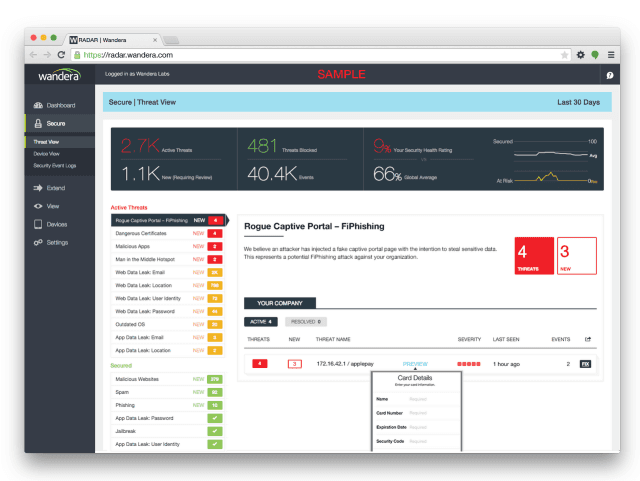
Experts at the mobile security company Wandera have reported a security flaw in Apple iOS that could be exploited to fool a user into provides his credit card data and personal information. An attacker can inject a fake “captive portal” page that imitates the legitimate Apple Pay interface by exploiting the default behavior of Apple iOS devices with Wi-Fi is enabled.

Every iOS based device with Wi-Fi turned on will attempt by default to access wireless networks with a known SSID, this means that an attacker can use a bogus access point could use a probe request capture to masquerade as a known network, and then display a pop-up screen masquerading as any web page or app.

The researcher at Wandera exploited this behavior to fool a mobile device into connect the rogue access point and then presents a pop-up portal page that appears like the Apple Pay page used to submit credit card data.

iOS  Apple pay hack

An attacker nearby a customer that is making an Apple Pay transaction could launch an attack in an attempt to force the customer’s mobile device to connect to bogus hotspot. The hacker could choose as location the nearly of PoS system with an Apple Pay terminal.

The unique defect for the attack described is that the fake Apple Pay screen is displayed beneath a “Log In” title bar that could alarm the users.

“In high footfall locations, even a very small ratio of success will yield a large number of valuable credit card numbers,” said Eldar Tuvey, CEO of Wandera. “It’s all so easy for them. Using readily available technology, which they may be discretely carrying about their person, hackers can for the first time focus their efforts where their victims are at their most susceptible—at the checkout.”

In  order to prevent such kind of attacks, it could be enough to turn Wi-Fi off when not deliberately connecting to a network.

Another thing to consider is that Apple Pay never asks users for credit card data to complete a transaction.

Pierluigi Paganini

(Security Affairs – Apple Pay, iOS)


