
Security Affairs
Two Barracuda ESG Flaws Could Be Combined for Full Root Access; Patches Released|Cyberattack Hits French Blood Banks as Hackers Target Refrigeration Systems Across Europe|CVE-2026-58868: Critical Android Bug Could Let Attackers Run Remote Code|U.S. CISA adds WordPress flaw to its Known Exploited Vulnerabilities catalog|Binance Hack: How Fake Job Interviews and AI Abuse Led to a $6.34 Billion Attack|Synology Warns of Ransomware Attacks Targeting NAS Devices Running Outdated DSM Versions|Inside XCPE, the botnet that turned 1.3M set-top boxes into proxy servers|NIS2 Makes Board Members Personally Liable for Access Control Decisions|Apple’s spyware notifications reach the Bundestag: what the BSI says to do now|VOLTA, the infostealer that asks an AI which victims are worth the effort|New wave of fridge cyberattacks hits European supermarkets, this time in Belgium, Luxembourg, Sweden and Estonia|Hackers Send Fake Nuclear Threat Alerts to Ukrainian and Russian Citizens|Two Barracuda ESG Flaws Could Be Combined for Full Root Access; Patches Released|Cyberattack Hits French Blood Banks as Hackers Target Refrigeration Systems Across Europe|CVE-2026-58868: Critical Android Bug Could Let Attackers Run Remote Code|U.S. CISA adds WordPress flaw to its Known Exploited Vulnerabilities catalog|Binance Hack: How Fake Job Interviews and AI Abuse Led to a $6.34 Billion Attack|Synology Warns of Ransomware Attacks Targeting NAS Devices Running Outdated DSM Versions|Inside XCPE, the botnet that turned 1.3M set-top boxes into proxy servers|NIS2 Makes Board Members Personally Liable for Access Control Decisions|Apple’s spyware notifications reach the Bundestag: what the BSI says to do now|VOLTA, the infostealer that asks an AI which victims are worth the effort|New wave of fridge cyberattacks hits European supermarkets, this time in Belgium, Luxembourg, Sweden and Estonia|Hackers Send Fake Nuclear Threat Alerts to Ukrainian and Russian Citizens|
Advertisement

Ad Placeholder

Full Width × 90

Breaking News

The source code of the 2020 variant of HelloKitty ransomware was leaked on a cybercrime forum

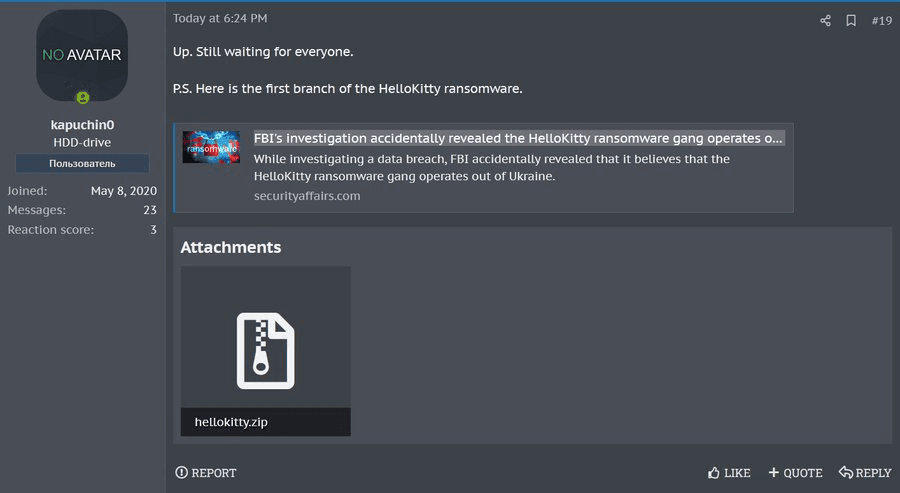
A threat actor has leaked the source code for the first version of the HelloKitty ransomware on a Russian-speaking cybercrime forum. Cybersecurity researchers 3xp0rt reported that a threat actor that goes online with the moniker ‘kapuchin0’ (and also uses the alias Gookee) has leaked the source code of the HelloKitty ransomware on the XSS forum. kapuchin0 claims […]

Source code HelloKitty ransomware Apache ActiveMQ

https://twitter.com/3xp0rtblog/status/1710387356979560800

A threat actor has leaked the source code for the first version of the HelloKitty ransomware on a Russian-speaking cybercrime forum.

Cybersecurity researchers 3xp0rt reported that a threat actor that goes online with the moniker ‘kapuchin0’ (and also uses the alias Gookee) has leaked the source code of the HelloKitty ransomware on the XSS forum.

kapuchin0 claims that the leaked code is the first breach of the HelloKitty ransomware.

Source code HelloKitty ransomware
Source 3xp0rt

BleepingComputer reported that the threat actor is also claiming to be developing a more powerful encryptor.

“We are preparing a new product and much more interesting than Lockbit.” said kapuchin0.

The leaked archive includes a Microsoft Visual Studio project that can be used to create the HelloKitty ransomware and the related decryptor.

BleepingComputer was able to verify with the help of the popular malware researcher Michael Gillespie that that source code is legitimate and is related to the first version of the ransomware that was employed in 2020.

The availability of the source in the cybercrime ecosystem can allow threat actors to develop their own version of the Hello Kitty ransomware.

The HelloKitty gang has been active since January 2021. In November 2021, the US FBI has published a flash alert warning private organizations of the evolution of the HelloKitty ransomware (aka FiveHands). According to the alert, the ransomware gang is launching distributed denial-of-service (DDoS) attacks as part of its extortion activities.

The ransomware gang targets their victims’ websites with DDoS attacks if they refuse to pay the ransom. The HelloKitty ransomware group, like other ransomware gangs, implements a double extortion model, stealing sensitive documents from victims before encrypting them. Then the threat actors threaten to leak the stolen data to force the victim into paying the ransom.

The HelloKitty/FiveHands gang is known to demand varying ransom payments in Bitcoin (BTC) that are commensurate with the economic capabilities of the victims.

The group’s operators use several techniques to breach the targets’ networks, such as exploiting SonicWall flaws (e.g., CVE-2021-20016, CVE-2021-20021, CVE-2021-20022, CVE-2021-2002) or using compromised credentials.

Follow me on Twitter: @securityaffairs and Facebook and Mastodon

Pierluigi Paganini

(SecurityAffairs – hacking, HelloKitty ransomware)


