
North Korea-linked Lazarus APT group targets cryptocurrency organizations with fake job offers in an ongoing spear-phishing campaign.
North Korea-linked Lazarus APT group (aka HIDDEN COBRA) has been observed while using LinkedIn lures in a spear-phishing campaign targeting the cryptocurrency organizations worldwide, including in the United States, the United Kingdom, Germany, Singapore, the Netherlands, Japan.
The activity of the Lazarus APT group surged in 2014 and 2015, its members used mostly custom-tailored malware in their attacks. This threat actor has been active since at least 2009, possibly as early as 2007, and it was involved in both cyber espionage campaigns and sabotage activities aimed to destroy data and disrupt systems.
The group is considered responsible for the massive WannaCry ransomware attack, a string of SWIFTattacks in 2016, and the Sony Pictures hack.
According to a report published by Kaspersky Lab in January 2020, in the two years the North Korea-linked APT group has continued to target cryptocurrency exchanges evolving its TTPs.
Now F-Secure Labs experts observed an ongoing spear-phishing campaign targeting an organization in the cryptocurrency industry.
Despite the effort of the group in making hard the attribution of the attack, F-Secure researchers found evidence that linked the attack to North Korea.
“In 2019, F-Secure uncovered technical details on Lazarus Group’s1 modus operandi during an investigation of an attack on an organisation in the cryptocurrency vertical, hereafter referred to as “the target”. The attack
was linked to a wider, ongoing global phishing campaign.” reads the report published by F-Secure.
“The attack was linked to this wider set of activity through several common indicators found in samples from the investigation, open source repositories, and proprietary intelligence sources”
F-Secure researchers believe the attack was advanced in nature and is part of a global phishing campaign running since at least January 2018.
Lazarus Group was able to delete traces of its activity, including malware employed in the attack as well as forensic evidence.
“Based on phishing artifacts recovered from Lazarus Group’s attack, F-Secure’s researchers were able to link the incident to a wider, ongoing campaign that’s been running since at least January 2018. According to the report, similar artifacts have been used in campaigns in at least 14 countries: the United States, China, the United Kingdom, Canada, Germany, Russia, South Korea, Argentina, Singapore, Hong Kong, Netherlands, Estonia, Japan, and the Philippines.” states F-Secure’s press release.
“Lazarus Group invested significant effort to evade the target organization’s defenses during the attack, such as by disabling anti-virus software on the compromised hosts, and removing the evidence of their malicious implants.”
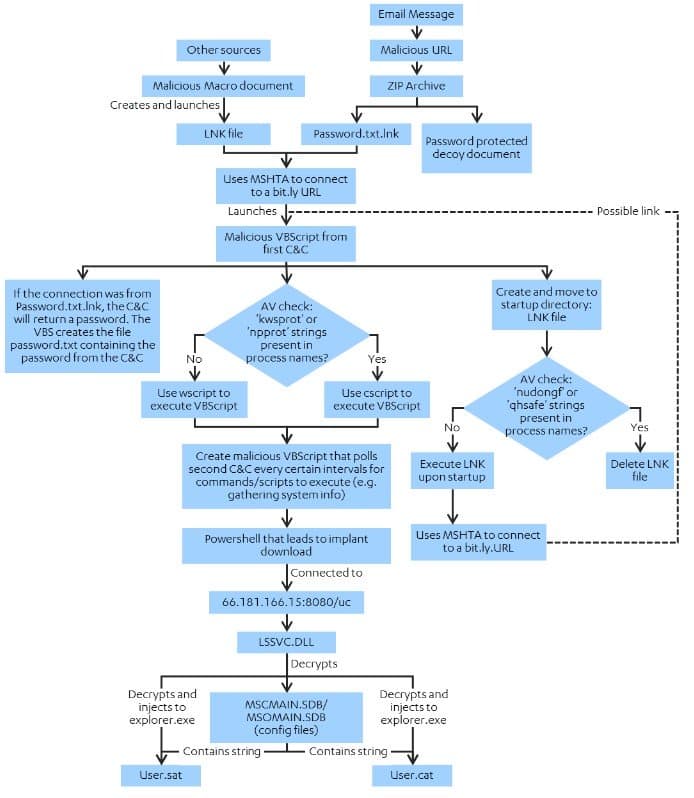
The attack chain used in this attack employed a maliciously crafted Word document that claimed to be protected by a General Data Protection Regulation (GDPR) which requires the target to enable content to read it.
Upon enabling the content of the document, it executes malicious embedded macro that connected to a bit.ly link and delivers the final payloads. The malware collects info and sends them back to the attackers’ C2 servers.

The analysis of the bit.ly link revealed it was accessed 73 times since early May 2019 from multiple countries.
“The main implants both contain the capability to download additional files, decompress data in memory, initiate C2 communication, execute arbitrary commands, and steal credentials from a number of sources.” continues the report. “The implants were also observed being used to connect to the network backdoor implants on other target hosts.”
Experts noticed that the Lazarus Group was using a custom version of Mimikatz to capture credentials and was disabling Credential Guard on infected systems to collect them directly from the memory.
“Lazarus Group’s activities are a continued threat: the phishing campaign associated with this attack has been observed continuing into 2020, raising the need for awareness and ongoing vigilance amongst organizations operating in the targeted verticals,” concludes the report.
“It is F-Secure’s assessment that the group will continue to target organizations within the cryptocurrency vertical while it remains such a profitable pursuit, but may also expand to target supply chain elements of the vertical to increase returns and longevity of the campaign.”
| [adrotate banner=”9″] | [adrotate banner=”12″] |
(SecurityAffairs – hacking, Lazarus)
[adrotate banner=”5″]
[adrotate banner=”13″]


