
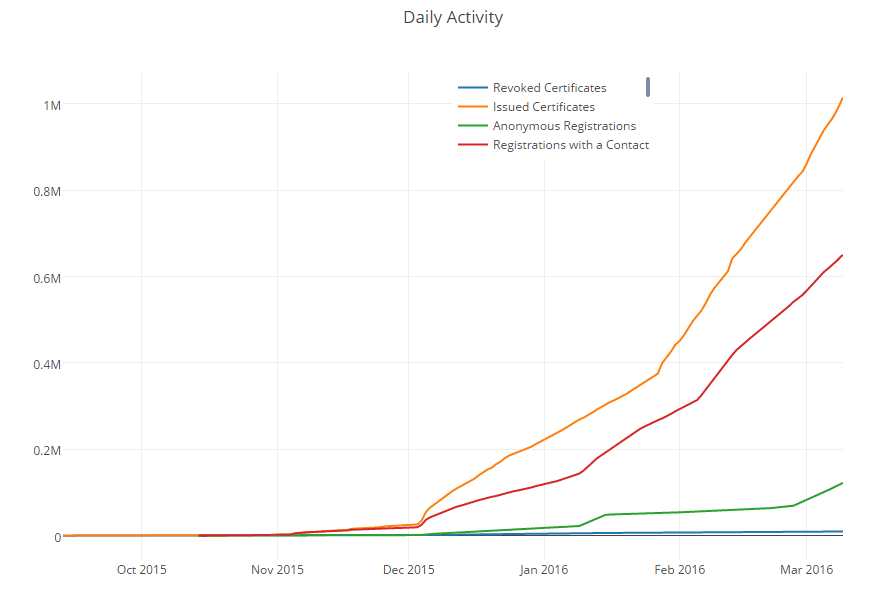
The Electronic Frontier Foundation announced that the Let’s Encrypt Certificate Authority issued its millionth certificate.
The open Certificate Authority (CA) Let’s Encrypt seems to be a success, the EFF is reaching its goals with the creation of this new certificate authority run by Internet Security Research Group (ISRG).
IT giants like Mozilla, Cisco, Akamai, Automattic and IdenTrust joined the initiative with the support of the Linux Foundation. The principal goal is to create a more secure web by encrypting website traffic using Transport Layer Security (TLS) and improve users’ privacy online.
The Let’s Encrypt CA issued its first certificate in September 2015, and today the EFF is proud to announce that Let’s Encrypt has issued its first million certificates.
“At 9:04am GMT today, the Let’s Encrypt Certificate Authority issued its millionth certificate. This is an amazing success, coming only 3 months and 5 days since a beta version of the service became publicly available. We’re very excited to be building a more secure and fully encrypted future for the World Wide Web.” states the Electronic Frontier Foundation.

The result is rousing if we consider that 90 percent of the 2.5 million domain names that take advantage of digital certificates issued by Let’s Encrypt had never been reachable by browser-valid HTTPS before.
The principal problems in implementing a HTTPs for each domain are the costs and the effort necessary to install the certificate. The Let’s Encrypt initiative aims to overwhelm these issues by issuing free digital certificates and by automating each phase of the lifecycle of a digital certificate.
The Let’s Encrypt has been a driving force for other similar initiatives, Amazon also started offering free certificates too.
There are other aspects to consider when dealing with Let’s Encrypt certificates, certificates are valid for only 90 days, this means that some website operators might forget to renew their certificates in due time.
“Unlike other CAs that issue certificates that don’t expire for years, LE is issuing short-lived certificates (90 days). All certificates are being published to the Certificate Transparency (CT) project, and you can see them at the crt.sh site.” explained David Holmes from F5 Networks.
Anyway let me say that I’m very happy for the results obtained by the Let’s Encrypt initiative, this is the evidence that we are converging to greater awareness of the risks and the need to take the necessary measures to protect our security and privacy.
| [adrotate banner=”9″] | [adrotate banner=”12″] |
(Security Affairs – PKI, privacy)
[adrotate banner=”5″]
[adrotate banner=”13″]


