
Security Affairs
Two Barracuda ESG Flaws Could Be Combined for Full Root Access; Patches Released|Cyberattack Hits French Blood Banks as Hackers Target Refrigeration Systems Across Europe|CVE-2026-58868: Critical Android Bug Could Let Attackers Run Remote Code|U.S. CISA adds WordPress flaw to its Known Exploited Vulnerabilities catalog|Binance Hack: How Fake Job Interviews and AI Abuse Led to a $6.34 Billion Attack|Synology Warns of Ransomware Attacks Targeting NAS Devices Running Outdated DSM Versions|Inside XCPE, the botnet that turned 1.3M set-top boxes into proxy servers|NIS2 Makes Board Members Personally Liable for Access Control Decisions|Apple’s spyware notifications reach the Bundestag: what the BSI says to do now|VOLTA, the infostealer that asks an AI which victims are worth the effort|New wave of fridge cyberattacks hits European supermarkets, this time in Belgium, Luxembourg, Sweden and Estonia|Hackers Send Fake Nuclear Threat Alerts to Ukrainian and Russian Citizens|Two Barracuda ESG Flaws Could Be Combined for Full Root Access; Patches Released|Cyberattack Hits French Blood Banks as Hackers Target Refrigeration Systems Across Europe|CVE-2026-58868: Critical Android Bug Could Let Attackers Run Remote Code|U.S. CISA adds WordPress flaw to its Known Exploited Vulnerabilities catalog|Binance Hack: How Fake Job Interviews and AI Abuse Led to a $6.34 Billion Attack|Synology Warns of Ransomware Attacks Targeting NAS Devices Running Outdated DSM Versions|Inside XCPE, the botnet that turned 1.3M set-top boxes into proxy servers|NIS2 Makes Board Members Personally Liable for Access Control Decisions|Apple’s spyware notifications reach the Bundestag: what the BSI says to do now|VOLTA, the infostealer that asks an AI which victims are worth the effort|New wave of fridge cyberattacks hits European supermarkets, this time in Belgium, Luxembourg, Sweden and Estonia|Hackers Send Fake Nuclear Threat Alerts to Ukrainian and Russian Citizens|
Advertisement

Ad Placeholder

Full Width × 90

Breaking News

Over 91,000 LG smart TVs running webOS are vulnerable to hacking

Researchers found multiple vulnerabilities in LG webOS running on smart TVs that could allow attackers to gain root access to the devices. Bitdefender researchers discovered multiple vulnerabilities in LG webOS running on smart TVs that could be exploited to bypass authorization and gain root access on the devices. The vulnerabilities discovered by the researchers impact […]

smart TVs

Researchers found multiple vulnerabilities in LG webOS running on smart TVs that could allow attackers to gain root access to the devices.

Bitdefender researchers discovered multiple vulnerabilities in LG webOS running on smart TVs that could be exploited to bypass authorization and gain root access on the devices.

The vulnerabilities discovered by the researchers impact WebOS versions 4 through 7 running on LG TVs.

“WebOS runs a service on ports 3000/3001 (HTTP/HTTPS/WSS) which is used by the LG ThinkQ smartphone app to control the TV. To set up the app, the user must enter a PIN code into the display on the TV screen.” reads the advisory. “An error in the account handler lets an attacker skip the PIN verification entirely and create a privileged user profile.”

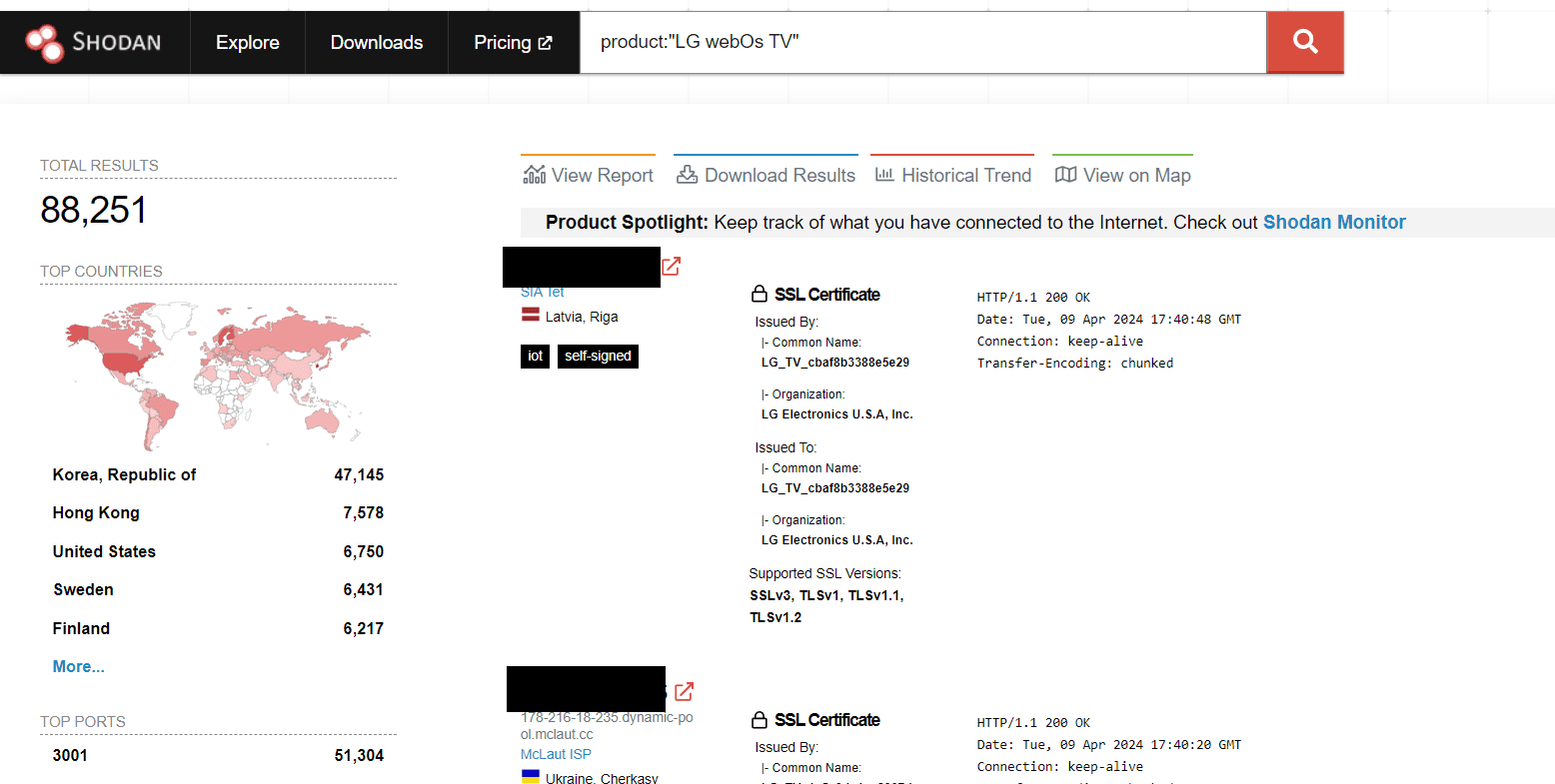
The researchers pointed out that despite the vulnerable service is intended for LAN access only, querying Shodan they identified over 91,000 devices that expose the service to the Internet. At this time, the number of exposed devices decreased to 88,000. Most of the Internet-facing devices are in South Korea, Hong Kong, the U.S., Sweden, and Finland.

smart TVs

Below is the list of vulnerabilities discovered by the experts in November 2023:

  • CVE-2023-6317 – An authentication bypass issue that can be exploited to bypass PIN verification and add a privileged user profile to the TV set without requiring user interaction
  • CVE-2023-6318 – An elevation of privileges issue that can be exploited to elevate privileges and gain root access to take control of the device
  • CVE-2023-6319 – A vulnerability that allows operating system command injection by manipulating a library named asm responsible for showing music lyrics
  • CVE-2023-6320 – A vulnerability that allows for the injection of authenticated commands by manipulating the com.webos.service.connectionmanager/tv/setVlanStaticAddress API endpoint

The vulnerabilities impact the following webOS versions:

  • webOS 4.9.7 – 5.30.40 running on LG43UM7000PLA
  • webOS 5.5.0 – 04.50.51 running on OLED55CXPUA
  • webOS 6.3.3-442 (kisscurl-kinglake) – 03.36.50 running on OLED48C1PUB
  • webOS 7.3.1-43 (mullet-mebin) – 03.33.85 running on OLED55A23LA

Below is the disclosure timeline:

  • November 01, 2023: Vendor disclosure
  • November 15, 2023: Vendor confirms the vulnerabilities.
  • December 14, 2023: Vendor requests extension
  • March 22, 2024: Patch release
  • April 09, 2024: Public release of this report

Follow me on Twitter: @securityaffairs and Facebook and Mastodon

Pierluigi Paganini

(SecurityAffairs – hacking, smart TVs)


