
Security Affairs
Cyberattack Hits French Blood Banks as Hackers Target Refrigeration Systems Across Europe|CVE-2026-58868: Critical Android Bug Could Let Attackers Run Remote Code|U.S. CISA adds WordPress flaw to its Known Exploited Vulnerabilities catalog|Binance Hack: How Fake Job Interviews and AI Abuse Led to a $6.34 Billion Attack|Synology Warns of Ransomware Attacks Targeting NAS Devices Running Outdated DSM Versions|Inside XCPE, the botnet that turned 1.3M set-top boxes into proxy servers|NIS2 Makes Board Members Personally Liable for Access Control Decisions|Apple’s spyware notifications reach the Bundestag: what the BSI says to do now|VOLTA, the infostealer that asks an AI which victims are worth the effort|New wave of fridge cyberattacks hits European supermarkets, this time in Belgium, Luxembourg, Sweden and Estonia|Hackers Send Fake Nuclear Threat Alerts to Ukrainian and Russian Citizens|Chainalysis Investigates Security Incident Involving AI-Driven Attack Techniques|Cyberattack Hits French Blood Banks as Hackers Target Refrigeration Systems Across Europe|CVE-2026-58868: Critical Android Bug Could Let Attackers Run Remote Code|U.S. CISA adds WordPress flaw to its Known Exploited Vulnerabilities catalog|Binance Hack: How Fake Job Interviews and AI Abuse Led to a $6.34 Billion Attack|Synology Warns of Ransomware Attacks Targeting NAS Devices Running Outdated DSM Versions|Inside XCPE, the botnet that turned 1.3M set-top boxes into proxy servers|NIS2 Makes Board Members Personally Liable for Access Control Decisions|Apple’s spyware notifications reach the Bundestag: what the BSI says to do now|VOLTA, the infostealer that asks an AI which victims are worth the effort|New wave of fridge cyberattacks hits European supermarkets, this time in Belgium, Luxembourg, Sweden and Estonia|Hackers Send Fake Nuclear Threat Alerts to Ukrainian and Russian Citizens|Chainalysis Investigates Security Incident Involving AI-Driven Attack Techniques|
Advertisement

Ad Placeholder

Full Width × 90

Breaking News

Malicious PDF Analysis

In the last few days I have done some analysis on malicious documents, especially PDF. Then I thought, “Why not turn a PDF analysis into an article?” Let’s go to our case study: I received a scan request for a PDF file that was reported to support an antivirus vendor, and it replied that the […]

PDF analysis

In the last few days I have done some analysis on malicious documents, especially PDF. Then I thought, “Why not turn a PDF analysis into an article?”

Let’s go to our case study:

I received a scan request for a PDF file that was reported to support an antivirus vendor, and it replied that the file was not malicious. Because the manufacturer’s analysis was not satisfactory, the team responsible for handling the incident requested a second opinion, since in other anti-virus tools the document was reported to be malicious. The team needed evidence to prove the risk involved in the file.

While conducting an initial analysis on the file, I identified that I had something suspicious:

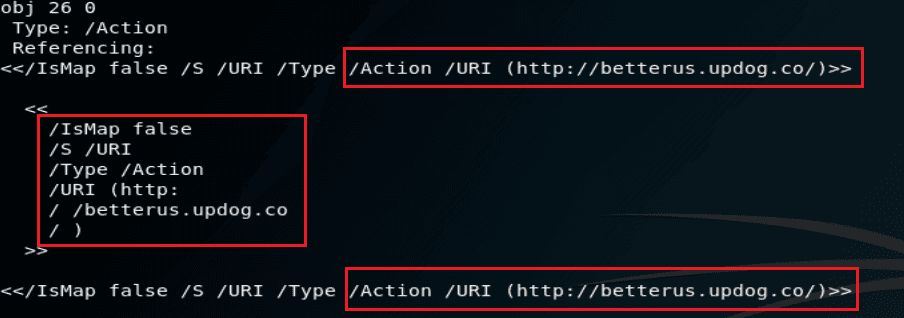
After an analysis in the structure of objects of the PDF it is possible to identify a malicious URL that is executed during the process of opening the document, that is to say, when the user opens the file in his station it executes of conceal form the call of the URL as shown below :

When performing a domain verification it is possible to reach the IP bound to it:

When performing a URL reputation analysis, a malicious history is identified:

When performing an IP reputation analysis, a malicious history is identified:

The interesting thing is to think that years ago we would never say that infection would be possible through malicious code, URL, shellcode, through obfuscation inside documents like PDF, DOC, DOCx, XLS, XLSx and PPT. Most security tools must always be adapted to this new reality of attack and infection.

It is essential that security professionals are increasingly able to work with this type of analysis that the antivirus tool is not usually able to do, I leave here the hint about the importance of studying malicious document analysis.

About the author: Zoziel Freire

Cyber Security Analyst Content Writer of the portal: www.infosectrain.com Analyst document’s malicious CompTIA Security Analytics Professional LPIC-3 Enterprise Linux Professionals CompTIA Cybersecurity Analyst Linkedin: https://www.linkedin.com/in/zozielfreire/

Twitter: https://twitter.com/zoziel

[adrotate banner=”9″] [adrotate banner=”12″]

Pierluigi Paganini

(SecurityAffairs – PDF analysis, hacking)

[adrotate banner=”5″] [adrotate banner=”13″]


