
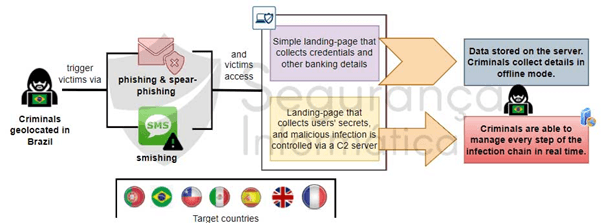
A massive social engineering campaign targeting banks has been delivered in the last two years in several countries.
A massive social engineering campaign has been delivered in the last two years in several countries, including Portugal, Spain, Brazil, Mexico, Chile, the UK, and France. According to Segurança Informática publication, the malicious waves have impacted banking organizations with the goal of stealing the users’ secrets, accessing the home banking portals, and also controlling all the operations on the fly via Command and Control (C2) servers geolocated in Brazil.

In short, criminal groups are targeting victims’ from different countries to collect their homebanking secrets and payment cards. The campaigns are carried out by using social engineering schemas, namely smishing, and spear-phishing through fake emails.
Criminals obtain lists of valid and tested phone numbers and emails from other malicious groups, and the process is performed on underground forums, Telegram channels or Discord chats.

The spear-phishing campaigns try to lure vicitms with fake emails that impersonate the banking institutions. The emails are extremely similar to the originals, exception their content, mainly related to debts or lack of payments.

According to the analysis, the malicious campaign consists of a redirector system, capable of performing an initial screening to verify that the users’ requests are valid and expected. The system is equipped with a blacklisting mechanism and a logging feature that notifies criminals of new infections.

When the victim matches all the rules, several pathways are possible, with different landing-pages. Some of them only collect raw data, including the homebanking credentials, SMS tokens and bank codes. On the other hand, a well-structured C2 server can be used to orchestrate all the processes in real-time, simulating a flow extremely similar to the legitimate service.
As phishing and malware campaigns make headlines every day, monitoring these types of behaviors and IoCs is crucial to fighting this emerging segment, which has grown in both volume and sophistication.
Additional details about the investigation can be found here:
About the author: Pedro Tavarez
Pedro Tavares is a professional in the field of information security working as an Ethical Hacker, Malware Analyst and also a Security Evangelist. He is also a founding member and Pentester at CSIRT.UBI and founder of the security computer blog seguranca–informatica.pt.
Follow me on Twitter: @securityaffairs and Facebook
| [adrotate banner=”9″] | [adrotate banner=”12″] |
(SecurityAffairs – hacking, social engineering)
[adrotate banner=”5″]
[adrotate banner=”13″]


