
Security Affairs
Cyberattack Hits French Blood Banks as Hackers Target Refrigeration Systems Across Europe|CVE-2026-58868: Critical Android Bug Could Let Attackers Run Remote Code|U.S. CISA adds WordPress flaw to its Known Exploited Vulnerabilities catalog|Binance Hack: How Fake Job Interviews and AI Abuse Led to a $6.34 Billion Attack|Synology Warns of Ransomware Attacks Targeting NAS Devices Running Outdated DSM Versions|Inside XCPE, the botnet that turned 1.3M set-top boxes into proxy servers|NIS2 Makes Board Members Personally Liable for Access Control Decisions|Apple’s spyware notifications reach the Bundestag: what the BSI says to do now|VOLTA, the infostealer that asks an AI which victims are worth the effort|New wave of fridge cyberattacks hits European supermarkets, this time in Belgium, Luxembourg, Sweden and Estonia|Hackers Send Fake Nuclear Threat Alerts to Ukrainian and Russian Citizens|Chainalysis Investigates Security Incident Involving AI-Driven Attack Techniques|Cyberattack Hits French Blood Banks as Hackers Target Refrigeration Systems Across Europe|CVE-2026-58868: Critical Android Bug Could Let Attackers Run Remote Code|U.S. CISA adds WordPress flaw to its Known Exploited Vulnerabilities catalog|Binance Hack: How Fake Job Interviews and AI Abuse Led to a $6.34 Billion Attack|Synology Warns of Ransomware Attacks Targeting NAS Devices Running Outdated DSM Versions|Inside XCPE, the botnet that turned 1.3M set-top boxes into proxy servers|NIS2 Makes Board Members Personally Liable for Access Control Decisions|Apple’s spyware notifications reach the Bundestag: what the BSI says to do now|VOLTA, the infostealer that asks an AI which victims are worth the effort|New wave of fridge cyberattacks hits European supermarkets, this time in Belgium, Luxembourg, Sweden and Estonia|Hackers Send Fake Nuclear Threat Alerts to Ukrainian and Russian Citizens|Chainalysis Investigates Security Incident Involving AI-Driven Attack Techniques|
Advertisement

Ad Placeholder

Full Width × 90

Breaking News

New Matanbuchus Campaign drops Cobalt Strike beacons

Matanbuchus malware-as-a-service (Maas) has been observed spreading through phishing campaigns, dropping Cobalt Strike beacons. Threat intelligence firm Cyble has observed a malware-as-a-service (Maas), named Matanbuchus, involved in malspam attacks dropping Cobalt Strike beacons. Matanbuchus is a malware loader that first appeared on the threat landscape in February 2021, when it was offered for rent on Russian-speaking […]

matanbuchus

Matanbuchus malware-as-a-service (Maas) has been observed spreading through phishing campaigns, dropping Cobalt Strike beacons.

Threat intelligence firm Cyble has observed a malware-as-a-service (Maas), named Matanbuchus, involved in malspam attacks dropping Cobalt Strike beacons.

Matanbuchus is a malware loader that first appeared on the threat landscape in February 2021, when it was offered for rent on Russian-speaking cybercrime forums at a price of $2500.

Cyble researchers started their investigation after coming across a Twitter post from a researcher warning of the loader spreading through spam campaigns.

matanbuchus

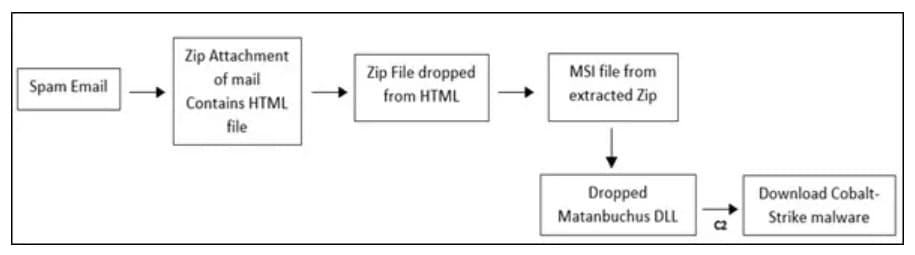
Matanbuchus could be used in a multi-stage attack chain due to its capability to download and execute second-stage executables from C2 servers.

The Matanbuchus attack chain starts through malspam messages using a ZIP attachment containing an HTML file. Once executed the HTML file, it decodes the base64 content embedded in the file and drops a ZIP file in the Downloads folder.

“However, there is a code present in the HTML file which shows that the ZIP file is in the OneDrive location. The ZIP file contains an MSI installer file. After extraction, it shows a fake error message upon the execution of the MSI file.” reads the analysis published by Cyble.

The MSI installer displays a fake error message upon execution while installing a DLL file (“main.dll”) in the background.

The ‘main.dll’ acts as a loader and downloads the actual Matanbuchus DLL from the C&C server. The DLL also establishes persistence by means of a scheduled task.

“Threat Actors use various techniques to deploy their malicious payloads into the victim’s system. In this case, we observed the TAs used Matanbuchus malware loader to deliver Cobalt Strike Beacons.” concludes Cyble.

The report also includes MITRE ATT&CK® Techniques and Indicators of Compromise.

Follow me on Twitter: @securityaffairs and Facebook

[adrotate banner=”9″][adrotate banner=”12″]

Pierluigi Paganini

(SecurityAffairs – hacking, Matanbuchus)

[adrotate banner=”5″]

[adrotate banner=”13″]


