Security Affairs
Two Barracuda ESG Flaws Could Be Combined for Full Root Access; Patches Released|Cyberattack Hits French Blood Banks as Hackers Target Refrigeration Systems Across Europe|CVE-2026-58868: Critical Android Bug Could Let Attackers Run Remote Code|U.S. CISA adds WordPress flaw to its Known Exploited Vulnerabilities catalog|Binance Hack: How Fake Job Interviews and AI Abuse Led to a $6.34 Billion Attack|Synology Warns of Ransomware Attacks Targeting NAS Devices Running Outdated DSM Versions|Inside XCPE, the botnet that turned 1.3M set-top boxes into proxy servers|NIS2 Makes Board Members Personally Liable for Access Control Decisions|Apple’s spyware notifications reach the Bundestag: what the BSI says to do now|VOLTA, the infostealer that asks an AI which victims are worth the effort|New wave of fridge cyberattacks hits European supermarkets, this time in Belgium, Luxembourg, Sweden and Estonia|Hackers Send Fake Nuclear Threat Alerts to Ukrainian and Russian Citizens|Two Barracuda ESG Flaws Could Be Combined for Full Root Access; Patches Released|Cyberattack Hits French Blood Banks as Hackers Target Refrigeration Systems Across Europe|CVE-2026-58868: Critical Android Bug Could Let Attackers Run Remote Code|U.S. CISA adds WordPress flaw to its Known Exploited Vulnerabilities catalog|Binance Hack: How Fake Job Interviews and AI Abuse Led to a $6.34 Billion Attack|Synology Warns of Ransomware Attacks Targeting NAS Devices Running Outdated DSM Versions|Inside XCPE, the botnet that turned 1.3M set-top boxes into proxy servers|NIS2 Makes Board Members Personally Liable for Access Control Decisions|Apple’s spyware notifications reach the Bundestag: what the BSI says to do now|VOLTA, the infostealer that asks an AI which victims are worth the effort|New wave of fridge cyberattacks hits European supermarkets, this time in Belgium, Luxembourg, Sweden and Estonia|Hackers Send Fake Nuclear Threat Alerts to Ukrainian and Russian Citizens|
Advertisement

Ad Placeholder

Full Width × 90

Breaking News

NetWalker ransomware gang threatens to release Michigan State University files

Michigan State University is the last victim of the NetWalker ransomware, attackers threaten to leak stolen files if it will not pay the ransom in seven days. Michigan State University hit by ransomware gang, NetWalker ransomware operators are threatening to leak stolen files if the university will not pay the ransom in seven days. At […]

NetWalker ransomware gang threatens to release Michigan State University files

Michigan State University is the last victim of the NetWalker ransomware, attackers threaten to leak stolen files if it will not pay the ransom in seven days.

Michigan State University hit by ransomware gang, NetWalker ransomware operators are threatening to leak stolen files if the university will not pay the ransom in seven days.

At the time of writing the ransom demand to decrypt their files was not disclosed.

Even if the MSU will restore from backups, the NetWalker ransomware gang will leak the documents stolen on its dark web leak site.

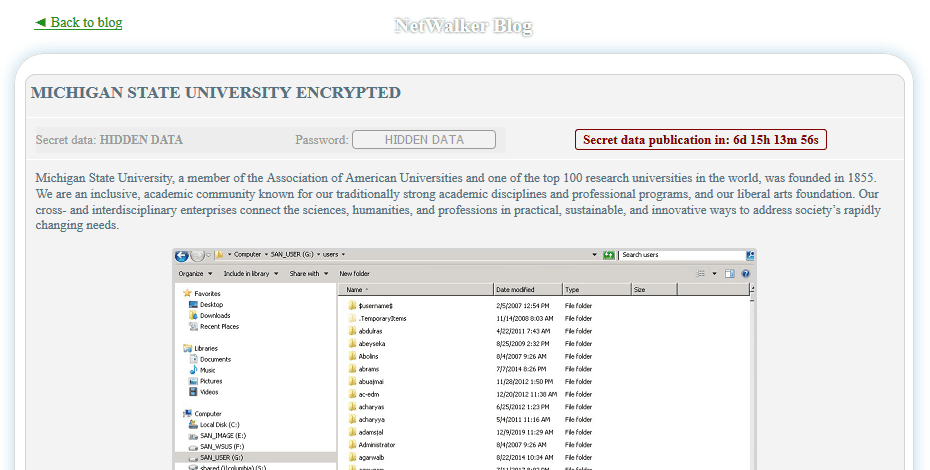
As a proof of the attack, NetWalker ransomware operators have shared five images on the leak site.

“These include two images showing a directory structure allegedly from the university’s network, a passport scan for a student, and two scans of Michigan State financial documents.” reported ZDNet.

Source ZDNet

The NetWalker group is very active in this period, the list of the victims of the gang includes the shipping giant Toll. Researchers also identified a new Coronavirus phishing campaign that aims at delivering the Netwalker Ransomware using COVID-19 lures.

The university did not reveal the extent of the attack, students and employees are still working from home due to the COVID-19 outbreak, anyway, the incident may not impact the e-learning activity.

NetWalker isn’t the unique ransomware gang that is threatening to publish data of the victims to force to pay the ransom, other gangs are DopplePaymer, Maze, Nefilim, Nemty, RagnarLocker, and REvil.

[adrotate banner=”9″][adrotate banner=”12″]

Pierluigi Paganini

(SecurityAffairs – Michigan State University, hacking)

[adrotate banner=”5″]

[adrotate banner=”13″]