
Threat actors are exploiting a zero-day flaw in Progress Software’s MOVEit Transfer product to steal data from organizations.
Threat actors are actively exploiting a zero-day vulnerability in the Progress MOVEit Transfer file transfer product to steal data from organizations.
MOVEit Transfer is a managed file transfer that is used by enterprises to securely transfer files using SFTP, SCP, and HTTP-based uploads.
The vulnerability is a SQL injection vulnerability, it can be exploited by an unauthenticated attacker to gain unauthorized access to MOVEit Transfer’s database.
“a SQL injection vulnerability has been found in the MOVEit Transfer web application that could allow an un-authenticated attacker to gain unauthorized access to MOVEit Transfer’s database.” reads the advisory published by the company. “Depending on the database engine being used (MySQL, Microsoft SQL Server, or Azure SQL), an attacker may be able to infer information about the structure and contents of the database in addition to executing SQL statements that alter or delete database elements.”
The vulnerability affects all MOVEit Transfer versions, it doesn’t affect the cloud version of the product. The company also shared Indicators of Compromise (IoCs) for this attack and urges customers that notice any of the indicators to immediately contact its security and IT teams.
Multiple security firms are warning that the vulnerability has been actively exploited in the wild.
GreyNoise researchers have observed scanning activity for the login page of MOVEit Transfer located at /human.aspx as early as March 3rd, 2023, for this reason, the experts recommend Progress customers to review potentially malicious activity that was recorded in the last 90 days.
“While we have not observed activity directly related to exploitation, all of the 5 IPs we have observed attempting to discover the location of MOVEit installations were marked as “Malicious” by GreyNoise for prior activities.” reads the alert published by GreyNoise. “The primary artifact, observed through publicly available information, is the presence of a webshell named human2.aspx. This is a post-exploitation file artifact that is written to the filesystem by a malicious actor allowing them to execute arbitrary commands. GreyNoise is observing scanning activity looking to identify the presence of the human2.aspx webshell dropped as part of the post-exploitation activity.”
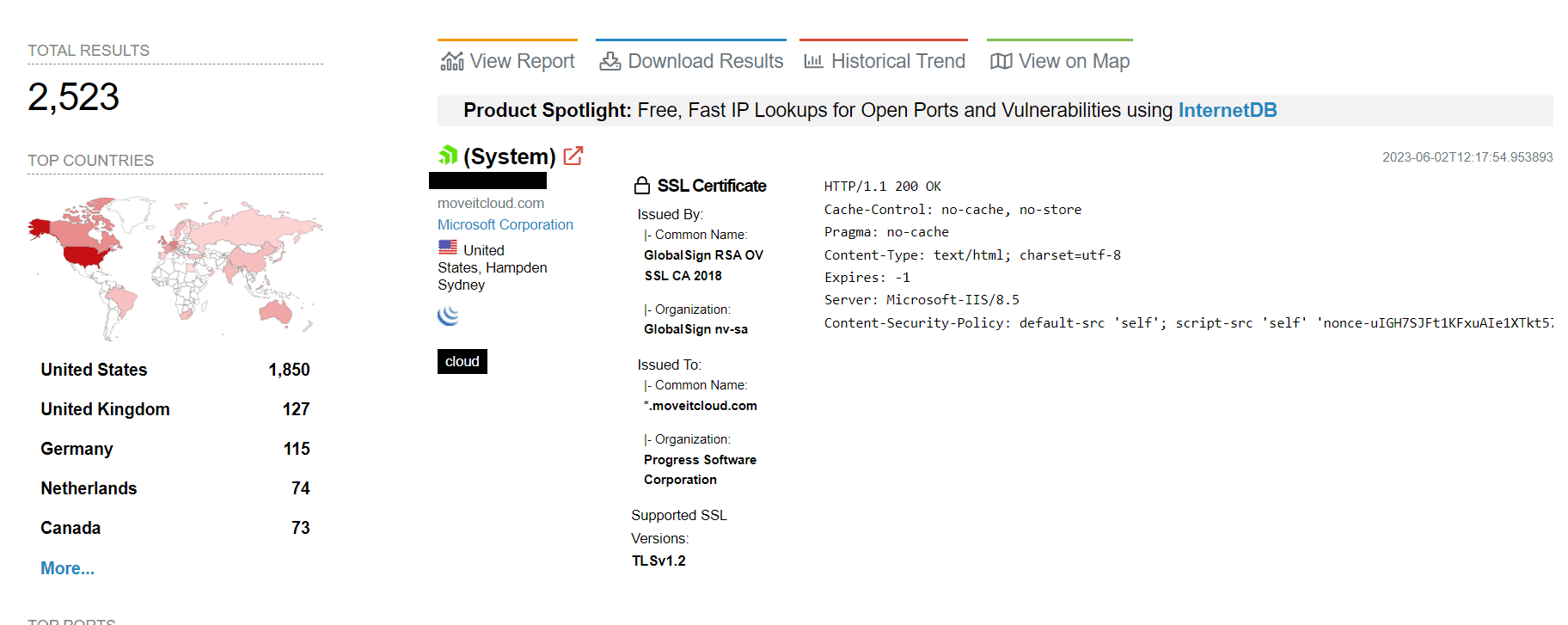
By May 31, Rapid7 experts discovered approximately 2,500 instances of MOVEit Transfer publicly accessible on the internet, with a significant portion located in the United States.

“Our teams have so far observed the same webshell name in multiple customer environments, which may indicate automated exploitation.” reported Rapid7.
Threat actors exploit the vulnerability to establish a webshell (‘human2.aspx’) in the ‘wwwroot’ folder of the MOVEit software.
Follow me on Twitter: @securityaffairs and Facebook and Mastodon
(SecurityAffairs – hacking, MOVEit Transfer)


