
Security Affairs
Two Barracuda ESG Flaws Could Be Combined for Full Root Access; Patches Released|Cyberattack Hits French Blood Banks as Hackers Target Refrigeration Systems Across Europe|CVE-2026-58868: Critical Android Bug Could Let Attackers Run Remote Code|U.S. CISA adds WordPress flaw to its Known Exploited Vulnerabilities catalog|Binance Hack: How Fake Job Interviews and AI Abuse Led to a $6.34 Billion Attack|Synology Warns of Ransomware Attacks Targeting NAS Devices Running Outdated DSM Versions|Inside XCPE, the botnet that turned 1.3M set-top boxes into proxy servers|NIS2 Makes Board Members Personally Liable for Access Control Decisions|Apple’s spyware notifications reach the Bundestag: what the BSI says to do now|VOLTA, the infostealer that asks an AI which victims are worth the effort|New wave of fridge cyberattacks hits European supermarkets, this time in Belgium, Luxembourg, Sweden and Estonia|Hackers Send Fake Nuclear Threat Alerts to Ukrainian and Russian Citizens|Two Barracuda ESG Flaws Could Be Combined for Full Root Access; Patches Released|Cyberattack Hits French Blood Banks as Hackers Target Refrigeration Systems Across Europe|CVE-2026-58868: Critical Android Bug Could Let Attackers Run Remote Code|U.S. CISA adds WordPress flaw to its Known Exploited Vulnerabilities catalog|Binance Hack: How Fake Job Interviews and AI Abuse Led to a $6.34 Billion Attack|Synology Warns of Ransomware Attacks Targeting NAS Devices Running Outdated DSM Versions|Inside XCPE, the botnet that turned 1.3M set-top boxes into proxy servers|NIS2 Makes Board Members Personally Liable for Access Control Decisions|Apple’s spyware notifications reach the Bundestag: what the BSI says to do now|VOLTA, the infostealer that asks an AI which victims are worth the effort|New wave of fridge cyberattacks hits European supermarkets, this time in Belgium, Luxembourg, Sweden and Estonia|Hackers Send Fake Nuclear Threat Alerts to Ukrainian and Russian Citizens|
Advertisement

Ad Placeholder

Full Width × 90

Breaking News

New Joomla release patches a serious SQLi flaw

Joomla just released a patch to fix a critical vulnerability that can allow an attacker to get full administrative access to a website. The new version of the popular Joomla content management system, the Joomla 3,4,5, is available online. The new release fixes a critical SQL injection vulnerability that could be exploited by attackers to […]

New Joomla release patches a serious SQLi flaw

Joomla just released a patch to fix a critical vulnerability that can allow an attacker to get full administrative access to a website.

The new version of the popular Joomla content management system, the Joomla 3,4,5, is available online. The new release fixes a critical SQL injection vulnerability that could be exploited by attackers to access data in the database of any website running on versions 3.2 to 4.4.4.

The experts also warn about the possibility to combine the flaw with two other vulnerabilities to carry out an attack. There are nearly three million active Joomla instances online that could be potentially compromised by hackers.

The three flaws have been found by the researcher from Trustwave’s Spiderlabs Asaf Orpani, who explained that an attacker could hijack the administrator session, exploit the main vulnerability, and then compromise the entire website.

The experts at Joomla fixed the issue in just eight days after their discovery.

The flaw resides in the core module of the Joomla CMS, an attackers can exploit a code from a PHP file in the Adminstrator folder, that is vulnerable to the SQL injection, to steal a session key.

Joomla new release SQLi core

Once obtained the session key it is sufficiently paste it to the cookie section in the request to access the admin folder to obtain administrator privileges.

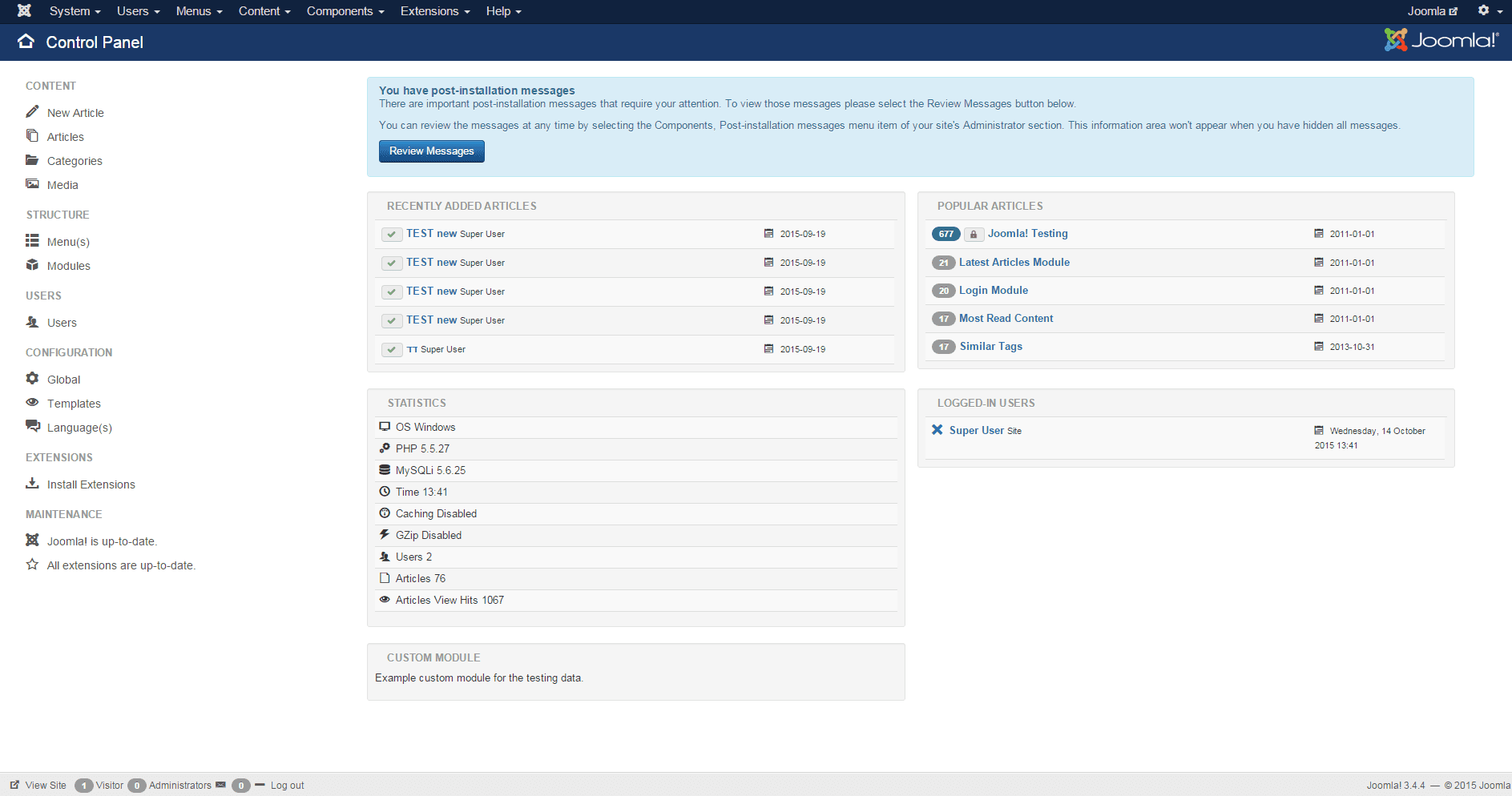
“Pasting the session ID we’ve extracted (which happens to be of an Administrator in our case) to the cookie section in the GET request allows us to access the /administrator/ folder,” Orpani writes, “We’ve also been granted administrator privileges and access to the administrator panel and a view of the control panel. And that’s it—we’ve compromised the website!” the experts wrote in a blog post.

The new Joomla release also addresses two sets of inadequate ACL checks in versions 3.2.0 through 3.4.4, and 3.0 through 3.4.4 of the CMS.

Pierluigi Paganini

(Security Affairs – Joomla CMS, SQL Injection)


