
Security Affairs
Cyberattack Hits French Blood Banks as Hackers Target Refrigeration Systems Across Europe|CVE-2026-58868: Critical Android Bug Could Let Attackers Run Remote Code|U.S. CISA adds WordPress flaw to its Known Exploited Vulnerabilities catalog|Binance Hack: How Fake Job Interviews and AI Abuse Led to a $6.34 Billion Attack|Synology Warns of Ransomware Attacks Targeting NAS Devices Running Outdated DSM Versions|Inside XCPE, the botnet that turned 1.3M set-top boxes into proxy servers|NIS2 Makes Board Members Personally Liable for Access Control Decisions|Apple’s spyware notifications reach the Bundestag: what the BSI says to do now|VOLTA, the infostealer that asks an AI which victims are worth the effort|New wave of fridge cyberattacks hits European supermarkets, this time in Belgium, Luxembourg, Sweden and Estonia|Hackers Send Fake Nuclear Threat Alerts to Ukrainian and Russian Citizens|Chainalysis Investigates Security Incident Involving AI-Driven Attack Techniques|Cyberattack Hits French Blood Banks as Hackers Target Refrigeration Systems Across Europe|CVE-2026-58868: Critical Android Bug Could Let Attackers Run Remote Code|U.S. CISA adds WordPress flaw to its Known Exploited Vulnerabilities catalog|Binance Hack: How Fake Job Interviews and AI Abuse Led to a $6.34 Billion Attack|Synology Warns of Ransomware Attacks Targeting NAS Devices Running Outdated DSM Versions|Inside XCPE, the botnet that turned 1.3M set-top boxes into proxy servers|NIS2 Makes Board Members Personally Liable for Access Control Decisions|Apple’s spyware notifications reach the Bundestag: what the BSI says to do now|VOLTA, the infostealer that asks an AI which victims are worth the effort|New wave of fridge cyberattacks hits European supermarkets, this time in Belgium, Luxembourg, Sweden and Estonia|Hackers Send Fake Nuclear Threat Alerts to Ukrainian and Russian Citizens|Chainalysis Investigates Security Incident Involving AI-Driven Attack Techniques|
Advertisement

Ad Placeholder

Full Width × 90

Breaking News

Office 365 phishing campaign leverages Oracle and Amazon cloud services

Experts warn of a new sophisticated phishing scheme for stealing Office 365 credentials from small and medium-sized businesses in the U.S. The new sophisticated phishing scheme was implemented by threat actors for stealing Office 365 credentials, it leverages both cloud services from Oracle and Amazon for their infrastructure. The campaign has been active for more […]

Office 365 phishing

Experts warn of a new sophisticated phishing scheme for stealing Office 365 credentials from small and medium-sized businesses in the U.S.

The new sophisticated phishing scheme was implemented by threat actors for stealing Office 365 credentials, it leverages both cloud services from Oracle and Amazon for their infrastructure.

The campaign has been active for more than half a year and targeted small and medium-sized businesses in the U.S. and Australia.

Threat actors used to compromise legitimate websites and used them as a proxy chain, This campaign also outstands for the abuse of legitimate services and websites for data exfiltration.

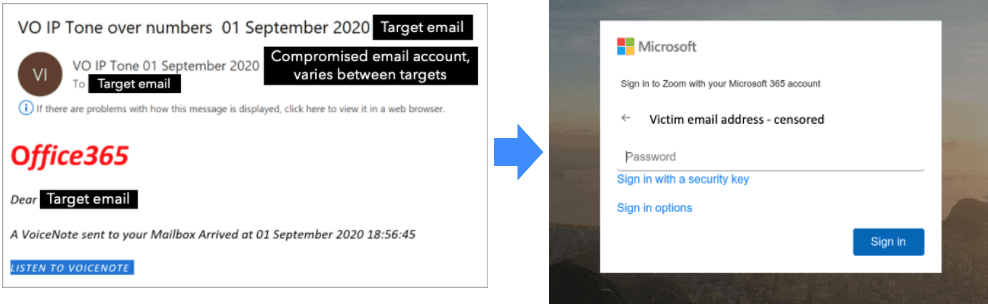
The phishing messages are fake notifications for voice messages and Zoom invitations that are created to trick victims into clicking an embedded link that finally lead the victim to the phishing page that was designed to steal login credentials.

Office 365 phishing
Source Bleeping Computer

According to cybersecurity firm Mitiga, the threat actors used compromised accounts to send out phishing messages and used Amazon Web Services (AWS) and Oracle Cloud in the redirect chain.

“Once the link was clicked, the user is redirected through several proxies, including AWS load balancers, all the way to a legitimate but compromised website” Ofir Rozmann, threat intelligence at Mitiga told Bleeping Computer.

Before the victims land the final landing page, the user is redirected through several proxies, including AWS load balancers.

Most of the fake Office 365 login pages were hosted on Oracle Cloud computing service, but experts also observed the use of Amazon Simple Storage Service (Amazon S3).

Mitiga researchers discovered more than 40 compromised websites that were employed in this Office 365 phishing campaign.

The analysis of the HTML code for the fake Office 365 pages suggests that attackers opted for a phishing-as-a-service.

Based on the email addresses employed in this campaign, Mitiga researchers determined that the campaign mainly aimed at C-level executives at small and medium-sized businesses as well as major financial institutions.

Additional technical details about this campaign, along with Mitiga recommendations to avoid falling victim to these attacks are reported here.

[adrotate banner=”9″][adrotate banner=”12″]

Pierluigi Paganini

(SecurityAffairs – hacking, Office 365)

[adrotate banner=”5″]

[adrotate banner=”13″]


