
Security Affairs
Two Barracuda ESG Flaws Could Be Combined for Full Root Access; Patches Released|Cyberattack Hits French Blood Banks as Hackers Target Refrigeration Systems Across Europe|CVE-2026-58868: Critical Android Bug Could Let Attackers Run Remote Code|U.S. CISA adds WordPress flaw to its Known Exploited Vulnerabilities catalog|Binance Hack: How Fake Job Interviews and AI Abuse Led to a $6.34 Billion Attack|Synology Warns of Ransomware Attacks Targeting NAS Devices Running Outdated DSM Versions|Inside XCPE, the botnet that turned 1.3M set-top boxes into proxy servers|NIS2 Makes Board Members Personally Liable for Access Control Decisions|Apple’s spyware notifications reach the Bundestag: what the BSI says to do now|VOLTA, the infostealer that asks an AI which victims are worth the effort|New wave of fridge cyberattacks hits European supermarkets, this time in Belgium, Luxembourg, Sweden and Estonia|Hackers Send Fake Nuclear Threat Alerts to Ukrainian and Russian Citizens|Two Barracuda ESG Flaws Could Be Combined for Full Root Access; Patches Released|Cyberattack Hits French Blood Banks as Hackers Target Refrigeration Systems Across Europe|CVE-2026-58868: Critical Android Bug Could Let Attackers Run Remote Code|U.S. CISA adds WordPress flaw to its Known Exploited Vulnerabilities catalog|Binance Hack: How Fake Job Interviews and AI Abuse Led to a $6.34 Billion Attack|Synology Warns of Ransomware Attacks Targeting NAS Devices Running Outdated DSM Versions|Inside XCPE, the botnet that turned 1.3M set-top boxes into proxy servers|NIS2 Makes Board Members Personally Liable for Access Control Decisions|Apple’s spyware notifications reach the Bundestag: what the BSI says to do now|VOLTA, the infostealer that asks an AI which victims are worth the effort|New wave of fridge cyberattacks hits European supermarkets, this time in Belgium, Luxembourg, Sweden and Estonia|Hackers Send Fake Nuclear Threat Alerts to Ukrainian and Russian Citizens|
Advertisement

Ad Placeholder

Full Width × 90

Breaking News

Oracle botches CVE-2018-2628 patch and hackers promptly start scanning for vulnerable WebLogic installs

According to a security expert, Oracle appears to have botched the CVE-2018-2628 fix, this means that attackers could bypass it to take over WebLogic servers. Earlier April, Oracle patched the critical CVE-2018-2628 vulnerability in Oracle WebLogic server, but an Alibaba security researcher @pyn3rd discovered that the proposed fix could be bypassed. https://twitter.com/pyn3rd/status/990114565219344384 The CVE-2018-2628 flaw was […]

Oracle botches CVE-2018-2628 patch and hackers promptly start scanning for vulnerable WebLogic installs

According to a security expert, Oracle appears to have botched the CVE-2018-2628 fix, this means that attackers could bypass it to take over WebLogic servers.

Earlier April, Oracle patched the critical CVE-2018-2628 vulnerability in Oracle WebLogic server, but an Alibaba security researcher @pyn3rd discovered that the proposed fix could be bypassed.

https://twitter.com/pyn3rd/status/990114565219344384

The CVE-2018-2628 flaw was addressed in Oracle’s Critical Patch Update (CPU) security advisory, a remote attacker can easily exploit the vulnerability to completely take over an Oracle WebLogic server.

“Vulnerability in the Oracle WebLogic Server component of Oracle Fusion Middleware (subcomponent: WLS Core Components). Supported versions that are affected are 10.3.6.0, 12.1.3.0, 12.2.1.2 and 12.2.1.3.” reads the description provided by Mitre. “Easily exploitable vulnerability allows unauthenticated attacker with network access via T3 to compromise Oracle WebLogic Server. Successful attacks of this vulnerability can result in takeover of Oracle WebLogic Server. CVSS 3.0 Base Score 9.8 (Confidentiality, Integrity and Availability impacts).”

@pyn3rd added that it is quite easy to bypass the patch:

https://twitter.com/pyn3rd/status/990463386084413440

The popular cyber security expert Kevin Beaumont explained that the mitigation implemented by Oracle seems to only blacklist commands.

https://twitter.com/GossiTheDog/status/990622126783782912

Such kind of errors could have serious consequences on the end users, since April 17, (just after Oracle published the quarterly Critical Patch Update (CPU) advisory). experts are observing threat actors started scanning the Internet, searching for Oracle WebLogic servers.

After Oracle published the Critical Patch Updates, the researchers Xinxi published the technical details of the CVE-2018-2628  vulnerability and later a user with moniker ‘Brianwrf’ shared proof-of-concept (PoC) code on GitHub.

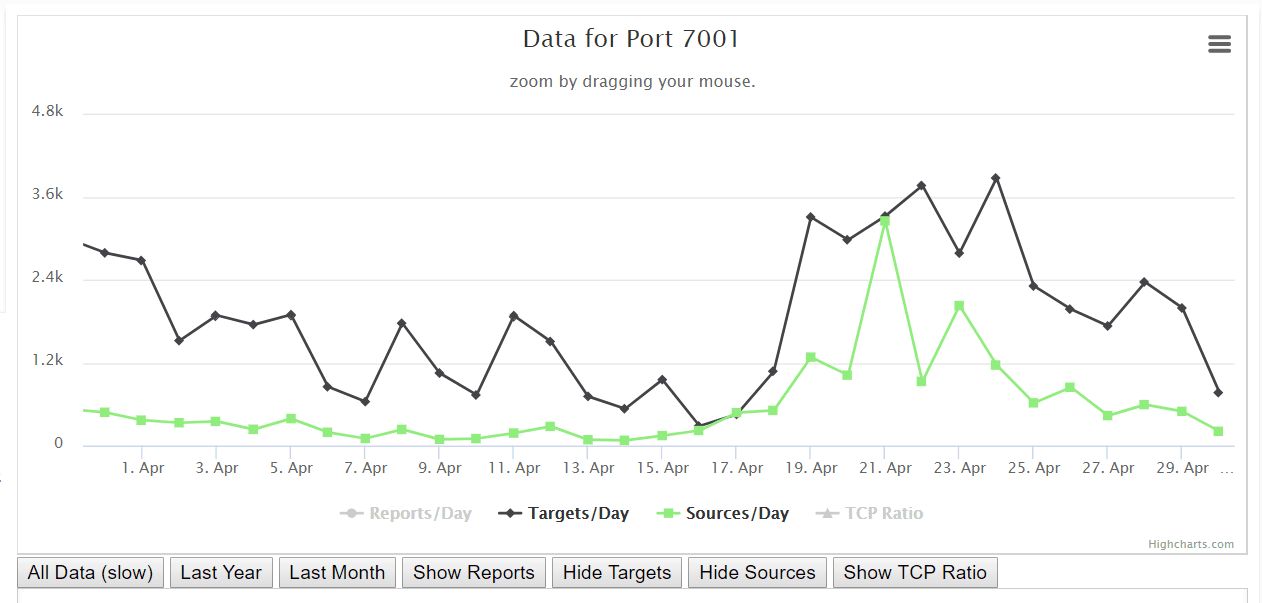
The availability of the PoC code caused a spike in scans for port 7001 that runs the vulnerable WebLogic T3 service.

In the following graph from SANS Institute shows the spike in Internet scans for port 7001:

CVE-2018-2628 scans

[adrotate banner=”9″] [adrotate banner=”12″]

Pierluigi Paganini

(Security Affairs – CVE-2018-2628 Oracle WebLogic, hacking)

[adrotate banner=”5″]

[adrotate banner=”13″]


