
Security Affairs
Two Barracuda ESG Flaws Could Be Combined for Full Root Access; Patches Released|Cyberattack Hits French Blood Banks as Hackers Target Refrigeration Systems Across Europe|CVE-2026-58868: Critical Android Bug Could Let Attackers Run Remote Code|U.S. CISA adds WordPress flaw to its Known Exploited Vulnerabilities catalog|Binance Hack: How Fake Job Interviews and AI Abuse Led to a $6.34 Billion Attack|Synology Warns of Ransomware Attacks Targeting NAS Devices Running Outdated DSM Versions|Inside XCPE, the botnet that turned 1.3M set-top boxes into proxy servers|NIS2 Makes Board Members Personally Liable for Access Control Decisions|Apple’s spyware notifications reach the Bundestag: what the BSI says to do now|VOLTA, the infostealer that asks an AI which victims are worth the effort|New wave of fridge cyberattacks hits European supermarkets, this time in Belgium, Luxembourg, Sweden and Estonia|Hackers Send Fake Nuclear Threat Alerts to Ukrainian and Russian Citizens|Two Barracuda ESG Flaws Could Be Combined for Full Root Access; Patches Released|Cyberattack Hits French Blood Banks as Hackers Target Refrigeration Systems Across Europe|CVE-2026-58868: Critical Android Bug Could Let Attackers Run Remote Code|U.S. CISA adds WordPress flaw to its Known Exploited Vulnerabilities catalog|Binance Hack: How Fake Job Interviews and AI Abuse Led to a $6.34 Billion Attack|Synology Warns of Ransomware Attacks Targeting NAS Devices Running Outdated DSM Versions|Inside XCPE, the botnet that turned 1.3M set-top boxes into proxy servers|NIS2 Makes Board Members Personally Liable for Access Control Decisions|Apple’s spyware notifications reach the Bundestag: what the BSI says to do now|VOLTA, the infostealer that asks an AI which victims are worth the effort|New wave of fridge cyberattacks hits European supermarkets, this time in Belgium, Luxembourg, Sweden and Estonia|Hackers Send Fake Nuclear Threat Alerts to Ukrainian and Russian Citizens|
Advertisement

Ad Placeholder

Full Width × 90

Breaking News

Zero-day vulnerability in Oracle WebLogic

Security experts are warning of a dangerous zero-day remote code vulnerability that affects the Oracle WebLogic service platform. Oracle WebLogic wls9_async and wls-wsat components are affected by a deserialization remote command execution zero-day vulnerability. This zero-day flaw affects all Weblogic versions, including the latest one, that have the wls9_async_response.war and wls-wsat.war components enabled. Oracle WebLogic Server is a Java EE application […]

Weblogic zeroday 2

Security experts are warning of a dangerous zero-day remote code vulnerability that affects the Oracle WebLogic service platform.


Oracle WebLogic wls9_async and wls-wsat components are affected by a deserialization remote command execution zero-day vulnerability.

This zero-day flaw affects all Weblogic versions, including the latest one, that have the wls9_async_response.war and wls-wsat.war components enabled.

Oracle WebLogic Server is a Java EE application server currently developed by Oracle Corporation, it is used by numerous applications and web enterprise portals based on Java technology. The flaw received the identifier CNVD-C-2019-48814.

An attacker could exploit the vulnerability to remotely execute commands without authorization by sending a specially crafted HTTP request.

Weblogic zeroday

According to the bulletin CNTA-2019-0015 issued by CNCERT/CC, the flaw affects the WebLogic 10.x and WebLogic 12.1.3 versions. The criticality flaw has not yet been addressed by Oracle.

Experts recomments to disable vulnerable modules “wls9_async_response.war” and “wls-wsat.war”, or to inhibit access to URLs “/ _async / * “and” / wls-wsat / * “within Oracle WebLogic installs.

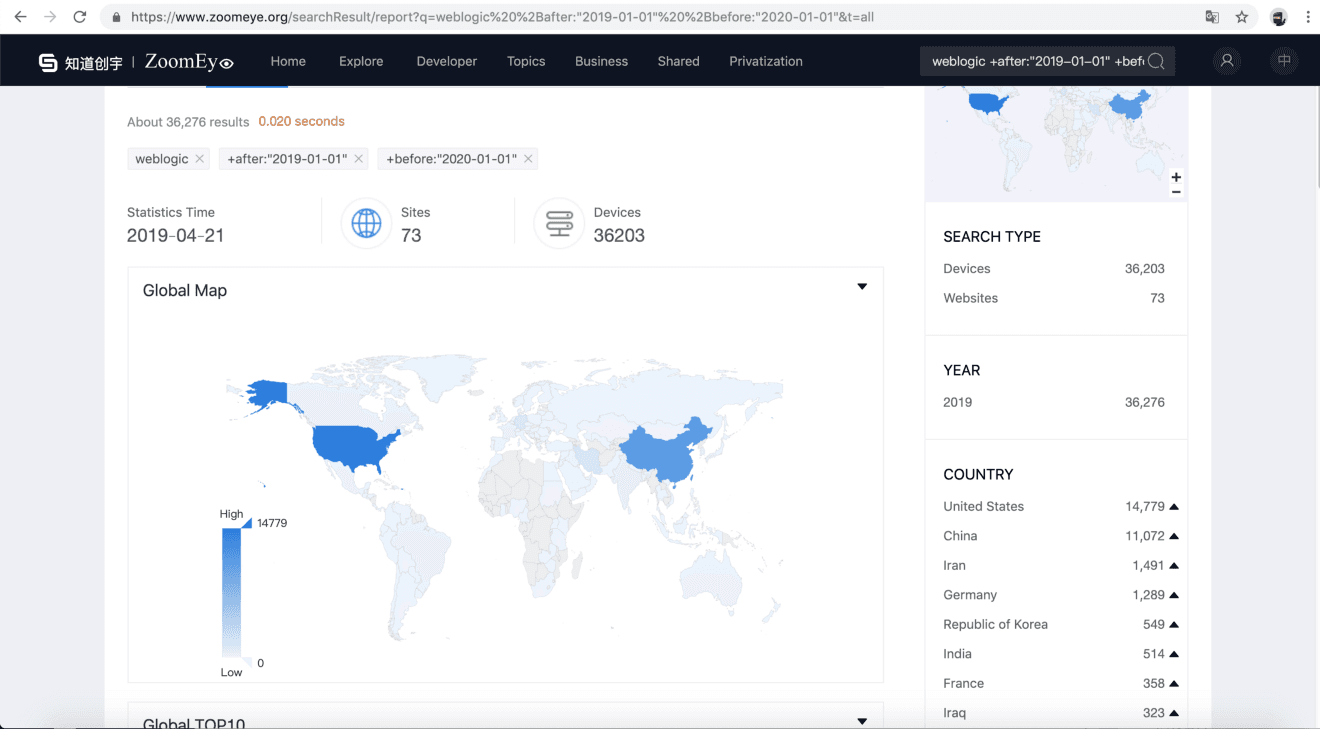
Experts at KnownSec 404 Team searched for vulnerable instances online by using the ZoomEye search engine, they found 36,173 installs, most of them in the US and China.

Weblogic zeroday 2

Experts at F5 Labs revealed to have already spotted a campaign exploiting the zero-day flaw in Weblogic servers.

[adrotate banner=”9″] [adrotate banner=”12″]

Pierluigi Paganini

(SecurityAffairs – Weblogic, zero-day)

[adrotate banner=”5″]

[adrotate banner=”13″]


