
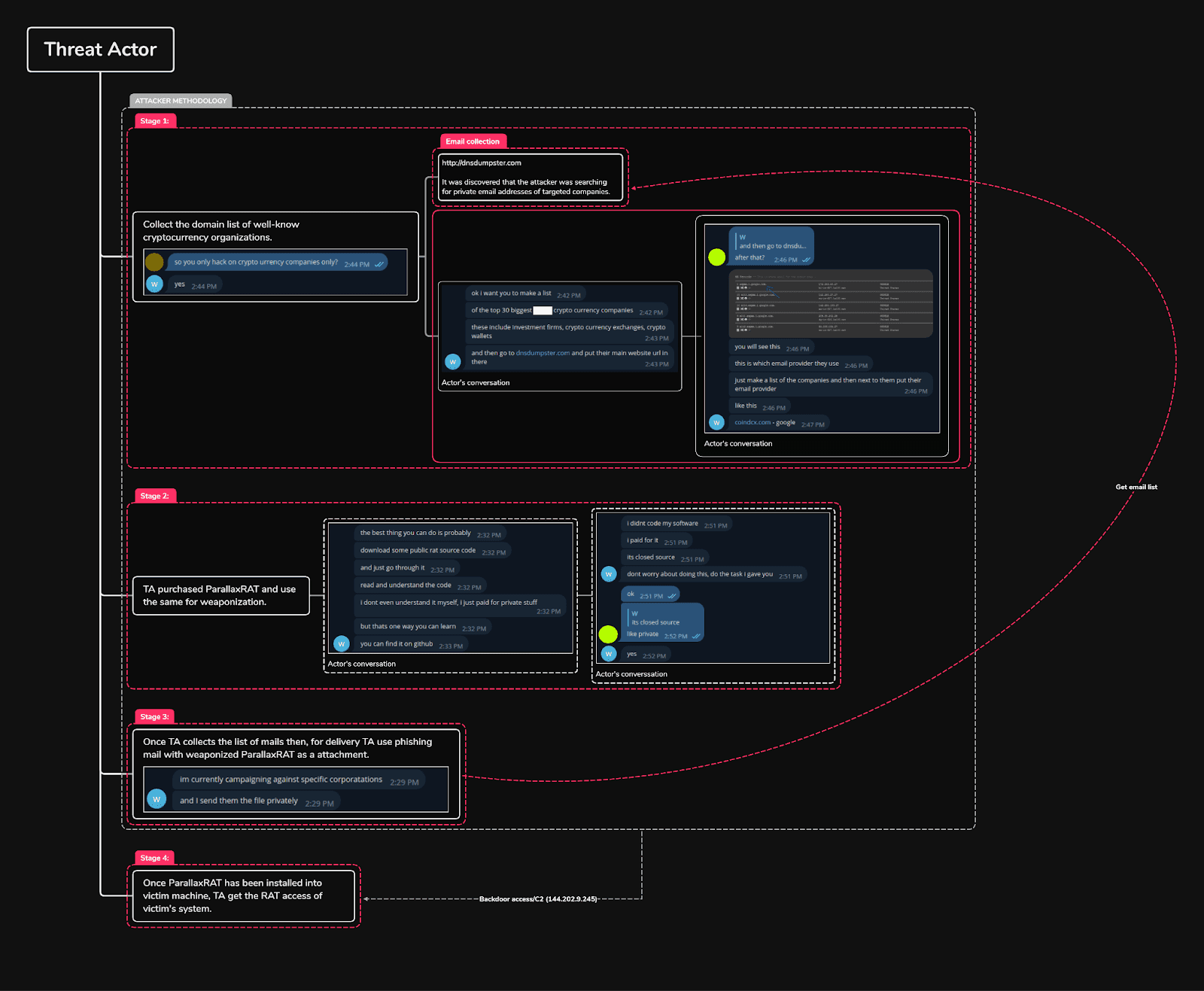
Experts warn of a new wave of attacks against cryptocurrency entities, threat actors are using a RAT dubbed Parallax RAT for Infiltration.
Researchers from cybersecurity firm Uptycs warns of attacks targeting cryptocurrency organizations with the Parallax remote access Trojan (RAT).
Parallax RAT has been distributed through malvertising and phishing campaigns since December 2019. The malware supports common RAT features, such as keylogging, capturing login credentials, accessing files, and remote control of infected systems.
The sample employed in recent attacks uses injection techniques to hide within legitimate processes and avoid detection. Upon successfully injecting the malicious code, threat actors can interact with their victim via Windows Notepad that likely serves as a communication channel.

A first payload analyzed by the experts is written in C++, it is in the form of a 32-bit executable. It uses the process-hollowing technique to inject the RAT into a legitimate Microsoft pipanel.exe process
“It seems to have been intentionally obfuscated by threat actors (TA) wanting to hide something. Its fifth section seems to have been altered and is unusually large compared to the remainder.” reads the analysis published by the experts. “Moreover, this section has been marked with the “Code and Executable” flag, indicating it contains executable code. The TA was able to decrypt its content and use it to create a new binary, which we refer to as payload2 (i.e., Parallax RAT). Payload1 uses a technique known as process-hollowing to inject payload2 into a legitimate Microsoft pipanel.exe process that then gets launched by an attacker.”
The malware achieves persistence by creating a copy of itself in the Windows Startup folder.
The second payload, ParallaxRAT, gathers sensitive information from the infected machines.
Upon successfully infecting the victim’s machine, the malware notifies the attacker. They interact with the victim by posing questions via Notepad and instructing them to connect to a Telegram channel.
The experts noticed that the operators can remotely shut down or restart the victim’s machine.
The content of the Telegram chat analyzed by the researchers revealed that the attackers have an interest in crypto companies.

The attackers gather private email addresses of cryptocurrency companies from the website, they use public service like dnsdumpster.com to find mail servers of the target organizations.
“It’s important for organizations to be aware of this malware’s existence and take necessary precautions to protect systems and data.” concludes the report that also provides Indicators of Compromise (IOCs).
Follow me on Twitter: @securityaffairs and Facebook and Mastodon
(SecurityAffairs – hacking, Parallax RAT)


