
Security Affairs
U.S. Charges Canadian Man in Alleged Hack of University Supercomputers|Two Barracuda ESG Flaws Could Be Combined for Full Root Access; Patches Released|Cyberattack Hits French Blood Banks as Hackers Target Refrigeration Systems Across Europe|CVE-2026-58868: Critical Android Bug Could Let Attackers Run Remote Code|U.S. CISA adds WordPress flaw to its Known Exploited Vulnerabilities catalog|Binance Hack: How Fake Job Interviews and AI Abuse Led to a $6.34 Billion Attack|Synology Warns of Ransomware Attacks Targeting NAS Devices Running Outdated DSM Versions|Inside XCPE, the botnet that turned 1.3M set-top boxes into proxy servers|NIS2 Makes Board Members Personally Liable for Access Control Decisions|Apple’s spyware notifications reach the Bundestag: what the BSI says to do now|VOLTA, the infostealer that asks an AI which victims are worth the effort|New wave of fridge cyberattacks hits European supermarkets, this time in Belgium, Luxembourg, Sweden and Estonia|U.S. Charges Canadian Man in Alleged Hack of University Supercomputers|Two Barracuda ESG Flaws Could Be Combined for Full Root Access; Patches Released|Cyberattack Hits French Blood Banks as Hackers Target Refrigeration Systems Across Europe|CVE-2026-58868: Critical Android Bug Could Let Attackers Run Remote Code|U.S. CISA adds WordPress flaw to its Known Exploited Vulnerabilities catalog|Binance Hack: How Fake Job Interviews and AI Abuse Led to a $6.34 Billion Attack|Synology Warns of Ransomware Attacks Targeting NAS Devices Running Outdated DSM Versions|Inside XCPE, the botnet that turned 1.3M set-top boxes into proxy servers|NIS2 Makes Board Members Personally Liable for Access Control Decisions|Apple’s spyware notifications reach the Bundestag: what the BSI says to do now|VOLTA, the infostealer that asks an AI which victims are worth the effort|New wave of fridge cyberattacks hits European supermarkets, this time in Belgium, Luxembourg, Sweden and Estonia|
Advertisement

Ad Placeholder

Full Width × 90

Breaking News

Payload Ransomware claims the hack of Royal Bahrain Hospital

The Payload Ransomware group claims to have breached the Royal Bahrain Hospital (RBH), a leading healthcare facility in Bahrain. The Payload Ransomware group claims to have hacked the Royal Bahrain Hospital (RBH) and stolen 110 GB of data. The ransomware gang added the healthcare facility to its Tor data leak site and published the images […]

Royal Bahrain Hospital data breach

The Payload Ransomware group claims to have breached the Royal Bahrain Hospital (RBH), a leading healthcare facility in Bahrain.

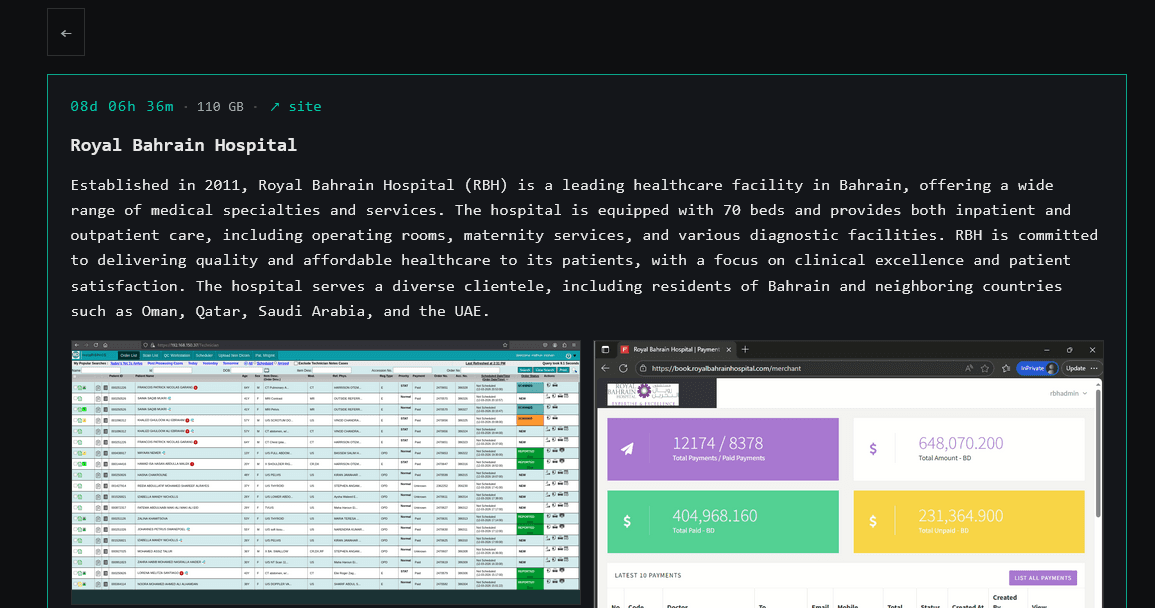
The Payload Ransomware group claims to have hacked the Royal Bahrain Hospital (RBH) and stolen 110 GB of data. The ransomware gang added the healthcare facility to its Tor data leak site and published the images of allegedly hacked systems as proof of the attack.

The group is threatening to release the stolen data if the ransom is not paid by March 23.

Royal Bahrain Hospital, founded in 2011, is a healthcare facility with 70 beds offering inpatient and outpatient services, including surgery, maternity care, and diagnostics. It serves patients from Bahrain and neighboring countries such as Oman, Qatar, Saudi Arabia, and the United Arab Emirates.

Payload ransomware is a relatively new cybercrime operation using a double-extortion model that combines data theft and file encryption to pressure victims. The group has targeted mid- to large-size companies in sectors such as real estate and logistics, mainly in emerging markets. Technically, the ransomware uses ChaCha20 for file encryption and Curve25519 for key exchange, while deleting shadow copies and disabling security tools.

Like many modern crews, Payload likely operates as a ransomware-as-a-service scheme and runs a Tor leak site to publish data from non-paying victims.

Follow me on Twitter: @securityaffairs and Facebook and Mastodon

Pierluigi Paganini

(SecurityAffairs – hacking, Royal Bahrain Hospital data breach)


