
Security Affairs
Two Barracuda ESG Flaws Could Be Combined for Full Root Access; Patches Released|Cyberattack Hits French Blood Banks as Hackers Target Refrigeration Systems Across Europe|CVE-2026-58868: Critical Android Bug Could Let Attackers Run Remote Code|U.S. CISA adds WordPress flaw to its Known Exploited Vulnerabilities catalog|Binance Hack: How Fake Job Interviews and AI Abuse Led to a $6.34 Billion Attack|Synology Warns of Ransomware Attacks Targeting NAS Devices Running Outdated DSM Versions|Inside XCPE, the botnet that turned 1.3M set-top boxes into proxy servers|NIS2 Makes Board Members Personally Liable for Access Control Decisions|Apple’s spyware notifications reach the Bundestag: what the BSI says to do now|VOLTA, the infostealer that asks an AI which victims are worth the effort|New wave of fridge cyberattacks hits European supermarkets, this time in Belgium, Luxembourg, Sweden and Estonia|Hackers Send Fake Nuclear Threat Alerts to Ukrainian and Russian Citizens|Two Barracuda ESG Flaws Could Be Combined for Full Root Access; Patches Released|Cyberattack Hits French Blood Banks as Hackers Target Refrigeration Systems Across Europe|CVE-2026-58868: Critical Android Bug Could Let Attackers Run Remote Code|U.S. CISA adds WordPress flaw to its Known Exploited Vulnerabilities catalog|Binance Hack: How Fake Job Interviews and AI Abuse Led to a $6.34 Billion Attack|Synology Warns of Ransomware Attacks Targeting NAS Devices Running Outdated DSM Versions|Inside XCPE, the botnet that turned 1.3M set-top boxes into proxy servers|NIS2 Makes Board Members Personally Liable for Access Control Decisions|Apple’s spyware notifications reach the Bundestag: what the BSI says to do now|VOLTA, the infostealer that asks an AI which victims are worth the effort|New wave of fridge cyberattacks hits European supermarkets, this time in Belgium, Luxembourg, Sweden and Estonia|Hackers Send Fake Nuclear Threat Alerts to Ukrainian and Russian Citizens|
Advertisement

Ad Placeholder

Full Width × 90

Breaking News

Microsoft warns about ongoing PonyFinal ransomware attacks

Microsoft is warning organizations to deploy protections against a new strain of PonyFinal ransomware that has been in the wild over the past two months. Microsoft’s security team issued a series of tweets warning organizations to deploy protections against a new piece of ransomware dubbed PonyFinal that has been in the wild over the past […]

ponyfinal ransomware

Microsoft is warning organizations to deploy protections against a new strain of PonyFinal ransomware that has been in the wild over the past two months.

Microsoft’s security team issued a series of tweets warning organizations to deploy protections against a new piece of ransomware dubbed PonyFinal that has been in the wild over the past two months.

PonyFinal is Java-based ransomware that is manually distributed by threat actors. The ransomware first appeared in the threat landscape earlier this year and was involved in highly targeted attacks against selected targets, mainly in India, Iran, and the US.

Human-operated ransomware is a technique usually employed in nation-state attacks that is becoming very popular in the cybercrime ecosystem.

In human-operated ransomware attack scenario, attackers use stolen credentials, exploit misconfiguration and vulnerabilities to access target networks, attempt to escalate privileges and move laterally, and deliver malware and exfiltrate data.

Most infamous human-operated ransomware campaigns include Sodinokibi, Samas, Bitpaymer, and Ryuk.

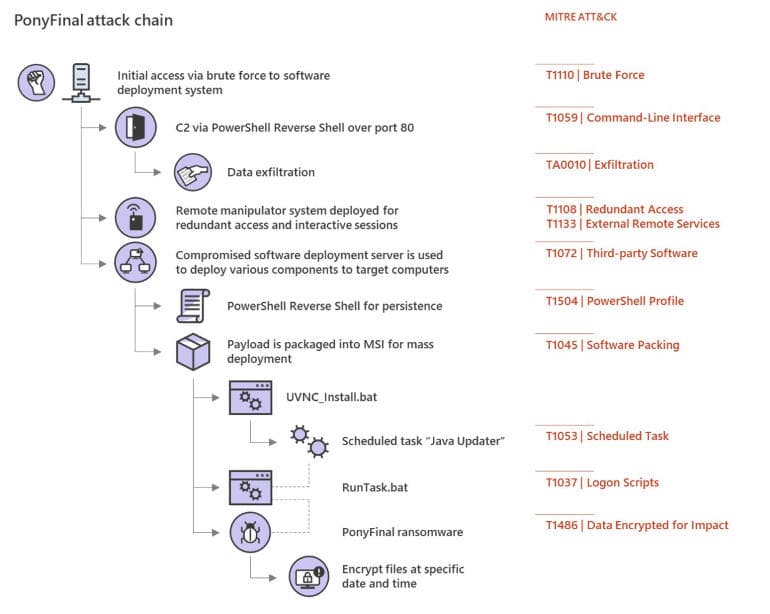
PonyFinal operators initially target organizations’ systems management server via brute force attacks, then they deploy a VBScript to run a PowerShell reverse shell to perform data dumps. Threat actors also use a remote manipulator system to bypass event logging.

Once the PonyFinal attackers gained access to the target’s network, they will move laterally to infect other systems with the ransomware.

In many cases, attackers targeted workstations running the Java Runtime Environment (JRE) because the PonyFinal is written in Java, but is some attacked the gang installed JRE on systems before deploying the ransomware.

The PonyFinal ransomware usually adds the “.enc” extension to the names of the encrypted files, it drops a ransom note (named README_files.txt) on the infected systems. The ransom note contains the payment instructions.

Experts pointed out that the encryption scheme of the PonyFinal ransomware is secure and there is no way at the time to recover encrypted files.

Unfortunately, PonyFinal is one of the several human-operated ransomware that were employed in attacks aimed at the healthcare sector during the COVID-19 pandemic.

Other threat are NetWalker, Maze, REvil, RagnarLocker, and LockBit.

[adrotate banner=”9″][adrotate banner=”12″]

Pierluigi Paganini

(SecurityAffairs – Ponyfinal ransomware, hacking)

[adrotate banner=”5″]

[adrotate banner=”13″]


