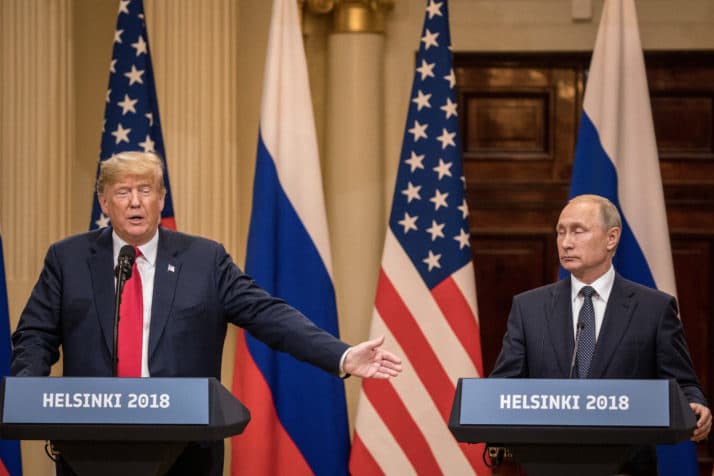
HELSINKI, FINLAND – JULY 16: U.S. President Donald Trump (L) and Russian President Vladimir Putin answer questions about the 2016 U.S Election collusion during a joint press conference after their summit on July 16, 2018 in Helsinki, Finland. The two leaders met one-on-one and discussed a range of issues including the 2016 U.S Election collusion. (Photo by Chris McGrath/Getty Images)
Putin is proposing a new cyber security collaboration with the United States, including a no-hack pact for the upcoming Presidential election.
Russian Government has published a statement by President Vladimir Putin that proposes to the United States a comprehensive program of measures for restoring the Russia – US cooperation in information security.
Russia was accused of interfering in the 2016 US presidential election, in February 2018 the special prosecutor Robert Mueller accused thirteen Russian nationals of tampering with the election and charged them with conspiring against the United States.
The measures proposed by Putin aim at building up a mutual trust between the two Governments, the collaboration will contribute to ensure global peace in the information space.
“One of today’s major strategic challenges is the risk of a large-scale confrontation in the digital field. A special responsibility for its prevention lies on the key players in the field of ensuring international information security (IIS).” reads the statement. “In this regard, we would like to once again address the US with a suggestion to agree on a comprehensive program of practical measures to reboot our relations in the field of security in the use of information and communication technologies (ICTs).”
Putin suggested four actions to set up a prolific collaboration on Information security.
- To restore a regular full-scale bilateral interagency high-level dialogue on the key issues of ensuring IIS.
- To maintain a continuous and effective functioning of the communication channels between competent agencies of our States through Nuclear Risk Reduction Centers, Computer Emergency Readiness Teams and high-level officials in charge of the issues of IIS within the bodies involved in ensuring national security, includig that of information.
- To jointly develop and conclude a bilateral intergovernmental agreement on preventing incidents in the information space similarly to the Soviet-American Agreement on the Prevention of Incidents On and Over the High Seas in force since 25 May 1972.
- To exchange, in a mutually acceptable format, guarantees of non-intervention into internal affairs of each other, including into electoral processes, inter alia, by means of the ICTs and high-tech methods.
Recently, the FBI warned that foreign actors and cybercriminals could spear disinformation aimed at discrediting the electoral process and undermine confidence in U.S. democratic institutions
The proposal of collaboration in information security is not new, the two states already discussed on the topic in 2017.
At the time, Putin and Trump discussed the creation of a joint Cyber Security unit, but the event and the tensions between the two states halted any joint initiative.
| [adrotate banner=”9″] | [adrotate banner=”12″] |
(SecurityAffairs – hacking, Putin)
[adrotate banner=”5″]
[adrotate banner=”13″]