
More than 350,000 open source projects can be potentially affected by a 15-Year-Old unpatched Python vulnerability
More than 350,000 open source projects can be potentially affected by an unpatched Python vulnerability, tracked as CVE-2007-4559 (CVSS score: 6.8), that was discovered 15 years ago.
The issue is a Directory traversal vulnerability that resides in the ‘extract’ and ‘extractall’ functions in the tarfile module in Python. A user-assisted remote attacker can trigger the issue to overwrite arbitrary files via a .. (dot dot) sequence in filenames in a TAR archive, a related issue to CVE-2001-1267.
“While investigating an unrelated vulnerability, Trellix Advanced Research Center stumbled across a vulnerability in Python’s tarfile module. Initially we thought we had found a new zero-day vulnerability. As we dug into the issue, we realized this was in fact CVE-2007-4559.” reads the post published by security firm Trellix.”The vulnerability is a path traversal attack in the extract and extractall functions in the tarfile module that allow an attacker to overwrite arbitrary files by adding the “..” sequence to filenames in a TAR archive.”
The experts pointed out that the issue was underestimated, it initially received a CVSS score of 6.8, however, in most cases an attacker exploit this issue to gain code execution from the file write. Trellix shared a video PoC that shows how to get code execution by exploiting Universal Radio Hacker:
An attacker can exploit the flaw by uploading a specially crafted tarfile that allows escaping the directory that a file is intended to be extracted to and achieve code execution.
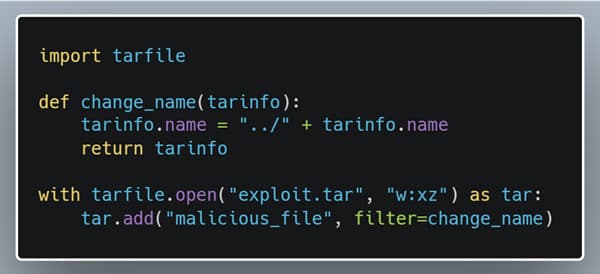
“For an attacker to take advantage of this vulnerability they need to add “..” with the separator for the operating system (“/” or “\”) into the file name to escape the directory the file is supposed to be extracted to. Python’s tarfile module lets us do exactly this:” continues the post.

“The tarfile module lets users add a filter that can be used to parse and modify a file’s metadata before it is added to the tar archive. This enables attackers to create their exploits with as little as the 6 lines of code above.”
The researchers built Creosote, a Python script that recursively looks through directories scanning for .py files and then analyzing them once they have been found. The script is used to automatically check repositories for vulnerability. Creosote provides as output the list of files that may contain vulnerabilities, sorting them into 3 categories based on confidence level (Vulnerable, Probably Vulnerable, Potentially Vulnerable).
Trellix added that the use of the Creosote tool revealed the existence of a vulnerability in the free and open-source scientific environment Spyder Python IDE Polemarch.
“As we have demonstrated above, this vulnerability is incredibly easy to exploit, requiring little to no knowledge about complicated security topics.” concludes the report. “Due to this fact and the prevalence of the vulnerability in the wild, Python’s tarfile module has become a massive supply chain issue threatening infrastructure around the world.”
Follow me on Twitter: @securityaffairs and Facebook
| [adrotate banner=”9″] | [adrotate banner=”12″] |
(SecurityAffairs – hacking, Python)
[adrotate banner=”5″]
[adrotate banner=”13″]


