
Ragnar Locker Ransomware operators have started to run Facebook advertisements to force their victims into paying the ransom.
In November 2019, ransomware operators have started adopting a new double-extortion strategy first used by the Maze gang that sees threat actors also stealing unencrypted files before encrypting infected systems. Then the attackers threaten to release the stolen files if a ransom is not paid.
Ransomware operators are adopting multiple tricks to make pressure on the victims, such as publishing post press releases about their attacks.
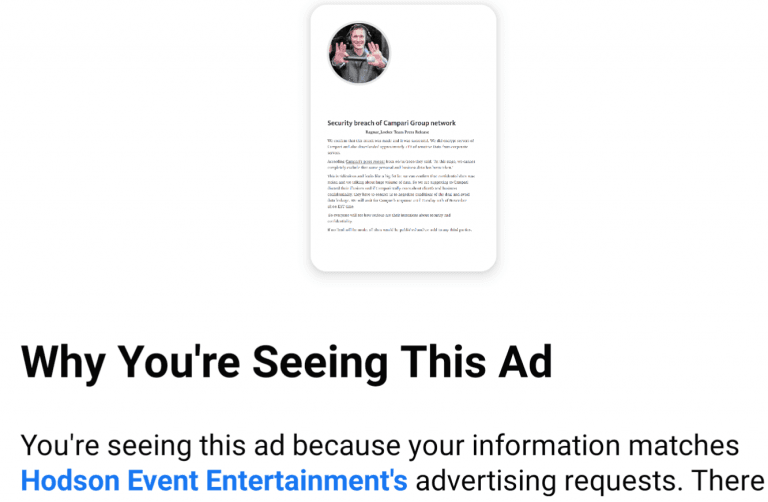
Ragnar Locker Ransomware operators are improving their extortion technique and started running Facebook advertisements to make pressure on their victims and force them to pay the ransom.
Ragnar Locker gangs started hacking into a Facebook advertiser’s account and creating advertisements their hack, this has already happened with the recent attack on the Italian liquor company Campari Group.
Ragnar Locker ransomware gang breached the Campari Group’s network last week and claims to have stolen 2 TB of unencrypted files before encrypting the infected systems. The threat actors demanded a $15 million ransom to provide a decryptor to recover the files.

“Now, one crime group has started using hacked Facebook accounts to run ads publicly pressuring their ransomware victims into paying up.” states the popular investigator Brian Krebs that first reported the news about the new extortion scheme. “The ad was designed to turn the screws to the Italian beverage vendor Campari Group, which acknowledged on Nov. 3 that its computer systems had been sidelined by a malware attack.”
The advertising campaign has begun on the evening of Monday, Nov. 9, on Facebook.

This Facebook advertisement campaign run by the Ragnar ransomware Team was titled “Security breach of Campari Group network,” it warned the victims of further sensitive data would be released.
The owner of the account hacked by the ransomware gang told Brian Krebs that the advertisement was shown to over 7,000 Facebook users before Facebook detected it as a fraudulent campaign.
Chris Hodson told Krebs that the hacked Facebook account belongs to his deejay activity named Hodson Event Entertainment, the attackers had budgeted $500 for this campaign. Hodson said that the fraudulent advertisement was shown to 7,150 Facebook users before Facebook blocked it and generated 770 clicks.
“
“I thought I had two-step verification turned on for all my accounts, but now it looks like the only one I didn’t have it set for was Facebook,” Hodson said.
Hodson said that Facebook billed him $35 for the first part of the campaign, the company, but the social network giant detected the ads as fraudulent just before his account could be billed another $159 for the campaign.
Facebook said the company is still investigating the incident.
The new extortion tactic demonstrates the continuous evolution of the ransomware extortion model, it is easy to prodict further sophisticated schema in the future.
| [adrotate banner=”9″] | [adrotate banner=”12″] |
(SecurityAffairs – hacking, Ragnar Locker ransomware)
[adrotate banner=”5″]
[adrotate banner=”13″]


