
Security Affairs
U.S. Charges Canadian Man in Alleged Hack of University Supercomputers|Two Barracuda ESG Flaws Could Be Combined for Full Root Access; Patches Released|Cyberattack Hits French Blood Banks as Hackers Target Refrigeration Systems Across Europe|CVE-2026-58868: Critical Android Bug Could Let Attackers Run Remote Code|U.S. CISA adds WordPress flaw to its Known Exploited Vulnerabilities catalog|Binance Hack: How Fake Job Interviews and AI Abuse Led to a $6.34 Billion Attack|Synology Warns of Ransomware Attacks Targeting NAS Devices Running Outdated DSM Versions|Inside XCPE, the botnet that turned 1.3M set-top boxes into proxy servers|NIS2 Makes Board Members Personally Liable for Access Control Decisions|Apple’s spyware notifications reach the Bundestag: what the BSI says to do now|VOLTA, the infostealer that asks an AI which victims are worth the effort|New wave of fridge cyberattacks hits European supermarkets, this time in Belgium, Luxembourg, Sweden and Estonia|U.S. Charges Canadian Man in Alleged Hack of University Supercomputers|Two Barracuda ESG Flaws Could Be Combined for Full Root Access; Patches Released|Cyberattack Hits French Blood Banks as Hackers Target Refrigeration Systems Across Europe|CVE-2026-58868: Critical Android Bug Could Let Attackers Run Remote Code|U.S. CISA adds WordPress flaw to its Known Exploited Vulnerabilities catalog|Binance Hack: How Fake Job Interviews and AI Abuse Led to a $6.34 Billion Attack|Synology Warns of Ransomware Attacks Targeting NAS Devices Running Outdated DSM Versions|Inside XCPE, the botnet that turned 1.3M set-top boxes into proxy servers|NIS2 Makes Board Members Personally Liable for Access Control Decisions|Apple’s spyware notifications reach the Bundestag: what the BSI says to do now|VOLTA, the infostealer that asks an AI which victims are worth the effort|New wave of fridge cyberattacks hits European supermarkets, this time in Belgium, Luxembourg, Sweden and Estonia|
Advertisement

Ad Placeholder

Full Width × 90

Breaking News

These are the sources of DDoS attacks against Russia, local NCCC warns

Russian government released a list containing IP addresses and domains behind DDoS attacks that hit Russian infrastructure after the invasion. While the conflict on the battlefield continues, hacktivists continue to target Russian infrastructure exposed online. The Russian National Coordinating Center for Computer Incidents (NCCC) released a massive list containing 17,576 IP addresses and 166 domains that were involved […]

DDoS Russia Ukraine

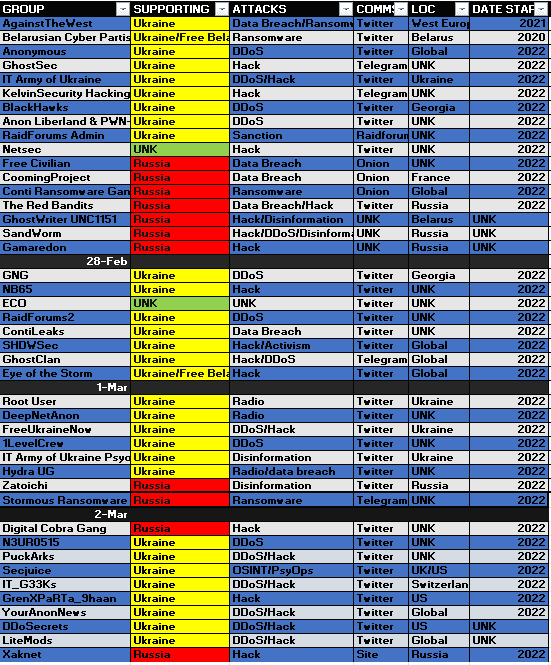
Update 3–2 March cyber group tracker: Ukraine-Russia war 2022. – Source CyberKnown

Russian government released a list containing IP addresses and domains behind DDoS attacks that hit Russian infrastructure after the invasion.

While the conflict on the battlefield continues, hacktivists continue to target Russian infrastructure exposed online. The Russian National Coordinating Center for Computer Incidents (NCCC) released a massive list containing 17,576 IP addresses and 166 domains that were involved in a series of DDoS attacks that targeted its infrastructure.

The list of domains includes the US CIA and FBI, USA Today, and Ukraine’s Korrespondent magazine, along with domains and apps specifically set up to target Russia amid the invasion.

The advisory provides a list of recommendations for Russian organizations, including conducting an inventory of all network devices and services operating in their organization, restricting outside access to them, setting up logging systems, using complex and unique passwords, using Russian DNS servers, watching out phishing attacks, enforcing data backups.

The Russian government fears the consequence of data breaches suffered by its organizations or possible interference by third-party nation state actors that could exploit the ongoing attacks to carry out covet cyber attacks.

The Kremlin also fear the spreading of news related to the conflict on its soil for this reason Twitter and Facebook restricted in Russia amid conflict with Ukraine.

If you are interested in understanding the numerous threat actors that are providing support to both Russia and Ukraine give a look at the following analysis:

https://securityaffairs.co/wordpress/128659/cyber-warfare-2/russia-ukraine-battlefield.html

Follow me on Twitter: @securityaffairs and Facebook

[adrotate banner=”9″][adrotate banner=”12″]

Pierluigi Paganini

(SecurityAffairs – hacking, DDoS)

[adrotate banner=”5″]

[adrotate banner=”13″]


