Security Affairs
Two Barracuda ESG Flaws Could Be Combined for Full Root Access; Patches Released|Cyberattack Hits French Blood Banks as Hackers Target Refrigeration Systems Across Europe|CVE-2026-58868: Critical Android Bug Could Let Attackers Run Remote Code|U.S. CISA adds WordPress flaw to its Known Exploited Vulnerabilities catalog|Binance Hack: How Fake Job Interviews and AI Abuse Led to a $6.34 Billion Attack|Synology Warns of Ransomware Attacks Targeting NAS Devices Running Outdated DSM Versions|Inside XCPE, the botnet that turned 1.3M set-top boxes into proxy servers|NIS2 Makes Board Members Personally Liable for Access Control Decisions|Apple’s spyware notifications reach the Bundestag: what the BSI says to do now|VOLTA, the infostealer that asks an AI which victims are worth the effort|New wave of fridge cyberattacks hits European supermarkets, this time in Belgium, Luxembourg, Sweden and Estonia|Hackers Send Fake Nuclear Threat Alerts to Ukrainian and Russian Citizens|Two Barracuda ESG Flaws Could Be Combined for Full Root Access; Patches Released|Cyberattack Hits French Blood Banks as Hackers Target Refrigeration Systems Across Europe|CVE-2026-58868: Critical Android Bug Could Let Attackers Run Remote Code|U.S. CISA adds WordPress flaw to its Known Exploited Vulnerabilities catalog|Binance Hack: How Fake Job Interviews and AI Abuse Led to a $6.34 Billion Attack|Synology Warns of Ransomware Attacks Targeting NAS Devices Running Outdated DSM Versions|Inside XCPE, the botnet that turned 1.3M set-top boxes into proxy servers|NIS2 Makes Board Members Personally Liable for Access Control Decisions|Apple’s spyware notifications reach the Bundestag: what the BSI says to do now|VOLTA, the infostealer that asks an AI which victims are worth the effort|New wave of fridge cyberattacks hits European supermarkets, this time in Belgium, Luxembourg, Sweden and Estonia|Hackers Send Fake Nuclear Threat Alerts to Ukrainian and Russian Citizens|
Advertisement

Ad Placeholder

Full Width × 90

Breaking News

Ryuk Ransomware evolution avoid encrypting Linux folders

Experts spotted a new strain of the Ryuk Ransomware that was developed to avoid encrypting folders commonly seen in *NIX operating systems. Recently the City of New Orleans was the victim of ransomware attack, researchers from the BleepingComputer community revealed that the malware that infected the City’s systems was the Ryuk Ransomware. The experts found on […]

ryuk ransomware avoid-unix-folders

Experts spotted a new strain of the Ryuk Ransomware that was developed to avoid encrypting folders commonly seen in *NIX operating systems.

Recently the City of New Orleans was the victim of ransomware attack, researchers from the BleepingComputer community revealed that the malware that infected the City’s systems was the Ryuk Ransomware. The experts found on the infected systems an executable named v2.exe.

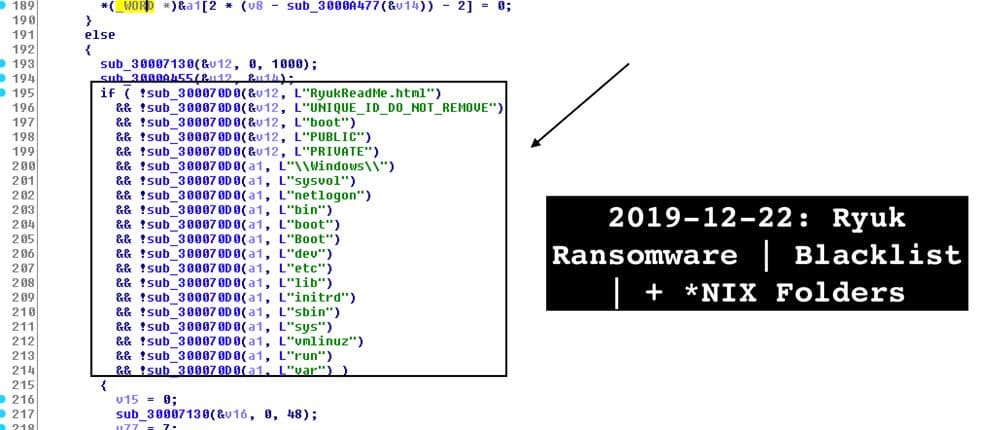
The popular malware researcher Vitali Kremez that analyzed the sample involved in the attack discovered a new feature implemented in this new variant of malware. Kremez noticed that the ransomware doesn’t encrypt folders that are associated with *NIX operating systems.

The researcher noticed that this variant of the Ryuk ransomware doesn’t encrypt files in the following *NIX folders:

bin
boot
Boot
dev
etc
lib
initrd
sbin
sys
vmlinuz
run
var

“At first glance, it seems strange that a Windows malware would blacklist *NIX folders when encrypting files.” reported BleepingComputer.

“A Linux/Unix variant of Ryuk does not exist”

Experts pointed out that known variants of the Ryuk ransomware only targets Windows systems, anyway, Windows 10 implements the Windows Subsystem for Linux (WSL) feature that allows users to install various Linux distributions directly in Windows. The installs utilize folders with the same blacklisted names and likely attackers were not interested in encrypting the *NIX system folders used by WSL to avoid impacting the functionality of the operating system. Don’t forget that the main goal of ransomware is encrypting data without impacting the underlying operating system.

[adrotate banner=”9″] [adrotate banner=”12″]

Pierluigi Paganini

(SecurityAffairs – Ryuk ransomware, malware)

[adrotate banner=”5″]

[adrotate banner=”13″]