
Security Affairs
Two Barracuda ESG Flaws Could Be Combined for Full Root Access; Patches Released|Cyberattack Hits French Blood Banks as Hackers Target Refrigeration Systems Across Europe|CVE-2026-58868: Critical Android Bug Could Let Attackers Run Remote Code|U.S. CISA adds WordPress flaw to its Known Exploited Vulnerabilities catalog|Binance Hack: How Fake Job Interviews and AI Abuse Led to a $6.34 Billion Attack|Synology Warns of Ransomware Attacks Targeting NAS Devices Running Outdated DSM Versions|Inside XCPE, the botnet that turned 1.3M set-top boxes into proxy servers|NIS2 Makes Board Members Personally Liable for Access Control Decisions|Apple’s spyware notifications reach the Bundestag: what the BSI says to do now|VOLTA, the infostealer that asks an AI which victims are worth the effort|New wave of fridge cyberattacks hits European supermarkets, this time in Belgium, Luxembourg, Sweden and Estonia|Hackers Send Fake Nuclear Threat Alerts to Ukrainian and Russian Citizens|Two Barracuda ESG Flaws Could Be Combined for Full Root Access; Patches Released|Cyberattack Hits French Blood Banks as Hackers Target Refrigeration Systems Across Europe|CVE-2026-58868: Critical Android Bug Could Let Attackers Run Remote Code|U.S. CISA adds WordPress flaw to its Known Exploited Vulnerabilities catalog|Binance Hack: How Fake Job Interviews and AI Abuse Led to a $6.34 Billion Attack|Synology Warns of Ransomware Attacks Targeting NAS Devices Running Outdated DSM Versions|Inside XCPE, the botnet that turned 1.3M set-top boxes into proxy servers|NIS2 Makes Board Members Personally Liable for Access Control Decisions|Apple’s spyware notifications reach the Bundestag: what the BSI says to do now|VOLTA, the infostealer that asks an AI which victims are worth the effort|New wave of fridge cyberattacks hits European supermarkets, this time in Belgium, Luxembourg, Sweden and Estonia|Hackers Send Fake Nuclear Threat Alerts to Ukrainian and Russian Citizens|
Advertisement

Ad Placeholder

Full Width × 90

Breaking News

Safe Browsing, Gmail will warn of emails from unauthenticated senders

Google announced a new feature in the Safe Browsing warning set, it will warn users when they will receive an email message from an unauthenticated sender. Google always takes care of security, the last features announced by the IT giant will warn Gmail users when they receive an email message from an unauthenticated sender. Google […]

Safe Browsing, Gmail will warn of emails from unauthenticated senders

Google announced a new feature in the Safe Browsing warning set, it will warn users when they will receive an email message from an unauthenticated sender.

Google always takes care of security, the last features announced by the IT giant will warn Gmail users when they receive an email message from an unauthenticated sender.

Google announces several new warnings that will be displayed when users will receive messages containing potentially dangerous links.

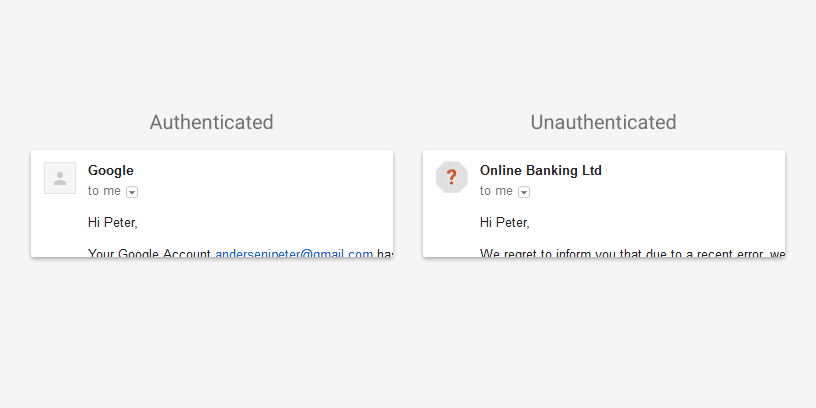
Starting this week Gmail users that access the service through their browser or via an Android device will display a question mark over a sender’s profile photo or user logo if the service cannot authenticate the sender with Sender Policy Framework (SPF) or DKIM.

Safe Browsing Gmail unauthenticated user warning

“On the web, if you receive a message with a link to a dangerous site known for phishing, malware, and Unwanted Software, you’ll begin to see warnings when you click on the link. These warnings are an extension of the Safe Browsing protection available to various web browsers today.” states the announcement published by Google.

Safe Browsing Safer Links in Gmail warning

Google clarified that “Not all affected email will necessarily be dangerous,” anyway it is important for a proper security posture to be extra careful about interacting with emails from unauthenticated sources.

Google is spending significant efforts against threat online like malware and phishing, and the IT giants also worked hard to protect its user’s privacy through the adoption of encryption.

In March, Google improved the Safe Browsing notification messages using a full-page warning related to state-sponsored hacking.

“Safe Browsing already protects Gmail users by identifying potentially dangerous links in messages. Starting this week, Gmail users will begin to see warnings if they click these links, further extending this protection to different web browsers and email apps. ” States the security advisory published by Google.

Back to the last security improvement announced by Google, the company plans to release it in a couple of weeks. The gradual rollout (potentially longer than 3 days for feature visibility) will impact all Gmail users.

[adrotate banner=”9″]

Pierluigi Paganini

(Security Affairs – Google, Safe Browsing)


