
Security Affairs
U.S. Charges Canadian Man in Alleged Hack of University Supercomputers|Two Barracuda ESG Flaws Could Be Combined for Full Root Access; Patches Released|Cyberattack Hits French Blood Banks as Hackers Target Refrigeration Systems Across Europe|CVE-2026-58868: Critical Android Bug Could Let Attackers Run Remote Code|U.S. CISA adds WordPress flaw to its Known Exploited Vulnerabilities catalog|Binance Hack: How Fake Job Interviews and AI Abuse Led to a $6.34 Billion Attack|Synology Warns of Ransomware Attacks Targeting NAS Devices Running Outdated DSM Versions|Inside XCPE, the botnet that turned 1.3M set-top boxes into proxy servers|NIS2 Makes Board Members Personally Liable for Access Control Decisions|Apple’s spyware notifications reach the Bundestag: what the BSI says to do now|VOLTA, the infostealer that asks an AI which victims are worth the effort|New wave of fridge cyberattacks hits European supermarkets, this time in Belgium, Luxembourg, Sweden and Estonia|U.S. Charges Canadian Man in Alleged Hack of University Supercomputers|Two Barracuda ESG Flaws Could Be Combined for Full Root Access; Patches Released|Cyberattack Hits French Blood Banks as Hackers Target Refrigeration Systems Across Europe|CVE-2026-58868: Critical Android Bug Could Let Attackers Run Remote Code|U.S. CISA adds WordPress flaw to its Known Exploited Vulnerabilities catalog|Binance Hack: How Fake Job Interviews and AI Abuse Led to a $6.34 Billion Attack|Synology Warns of Ransomware Attacks Targeting NAS Devices Running Outdated DSM Versions|Inside XCPE, the botnet that turned 1.3M set-top boxes into proxy servers|NIS2 Makes Board Members Personally Liable for Access Control Decisions|Apple’s spyware notifications reach the Bundestag: what the BSI says to do now|VOLTA, the infostealer that asks an AI which victims are worth the effort|New wave of fridge cyberattacks hits European supermarkets, this time in Belgium, Luxembourg, Sweden and Estonia|
Advertisement

Ad Placeholder

Full Width × 90

Breaking News

Researchers spotted a new malware in the wild, the Saturn Ransomware

Researchers at the MalwareHunterTeam spotted a new strain of ransomware called Saturn Ransomware, the name derives from the .saturn extension it appends to the name of the encrypted files. Currently, the malware requests victims of $300 USD payment that doubles after 7 days. Once infected a system, the Saturn Ransomware checks if it is running in a […]

Researchers spotted a new malware in the wild, the Saturn Ransomware

Researchers at the MalwareHunterTeam spotted a new strain of ransomware called Saturn Ransomware, the name derives from the .saturn extension it appends to the name of the encrypted files.

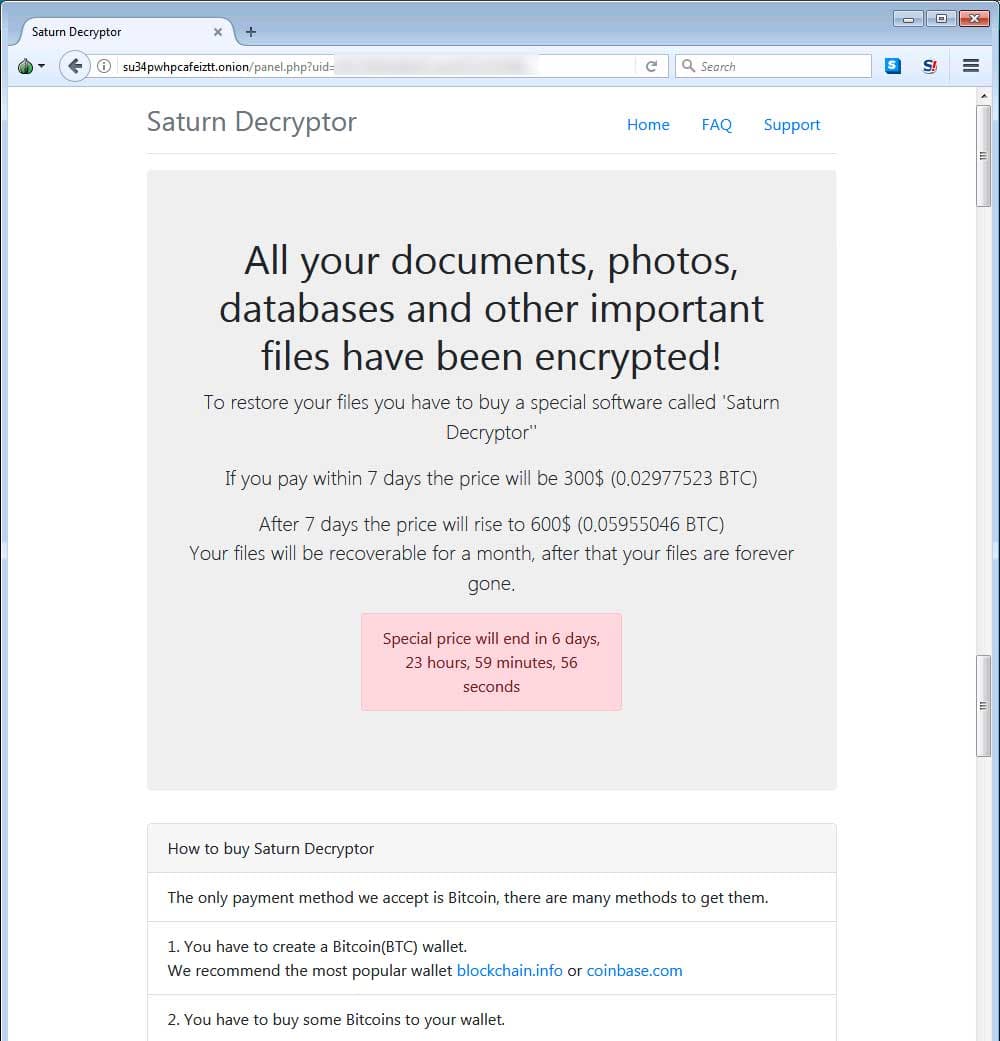
Currently, the malware requests victims of $300 USD payment that doubles after 7 days.

Once infected a system, the Saturn Ransomware checks if it is running in a virtual environment and eventually it halts the execution to avoid being analyzed by researchers.

Then it performs a series of actions to make impossible for the victims restoring the encrypted files, it deletes shadow volume copies, disables Windows startup repair, and to clear the Windows backup catalog.

Below the command executed by the malicious code:


At this point, the Saturn ransomware is ready to encrypt files having certain file types.

The ransomware such as many other threats uses a Tor payment site that is reported in the ransom note dropped on the machine while the Saturn ransomware is encrypting the files.

“While encrypting the computer, Saturn Ransomware will drop ransom notes named #DECRYPT_MY_FILES#.html and #DECRYPT_MY_FILES#.txt and a key file named #KEY-[id].KEY in each folder that it encrypts a file. The key file is used to login to the TOR ransom site, while the ransom note contains brief information on what has happened to the victims files and a link to the TOR payment site at su34pwhpcafeiztt.onion.” wrote Larwrence Abrams from Bleeping Computer.

Saturn Ransomware

File encrypted by the Saturn Ransomware (Source Bleeping computer)

The Saturn ransomware also drops a #DECRYPT_MY_FILES#.vbs triggers an audio message to the victims, and it sets your Windows desktop background to  #DECRYPT_MY_FILES.BMP.

The authentication to TOR site is made by uploading the key file, then users will display the Saturn Decryptor page for the victim that includes detailed instructions.

Researchers are still analyzing the Saturn ransomware, even if it is being actively distributed, it is still unclear what distribution vector threat actors are using to spread it.

Further information, including the Indicators of compromise (IoCs), are available in the blog post published by Bleeping Computer.

[adrotate banner=”9″] [adrotate banner=”12″]

Pierluigi Paganini

(Security Affairs – Saturn, cybercrime)

[adrotate banner=”5″]

[adrotate banner=”13″]


