
Security Affairs
Two Barracuda ESG Flaws Could Be Combined for Full Root Access; Patches Released|Cyberattack Hits French Blood Banks as Hackers Target Refrigeration Systems Across Europe|CVE-2026-58868: Critical Android Bug Could Let Attackers Run Remote Code|U.S. CISA adds WordPress flaw to its Known Exploited Vulnerabilities catalog|Binance Hack: How Fake Job Interviews and AI Abuse Led to a $6.34 Billion Attack|Synology Warns of Ransomware Attacks Targeting NAS Devices Running Outdated DSM Versions|Inside XCPE, the botnet that turned 1.3M set-top boxes into proxy servers|NIS2 Makes Board Members Personally Liable for Access Control Decisions|Apple’s spyware notifications reach the Bundestag: what the BSI says to do now|VOLTA, the infostealer that asks an AI which victims are worth the effort|New wave of fridge cyberattacks hits European supermarkets, this time in Belgium, Luxembourg, Sweden and Estonia|Hackers Send Fake Nuclear Threat Alerts to Ukrainian and Russian Citizens|Two Barracuda ESG Flaws Could Be Combined for Full Root Access; Patches Released|Cyberattack Hits French Blood Banks as Hackers Target Refrigeration Systems Across Europe|CVE-2026-58868: Critical Android Bug Could Let Attackers Run Remote Code|U.S. CISA adds WordPress flaw to its Known Exploited Vulnerabilities catalog|Binance Hack: How Fake Job Interviews and AI Abuse Led to a $6.34 Billion Attack|Synology Warns of Ransomware Attacks Targeting NAS Devices Running Outdated DSM Versions|Inside XCPE, the botnet that turned 1.3M set-top boxes into proxy servers|NIS2 Makes Board Members Personally Liable for Access Control Decisions|Apple’s spyware notifications reach the Bundestag: what the BSI says to do now|VOLTA, the infostealer that asks an AI which victims are worth the effort|New wave of fridge cyberattacks hits European supermarkets, this time in Belgium, Luxembourg, Sweden and Estonia|Hackers Send Fake Nuclear Threat Alerts to Ukrainian and Russian Citizens|
Advertisement

Ad Placeholder

Full Width × 90

Breaking News

Senegal shuts National ID office after ransomware attack

Senegal closed its national ID card office after a ransomware cyberattack disrupted ID, passport, and biometric services. Senegal confirmed a cyberattack on the Directorate of File Automation, the government office that manages national ID cards, passports, and biometric data. After ransomware claims surfaced, authorities temporarily closed the office to contain the incident. The agency warned […]

Senegal data breach

Senegal closed its national ID card office after a ransomware cyberattack disrupted ID, passport, and biometric services.

Senegal confirmed a cyberattack on the Directorate of File Automation, the government office that manages national ID cards, passports, and biometric data. After ransomware claims surfaced, authorities temporarily closed the office to contain the incident. The agency warned the country’s 19.5 million residents that operations were suspended while officials assessed the impact and worked to restore services securely.

The authorities sought to reassure citizens, stating that the incident did not affect the integrity of their data.

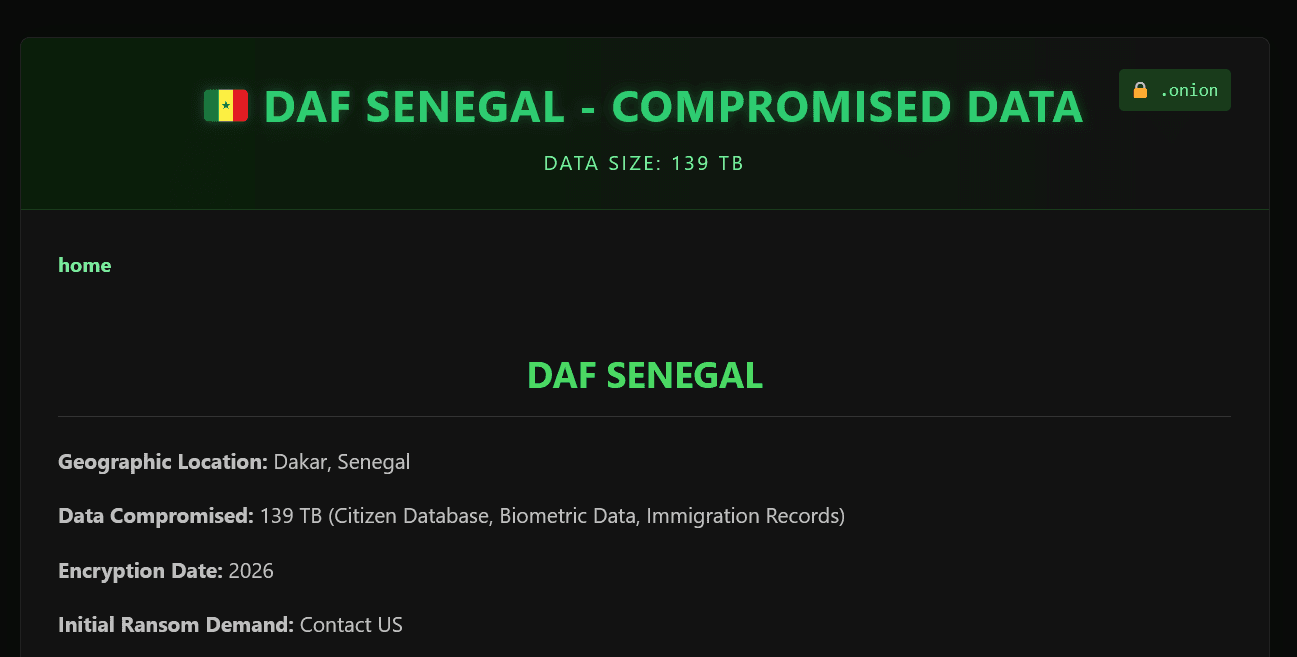
A new ransomware group called Green Blood Group claimed it breached the agency and stole 139 GB of data, including citizen records, biometric information, and immigration documents.

The group published a list of documents & backup files as proof of the hack.

Hackers leaked data and an email from Quik Saw Choo, senior GM at Malaysia’s IRIS Corporation, which is helping create Senegal’s digital ID cards. In the Jan 20 email, Choo told Senegalese officials that hackers breached two DAF servers on Jan 19, stealing card personalization data from one. IRIS cut network access to one server, changed passwords on the other, and blocked foreign mission connections. Choo said Malaysian cybersecurity experts were assisting and planned to travel to Dakar on Jan 22 to investigate and fix the issue.

“The cyberattack comes amid an ongoing standoff between the Senegalese state and Iris Corporation, the Malaysian firm awarded the contract to produce the country’s digital National Identification Cards (CNI). The dispute centers on unpaid invoices. According to sources, once the breach was detected, Iris Corporation requested that DAF shut down all systems while it prepared to dispatch its technical team to Dakar.” reported the Gambia Journal.

“That request has raised questions about a possible link between the commercial dispute and the cyberattack, although no official confirmation has been made. Authorities have so far not publicly attributed responsibility or detailed the scope of any data compromise.”

Follow me on Twitter: @securityaffairs and Facebook and Mastodon

Pierluigi Paganini

(SecurityAffairs – hacking, Senegal)


