
Security Affairs
Two Barracuda ESG Flaws Could Be Combined for Full Root Access; Patches Released|Cyberattack Hits French Blood Banks as Hackers Target Refrigeration Systems Across Europe|CVE-2026-58868: Critical Android Bug Could Let Attackers Run Remote Code|U.S. CISA adds WordPress flaw to its Known Exploited Vulnerabilities catalog|Binance Hack: How Fake Job Interviews and AI Abuse Led to a $6.34 Billion Attack|Synology Warns of Ransomware Attacks Targeting NAS Devices Running Outdated DSM Versions|Inside XCPE, the botnet that turned 1.3M set-top boxes into proxy servers|NIS2 Makes Board Members Personally Liable for Access Control Decisions|Apple’s spyware notifications reach the Bundestag: what the BSI says to do now|VOLTA, the infostealer that asks an AI which victims are worth the effort|New wave of fridge cyberattacks hits European supermarkets, this time in Belgium, Luxembourg, Sweden and Estonia|Hackers Send Fake Nuclear Threat Alerts to Ukrainian and Russian Citizens|Two Barracuda ESG Flaws Could Be Combined for Full Root Access; Patches Released|Cyberattack Hits French Blood Banks as Hackers Target Refrigeration Systems Across Europe|CVE-2026-58868: Critical Android Bug Could Let Attackers Run Remote Code|U.S. CISA adds WordPress flaw to its Known Exploited Vulnerabilities catalog|Binance Hack: How Fake Job Interviews and AI Abuse Led to a $6.34 Billion Attack|Synology Warns of Ransomware Attacks Targeting NAS Devices Running Outdated DSM Versions|Inside XCPE, the botnet that turned 1.3M set-top boxes into proxy servers|NIS2 Makes Board Members Personally Liable for Access Control Decisions|Apple’s spyware notifications reach the Bundestag: what the BSI says to do now|VOLTA, the infostealer that asks an AI which victims are worth the effort|New wave of fridge cyberattacks hits European supermarkets, this time in Belgium, Luxembourg, Sweden and Estonia|Hackers Send Fake Nuclear Threat Alerts to Ukrainian and Russian Citizens|
Advertisement

Ad Placeholder

Full Width × 90

Breaking News

Cyber spies of the Sofacy APT increased its operations tenfold

According to a new report published by the Kaspersky Lab, the Sofacy APT has recently increased its activities. According to a new report published by the Kaspersky Lab, the Advanced persistent threat group Sofacy (also known as APT28 , Fancy Bear, Sednit, and STRONTIUM) has increased its activity. The Sofacy group has been active since 2008, targeting mostly military […]

Cyber spies of the Sofacy APT increased its operations tenfold

According to a new report published by the Kaspersky Lab, the Sofacy APT has recently increased its activities.

According to a new report published by the Kaspersky Lab, the Advanced persistent threat group Sofacy (also known as APT28 , Fancy Bear, Sednit, and STRONTIUM) has increased its activity.

The Sofacy group has been active since 2008, targeting mostly military and government entities in NATO countries, the experts speculate that its is a nation-state actor.

The experts speculate that the Sofacy has increased its operations tenfold by targeting high-profile entities by using a new set of hacking tools.

In the last months, the researchers have uncovered a series of attacks, relying on a new set of tools and zero-day exploits, and targeting defense-related targets with specific focus with the Ukraine.

“In the months leading up to August, the Sofacy group launched several waves of attacks relying on zero-day exploits in Microsoft Office, Oracle Sun Java, Adobe Flash Player and Windows itself. For instance, its JHUHUGIT implant was delivered through a Flash zero-day and used a Windows EoP exploit to break out of the sandbox. ” state a blog post published by Kaspersky Lab.
sofacy eng_1

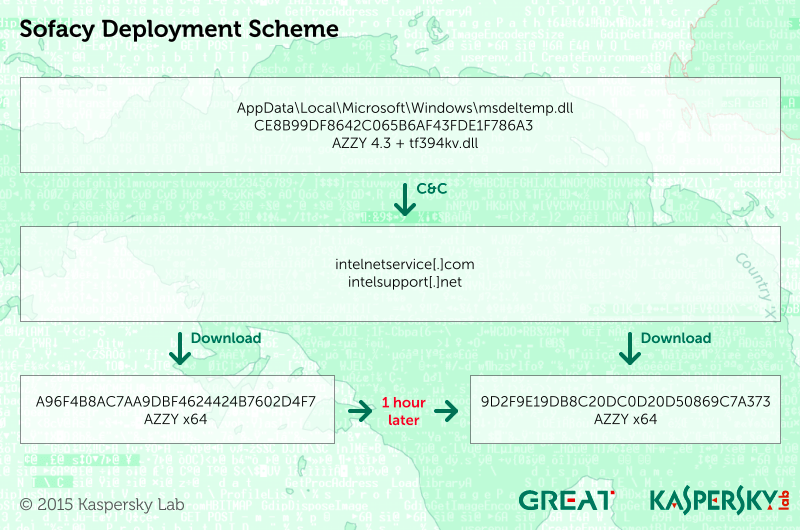
The experts spotted a rare modification of the AZZY backdoor used by the threat actors for reconnaissance purposes. The first versions of the AZZY backdoor were discovered in August, once the attackers compromise the target they use more backdoor for lateral movements.

“The attackers deploy a rare modification of the AZZY backdoor, which is used for the initial reconnaissance. Once a foothold is established, they try to upload more backdoors, USB stealers as well as other hacking tools such as “Mimikatz” for lateral movement,” continues the post.

Kurt Baumgartner, principal security researcher at Kaspersky Lab, explained that the Sofacy APT group is very technically capable, it is able to design new hacking tools depending on the specific target.

“This quick work is a new characteristic of their work, and this stepped up urgency is something that is unusual. In general, APT intrusions can last months or longer, and in these cases, we see Sofacy acting with unusually ramped urgency,” Baumgartner said.

We will continue to follow the operations of the Sofacy APT group, stay tuned …

[adrotate banner=”9″] [adrotate banner=”12″]

Pierluigi Paganini

(Security Affairs – Sofacy APT, cyberespionage)

[adrotate banner=”5″]

[adrotate banner=”13″]


