

CISA revealed that threat actors behind the SolarWinds hack also used password guessing and password spraying in its attacks.
Cybersecurity and Infrastructure Security Agency (CISA) revealed that threat actors behind the SolarWinds supply chain attack also employed common hacker techniques to compromise the networks of the targeted organizations, including password guessing and password spraying.
“Frequently, CISA has observed the APT actor gaining Initial Access [TA0001] to victims’ enterprise networks via compromised SolarWinds Orion products (e.g., Solorigate, Sunburst).[1]” reads the CISA’s alert. “However, CISA is investigating instances in which the threat actor may have obtained initial access by Password Guessing [T1110.001], Password Spraying [T1110.003], and/or exploiting inappropriately secured administrative or service credentials (Unsecured Credentials [T1552]) instead of utilizing the compromised SolarWinds Orion products.”
CISA also added that inappropriately secured administrative credentials accessible via external remote access services were abused by thet attackers.
The alert issued on January 6, highlights that it does not supersede the requirements of ED 21-01 or any supplemental guidance and does not represent formal guidance to federal agencies under ED 21-01.
CISA added that it is investigating incidents in which threat actors abused the Security Assertion Markup Language (SAML) tokens.
Experts from CISA observed threat actors escalating privilege within a compromised network and using native Windows tools and techniques, such as Windows Management Instrumentation (WMI), to enumerate the Microsoft Active Directory Federated Services (ADFS) certificate-signing capability. Then the attackers used to forge authentication tokens (OAuth) to issue claims to service providers and then attempt to access the Microsoft Cloud environments.
At the end of December, the Microsoft 365 Defender Team revealed that the goal of the threat actors behind the SolarWinds supply chain attack was to move to the victims’ cloud infrastructure once infected their network with the Sunburst/Solorigate backdoor.
In a report published on December 28, Microsoft said the threat actor’s primary goal was to gain access to cloud-hosted infrastructure, which in many cases was the company’s own Azure and Microsoft 365 environments.
To help victims deal with these “to-cloud” escalations, CISA has also published a second advisory today with guidance on how to search Microsoft-based cloud setups for traces of this group’s activity and then remediate servers.
Once deployed the backdoor, threat actors used it to steal credentials, escalate privileges, and make lateral movement within the target network to gain the ability to create valid SAML tokens. Microsoft experts reported that attackers created valid SAML tokens by stealing the SAML signing certificate or by adding or modifying existing federation trust.
Then the attackers created SAML tokens to access cloud resources and exfiltrate emails and sensitive data.
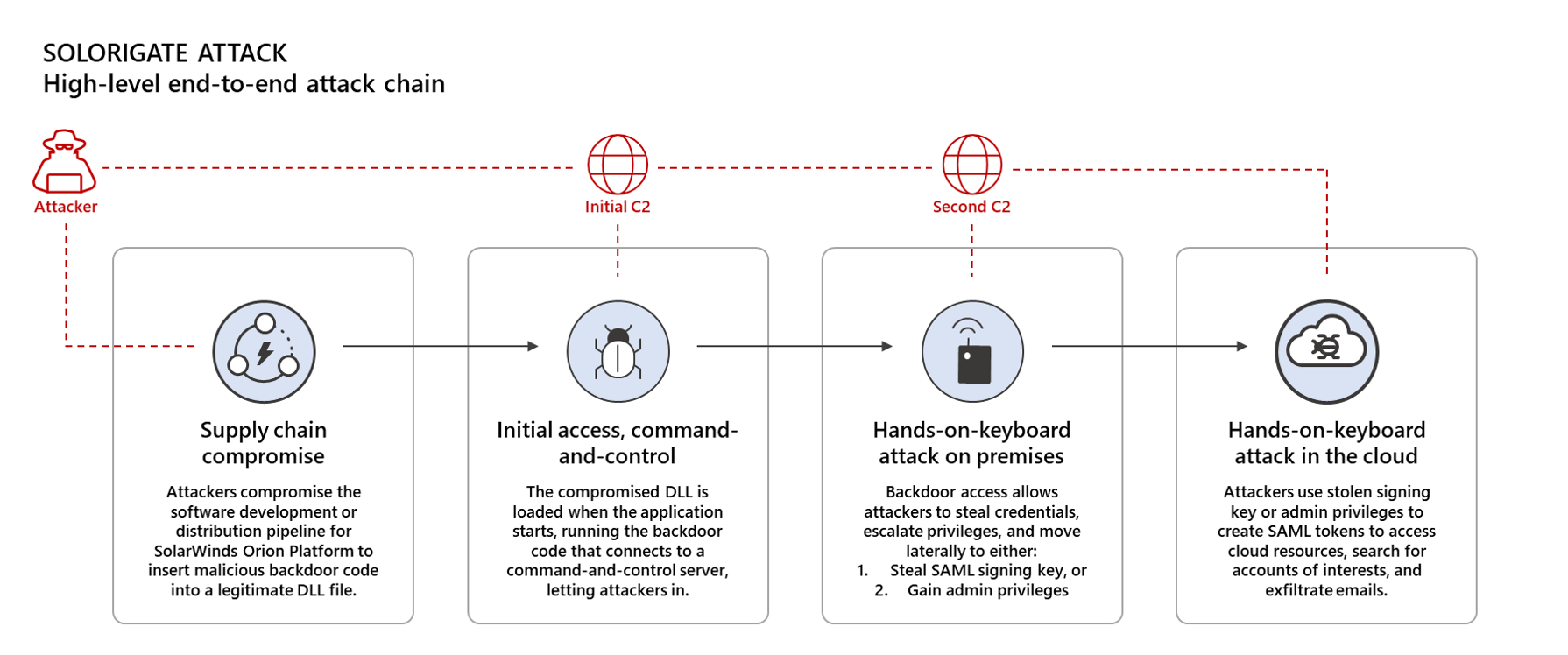
“This attack is an advanced and stealthy campaign with the ability to blend in, which could allow attackers to stay under the radar for long periods of time before being detected.” continues the post.
Recently, both US CISA and cybersecurity firm Crowdstrike released free detection tools to audit Azure and MS 365 environments.
If you want to receive the weekly Security Affairs Newsletter for free subscribe here.
| [adrotate banner=”9″] | [adrotate banner=”12″] |
(SecurityAffairs – hacking, SolarWinds)
[adrotate banner=”5″]
[adrotate banner=”13″]

