
Security Affairs
Two Barracuda ESG Flaws Could Be Combined for Full Root Access; Patches Released|Cyberattack Hits French Blood Banks as Hackers Target Refrigeration Systems Across Europe|CVE-2026-58868: Critical Android Bug Could Let Attackers Run Remote Code|U.S. CISA adds WordPress flaw to its Known Exploited Vulnerabilities catalog|Binance Hack: How Fake Job Interviews and AI Abuse Led to a $6.34 Billion Attack|Synology Warns of Ransomware Attacks Targeting NAS Devices Running Outdated DSM Versions|Inside XCPE, the botnet that turned 1.3M set-top boxes into proxy servers|NIS2 Makes Board Members Personally Liable for Access Control Decisions|Apple’s spyware notifications reach the Bundestag: what the BSI says to do now|VOLTA, the infostealer that asks an AI which victims are worth the effort|New wave of fridge cyberattacks hits European supermarkets, this time in Belgium, Luxembourg, Sweden and Estonia|Hackers Send Fake Nuclear Threat Alerts to Ukrainian and Russian Citizens|Two Barracuda ESG Flaws Could Be Combined for Full Root Access; Patches Released|Cyberattack Hits French Blood Banks as Hackers Target Refrigeration Systems Across Europe|CVE-2026-58868: Critical Android Bug Could Let Attackers Run Remote Code|U.S. CISA adds WordPress flaw to its Known Exploited Vulnerabilities catalog|Binance Hack: How Fake Job Interviews and AI Abuse Led to a $6.34 Billion Attack|Synology Warns of Ransomware Attacks Targeting NAS Devices Running Outdated DSM Versions|Inside XCPE, the botnet that turned 1.3M set-top boxes into proxy servers|NIS2 Makes Board Members Personally Liable for Access Control Decisions|Apple’s spyware notifications reach the Bundestag: what the BSI says to do now|VOLTA, the infostealer that asks an AI which victims are worth the effort|New wave of fridge cyberattacks hits European supermarkets, this time in Belgium, Luxembourg, Sweden and Estonia|Hackers Send Fake Nuclear Threat Alerts to Ukrainian and Russian Citizens|
Advertisement

Ad Placeholder

Full Width × 90

Breaking News

TeaBot Android banking Trojan targets banks in Europe

Malware researchers from Cleafy warn of a new Android banking trojan dubbed TeaBot (aka Anatsa) that is targeting banks in Europe. Malware experts from the Italian cybersecurity firm Cleafy have spotted a new Android banking trojan dubbed TeaBot (aka Anatsa) that is targeting banks in Spain, Germany, Italy, Belgium, and the Netherlands. TeaBot malware appeared […]

TeaBot

Malware researchers from Cleafy warn of a new Android banking trojan dubbed TeaBot (aka Anatsa) that is targeting banks in Europe.

Malware experts from the Italian cybersecurity firm Cleafy have spotted a new Android banking trojan dubbed TeaBot (aka Anatsa) that is targeting banks in Spain, Germany, Italy, Belgium, and the Netherlands.

TeaBot malware appeared in the threat landscape at the beginning of January 2021, it is still under development and according to the researchers, it is able to hijack users’ credentials and SMS messages.

The researchers detected on 29th March 2021, for the first time the inclusion of injections against Italian
banks, and in May the malware targeted Belgium and Netherlands banks.

TeaBot supports the main features of Android banking Trojan and like other similar malware families it abuses
Accessibility Services. Below a list of features implemented by the malware:

  • Ability to perform Overlay Attacks against multiple banks applications to steal login
    credentials and credit card information
  • Ability to send / intercept / hide SMS messages
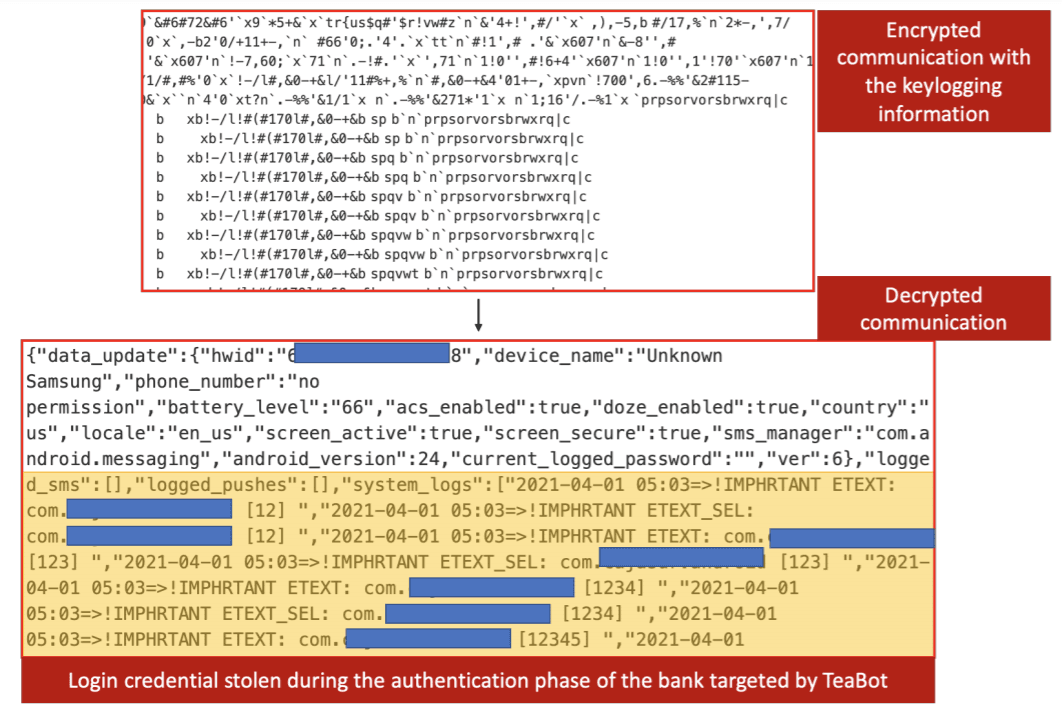
  • Enabling keylogging functionalities
  • Ability to steal Google Authentication codes
  • Ability to obtain full remote control of an Android device (via Accessibility Services and realtime screen-sharing)

“The main goal of TeaBot is stealing victim’s credentials and SMS messages for enabling frauds scenarios against a predefined list of banks,” reads the analysis published by Cleafy. “Once TeaBot is successfully installed in the victim’s device, attackers can obtain a live streaming of the device screen (on demand) and also interact with it via Accessibility Services.”

TeaBot

The malicious app masquerades as media and shipment services such as TeaTV, VLC MediaPlayer, Mobdro, DHL, and UPS. Upon launching the app it will download and execute a second-stage payload then it tricks the victim into granting it accessibility service permissions.

TeaBot leverages accessibility service permissions to achieve real-time interaction with the compromised device, to record keystrokes, take screenshots, and perform overlay attacks against multiple bank apps to steal sensitive data.

The report published by the experts also includes IoCs for the threat.

Follow me on Twitter: @securityaffairs and Facebook

[adrotate banner=”9″][adrotate banner=”12″]

Pierluigi Paganini

(SecurityAffairs – hacking, Android)

[adrotate banner=”5″]

[adrotate banner=”13″]


