
Security Affairs
Two Barracuda ESG Flaws Could Be Combined for Full Root Access; Patches Released|Cyberattack Hits French Blood Banks as Hackers Target Refrigeration Systems Across Europe|CVE-2026-58868: Critical Android Bug Could Let Attackers Run Remote Code|U.S. CISA adds WordPress flaw to its Known Exploited Vulnerabilities catalog|Binance Hack: How Fake Job Interviews and AI Abuse Led to a $6.34 Billion Attack|Synology Warns of Ransomware Attacks Targeting NAS Devices Running Outdated DSM Versions|Inside XCPE, the botnet that turned 1.3M set-top boxes into proxy servers|NIS2 Makes Board Members Personally Liable for Access Control Decisions|Apple’s spyware notifications reach the Bundestag: what the BSI says to do now|VOLTA, the infostealer that asks an AI which victims are worth the effort|New wave of fridge cyberattacks hits European supermarkets, this time in Belgium, Luxembourg, Sweden and Estonia|Hackers Send Fake Nuclear Threat Alerts to Ukrainian and Russian Citizens|Two Barracuda ESG Flaws Could Be Combined for Full Root Access; Patches Released|Cyberattack Hits French Blood Banks as Hackers Target Refrigeration Systems Across Europe|CVE-2026-58868: Critical Android Bug Could Let Attackers Run Remote Code|U.S. CISA adds WordPress flaw to its Known Exploited Vulnerabilities catalog|Binance Hack: How Fake Job Interviews and AI Abuse Led to a $6.34 Billion Attack|Synology Warns of Ransomware Attacks Targeting NAS Devices Running Outdated DSM Versions|Inside XCPE, the botnet that turned 1.3M set-top boxes into proxy servers|NIS2 Makes Board Members Personally Liable for Access Control Decisions|Apple’s spyware notifications reach the Bundestag: what the BSI says to do now|VOLTA, the infostealer that asks an AI which victims are worth the effort|New wave of fridge cyberattacks hits European supermarkets, this time in Belgium, Luxembourg, Sweden and Estonia|Hackers Send Fake Nuclear Threat Alerts to Ukrainian and Russian Citizens|
Advertisement

Ad Placeholder

Full Width × 90

Breaking News

Operators of the TheMoon botnet offer it as a service

Researchers at the CenturyLink Threat Research Labs discovered that the operators of the TheMoon IoT botnet are offering it as a service. Experts at the CenturyLink Threat Research Labs observed a new evolution for the TheMoon IoT botnet, operators added a previously undocumented module that allows them to offer it with a malware-as-a-service model. The […]

TheMoon botnet

Researchers at the CenturyLink Threat Research Labs discovered that the operators of the TheMoon IoT botnet are offering it as a service.

Experts at the CenturyLink Threat Research Labs observed a new evolution for the TheMoon IoT botnet, operators added a previously undocumented module that allows them to offer it with a malware-as-a-service model.

The activity of the TheMoon botnet was first spotted in 2014, and since 2017 its operators added to the code of the bot at least 6 IoT device exploits.
The botnet target broadband modems or routers from several vendors, including Linksys, ASUS, MikroTik, D-Link, and GPON routers.

In May 2018, researchers from security firm Qihoo 360 Netlab reported that cybercriminals that targeted the Dasan GPON routers were using another new zero-day flaw affecting the same routers and recruit them in their botnet.

Now CenturyLink Threat Research Labs collected evidence that botnet actor has sold this proxy botnet as a service to other cybercrime gangs that were using it for credential brute forcing, video advertisement fraud, general traffic obfuscation and more.

Experts noticed several devices performing credential brute force attacks on multiple popular websites, then they uncovered a C2 operating at 91[.]215[.] 158[.]118. This address was associated with previous TheMoon campaign.

Experts uncovered a video ad fraud operator using TheMoon on a single server that received requests by 19,000 unique URLs on 2,700 unique domains over a six-hour period.

The new module was deployed on MIPS devices and allows operators to abuse infected devices as a SOCKS5 proxy and offer a network proxy as a service.

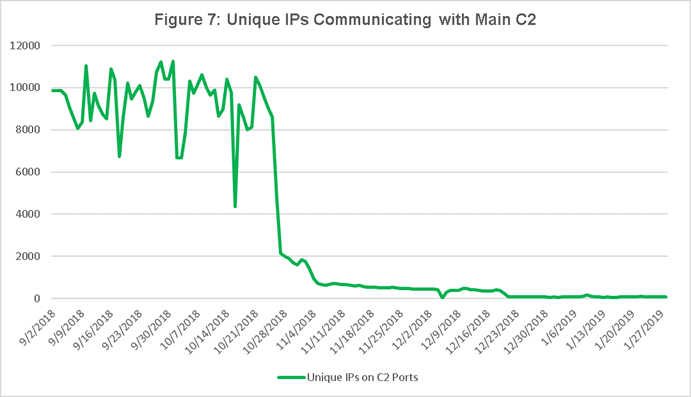
CenturyLink blocked TheMoon infrastructure on its ISP network and reported its findings to other network owners of potentially infected devices.

TheMoon botnet

Further details including IoCs are reported in the analysis published by
CenturyLink.

[adrotate banner=”9″] [adrotate banner=”12″]

Pierluigi Paganini

(SecurityAffairs – TheMoon botnet, hacking)

[adrotate banner=”5″] [adrotate banner=”13″]


