
Security Affairs
Two Barracuda ESG Flaws Could Be Combined for Full Root Access; Patches Released|Cyberattack Hits French Blood Banks as Hackers Target Refrigeration Systems Across Europe|CVE-2026-58868: Critical Android Bug Could Let Attackers Run Remote Code|U.S. CISA adds WordPress flaw to its Known Exploited Vulnerabilities catalog|Binance Hack: How Fake Job Interviews and AI Abuse Led to a $6.34 Billion Attack|Synology Warns of Ransomware Attacks Targeting NAS Devices Running Outdated DSM Versions|Inside XCPE, the botnet that turned 1.3M set-top boxes into proxy servers|NIS2 Makes Board Members Personally Liable for Access Control Decisions|Apple’s spyware notifications reach the Bundestag: what the BSI says to do now|VOLTA, the infostealer that asks an AI which victims are worth the effort|New wave of fridge cyberattacks hits European supermarkets, this time in Belgium, Luxembourg, Sweden and Estonia|Hackers Send Fake Nuclear Threat Alerts to Ukrainian and Russian Citizens|Two Barracuda ESG Flaws Could Be Combined for Full Root Access; Patches Released|Cyberattack Hits French Blood Banks as Hackers Target Refrigeration Systems Across Europe|CVE-2026-58868: Critical Android Bug Could Let Attackers Run Remote Code|U.S. CISA adds WordPress flaw to its Known Exploited Vulnerabilities catalog|Binance Hack: How Fake Job Interviews and AI Abuse Led to a $6.34 Billion Attack|Synology Warns of Ransomware Attacks Targeting NAS Devices Running Outdated DSM Versions|Inside XCPE, the botnet that turned 1.3M set-top boxes into proxy servers|NIS2 Makes Board Members Personally Liable for Access Control Decisions|Apple’s spyware notifications reach the Bundestag: what the BSI says to do now|VOLTA, the infostealer that asks an AI which victims are worth the effort|New wave of fridge cyberattacks hits European supermarkets, this time in Belgium, Luxembourg, Sweden and Estonia|Hackers Send Fake Nuclear Threat Alerts to Ukrainian and Russian Citizens|
Advertisement

Ad Placeholder

Full Width × 90

Breaking News

Many misconfigured Tor sites expose the public IP address via SSL certificates

Security researcher discovered that many misconfigured Tor sites using SSL certificated could expose the public IP addresses of underlying servers. Yonathan Klijnsma, a threat researcher at RiskIQ, has discovered that many misconfigured Tor sites using SSL certificated could expose the public IP addresses of underlying servers. Properly configured servers hosting hidden services have to listen only on the localhost (127.0.0.1) […]

SSL certificates Tor public address

Security researcher discovered that many misconfigured Tor sites using SSL certificated could expose the public IP addresses of underlying servers.

Yonathan Klijnsma, a threat researcher at RiskIQ, has discovered that many misconfigured Tor sites using SSL certificated could expose the public IP addresses of underlying servers.

Properly configured servers hosting hidden services have to listen only on the localhost (127.0.0.1) instead of any other public IP address.

“The way these guys are messing up is that they have their local Apache or Nginx server listening on any (* or 0.0.0.0) IP address, which means Tor connections will work obviously, but also external connections will as well,” 

Klijnsma explained to BleepingComputer. “This is especially true if they don’t use a firewall. These servers should be configured to only listen on 127.0.0.1.”

The expert highlighted that it is quite easy to find misconfigured servers that expose their public IP address.

Every time an administrator of a hidden service adds an SSL certificate to a site, it associates the .onion domain with the certificate. The Common Name (CN) field of the certificate reports the .onion address of the hidden service.
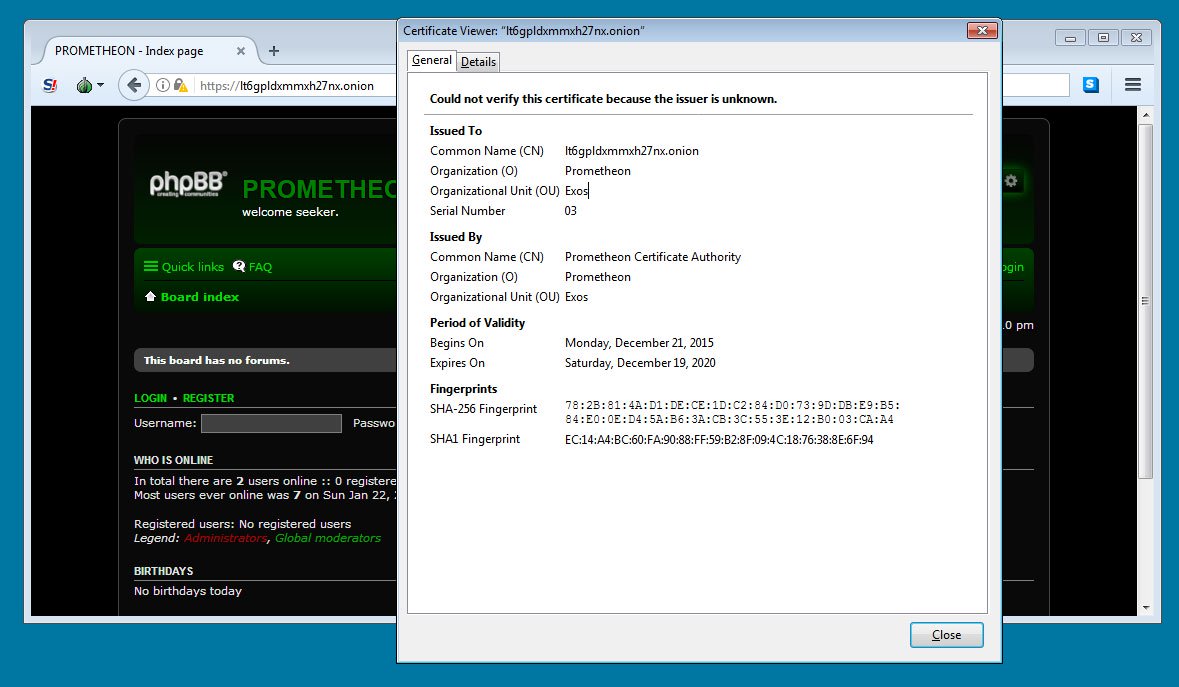
Tor sites IP address

When administrators misconfigure a server so that it listens on a public IP address, the SSL certificate associated with the website will be used for the public IP address.

Klijnsma discovered the misconfigured servers by crawling the Internet and associating SSL certificates to they’re hosted IP addressed. In this way, the expert discovered the misconfigured hidden Tor services and the corresponding public IP addressed.

The expert concluded that to avoid the exposure of the public IP address for a Tor hidden service it should only listen on 127.0.0.1.

[adrotate banner=”9″] [adrotate banner=”12″]

Pierluigi Paganini

(Security Affairs – SSL certificates, Tor sites)

[adrotate banner=”5″]

[adrotate banner=”13″]


