
Security Affairs
Two Barracuda ESG Flaws Could Be Combined for Full Root Access; Patches Released|Cyberattack Hits French Blood Banks as Hackers Target Refrigeration Systems Across Europe|CVE-2026-58868: Critical Android Bug Could Let Attackers Run Remote Code|U.S. CISA adds WordPress flaw to its Known Exploited Vulnerabilities catalog|Binance Hack: How Fake Job Interviews and AI Abuse Led to a $6.34 Billion Attack|Synology Warns of Ransomware Attacks Targeting NAS Devices Running Outdated DSM Versions|Inside XCPE, the botnet that turned 1.3M set-top boxes into proxy servers|NIS2 Makes Board Members Personally Liable for Access Control Decisions|Apple’s spyware notifications reach the Bundestag: what the BSI says to do now|VOLTA, the infostealer that asks an AI which victims are worth the effort|New wave of fridge cyberattacks hits European supermarkets, this time in Belgium, Luxembourg, Sweden and Estonia|Hackers Send Fake Nuclear Threat Alerts to Ukrainian and Russian Citizens|Two Barracuda ESG Flaws Could Be Combined for Full Root Access; Patches Released|Cyberattack Hits French Blood Banks as Hackers Target Refrigeration Systems Across Europe|CVE-2026-58868: Critical Android Bug Could Let Attackers Run Remote Code|U.S. CISA adds WordPress flaw to its Known Exploited Vulnerabilities catalog|Binance Hack: How Fake Job Interviews and AI Abuse Led to a $6.34 Billion Attack|Synology Warns of Ransomware Attacks Targeting NAS Devices Running Outdated DSM Versions|Inside XCPE, the botnet that turned 1.3M set-top boxes into proxy servers|NIS2 Makes Board Members Personally Liable for Access Control Decisions|Apple’s spyware notifications reach the Bundestag: what the BSI says to do now|VOLTA, the infostealer that asks an AI which victims are worth the effort|New wave of fridge cyberattacks hits European supermarkets, this time in Belgium, Luxembourg, Sweden and Estonia|Hackers Send Fake Nuclear Threat Alerts to Ukrainian and Russian Citizens|
Advertisement

Ad Placeholder

Full Width × 90

Breaking News

Threat actors are using the Tox P2P messenger as C2 server

Threat actors are using the Tox peer-to-peer instant messaging service as a command-and-control server, Uptycs researchers reported. Tox is a peer-to-peer serverless instant messaging services that uses NaCl for encryption and decryption. Uptycs researchers reported that threat actors have started using the Tox peer-to-peer instant messaging service as a command-and-control server. Tox has been used in […]

tox

Threat actors are using the Tox peer-to-peer instant messaging service as a command-and-control server, Uptycs researchers reported.

Tox is a peer-to-peer serverless instant messaging services that uses NaCl for encryption and decryption.

Uptycs researchers reported that threat actors have started using the Tox peer-to-peer instant messaging service as a command-and-control server. Tox has been used in the last months by threat actors as a communication channel between ransomware gangs and their victims.

The researchers recently discovered an ELF sample that acts as a bot and can run scripts on the victim machine using the Tox protocol.

The binary is written in C and has only statically linked the c-toxcore library. 

The shell_script variable analyzed by the experts kills certain programs that are known to infect linux servers and deletes the crontab, which is often used by malicious code to maintain persistence. A function called start_routine1 opens a file with a random filename in /var/tmp/ and dumps the contents of shell_script in there and later executes it.

Experts reported that the dropped shell script contains commands to kill processes associated with cryptominer.

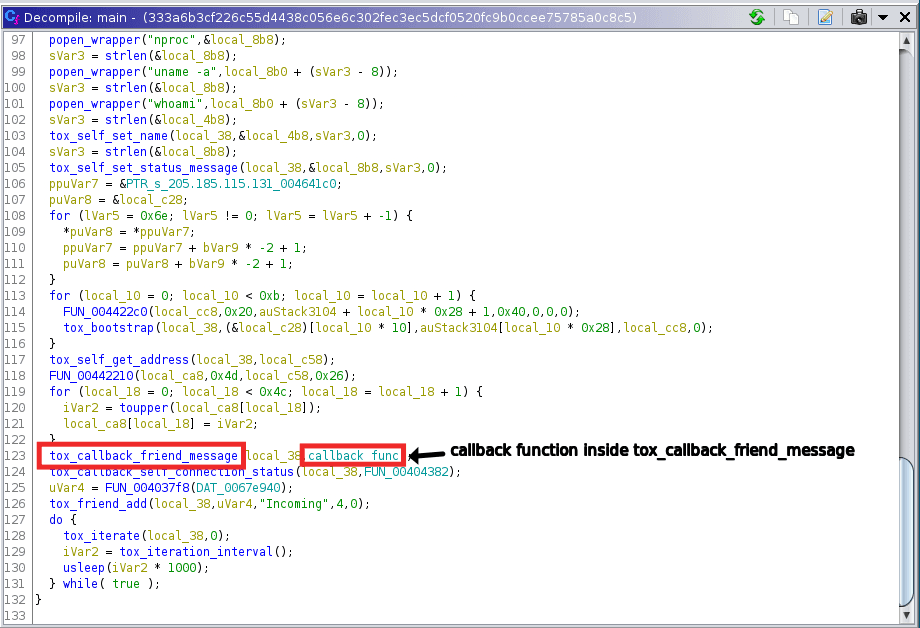
The pthread_create in the main function also called the rstart_routine2 function which sends the output of every command over UDP to the Tox recipient. The function could execute multiple commands on the machine, including nproc, whoami, and machine-id.

The main function also includes a set of functions to set up the P2P instant messaging service on the victim’s machine, such as tox_new, tox_self_set_name, and tox_self_set_status_message.

tox

“While the discussed sample does not do anything explicitly malicious, we feel that it might be a component of a coinminer campaign. We are observing it for the first time where Tox protocol is used to run scripts onto the machine.” concludes the report. “We have seen attackers using Tox as a communication mechanism in the past, like in HelloXD ransomware, where the attacker used Tox and onion-based messengers. Therefore, it becomes important to monitor the network components involved in the attack chains.“

Follow me on Twitter: @securityaffairs and Facebook

[adrotate banner=”9″][adrotate banner=”12″]

Pierluigi Paganini

(SecurityAffairs – hacking, bot)

[adrotate banner=”5″]

[adrotate banner=”13″]


