
Security Affairs
Two Barracuda ESG Flaws Could Be Combined for Full Root Access; Patches Released|Cyberattack Hits French Blood Banks as Hackers Target Refrigeration Systems Across Europe|CVE-2026-58868: Critical Android Bug Could Let Attackers Run Remote Code|U.S. CISA adds WordPress flaw to its Known Exploited Vulnerabilities catalog|Binance Hack: How Fake Job Interviews and AI Abuse Led to a $6.34 Billion Attack|Synology Warns of Ransomware Attacks Targeting NAS Devices Running Outdated DSM Versions|Inside XCPE, the botnet that turned 1.3M set-top boxes into proxy servers|NIS2 Makes Board Members Personally Liable for Access Control Decisions|Apple’s spyware notifications reach the Bundestag: what the BSI says to do now|VOLTA, the infostealer that asks an AI which victims are worth the effort|New wave of fridge cyberattacks hits European supermarkets, this time in Belgium, Luxembourg, Sweden and Estonia|Hackers Send Fake Nuclear Threat Alerts to Ukrainian and Russian Citizens|Two Barracuda ESG Flaws Could Be Combined for Full Root Access; Patches Released|Cyberattack Hits French Blood Banks as Hackers Target Refrigeration Systems Across Europe|CVE-2026-58868: Critical Android Bug Could Let Attackers Run Remote Code|U.S. CISA adds WordPress flaw to its Known Exploited Vulnerabilities catalog|Binance Hack: How Fake Job Interviews and AI Abuse Led to a $6.34 Billion Attack|Synology Warns of Ransomware Attacks Targeting NAS Devices Running Outdated DSM Versions|Inside XCPE, the botnet that turned 1.3M set-top boxes into proxy servers|NIS2 Makes Board Members Personally Liable for Access Control Decisions|Apple’s spyware notifications reach the Bundestag: what the BSI says to do now|VOLTA, the infostealer that asks an AI which victims are worth the effort|New wave of fridge cyberattacks hits European supermarkets, this time in Belgium, Luxembourg, Sweden and Estonia|Hackers Send Fake Nuclear Threat Alerts to Ukrainian and Russian Citizens|
Advertisement

Ad Placeholder

Full Width × 90

Breaking News

Popular travel websites warn Customers of Phishing scam

The customers of popular travel websites are targeted by phishing scam in an attempt to lure them into disclosing personal information. The users of popular travel websites are targeted by phishing campaigns in an attempt to lure them into disclosing personal information. The travel websites have issued an alert to inform their customers of fraudulent […]

Popular travel websites warn Customers of Phishing scam

The customers of popular travel websites are targeted by phishing scam in an attempt to lure them into disclosing personal information.

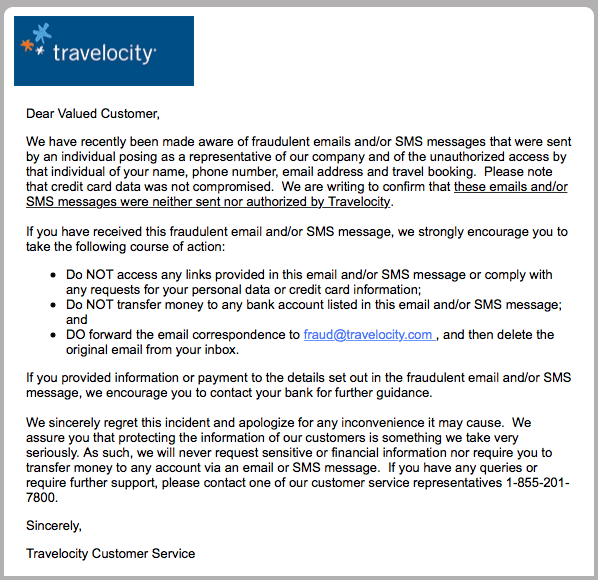
The users of popular travel websites are targeted by phishing campaigns in an attempt to lure them into disclosing personal information. The travel websites have issued an alert to inform their customers of fraudulent emails and SMS messages used to deceive victims.

Among the companies targeted by the hackers, there are popular online travel agencies including Hotels.com, Expedia and Travelocity.

Some users already notified to have received a phone call that informed them of a $2600 win towards trip, the hackers requested a valid credit card to check into the resort. The malicious messages notified users the company had detected suspicious activities on their accounts that caused unauthorized access of customer data (i.e. names, phone numbers, email addresses and travel bookings).

A number of travelers who use Hotels.com were recently tricked into disclosing their personal data.

The situation is similar for Expedia, the company Head of Communications Sarah Gavin confirmed that the data had not been stolen from Expedia, but rather a third-party. The report issued by the company confirmed that the impacted users who had used the Expedia system recently to book a stay a specific hotel that was scammed by criminals.

“The data was stolen by a criminal who successfully phished a partner hotel and obtained that hotel’s login credentials, subsequently stealing names and other information about consumers who had used the Expedia system recently to book a stay at that hotel,” read the report.

expedia travel websites fraudulent email

The companies operating the travel websites encouraged users to take cautionary steps when receiving suspicious messages, it is important to remark that these firms will never request sensitive data to their customers.

“We will never request sensitive or financial information nor require you to transfer money to any account via an email or SMS message,” read the notice.

Pierluigi Paganini

(Security Affairs – travel websites, phishing)


