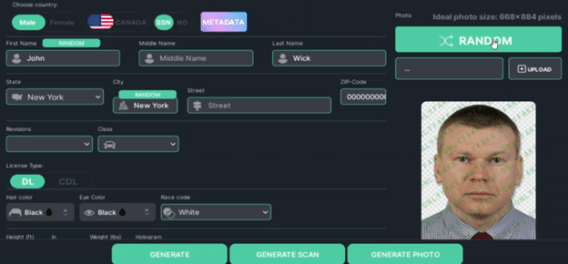
Ukrainian citizen Yurii Nazarenko admitted running OnlyFake, an AI-driven site that sold over 10,000 fake IDs worldwide.
Ukrainian man Yurii Nazarenko pleaded guilty to operating OnlyFake, an AI-powered site that generated and sold more than 10,000 counterfeit IDs globally.
“United States Attorney for the Southern District of New York, Jay Clayton, and Assistant Director in Charge of the New York Field Office of the Federal Bureau of Investigation (“FBI”), James C. Barnacle, Jr., announced today that Ukrainian national YURII NAZARENKO, a/k/a “Yuriy Nazarenko,” a/k/a “Uriel Septimberus,” a/k/a “Tor Ford,” a/k/a “John Wick,” has been charged and pled guilty for his role in operating the website “OnlyFake,” which sold fake photos of identification documents such as passports and driver’s licenses (“Digital Fake IDs”).” reads the press release published by DoJ. “NAZARENKO pled guilty today to conspiracy to commit fraud in connection with identification documents, authentication features, and information before U.S. District Judge Margaret M. Garnett.”
According to court filings, OnlyFake let customers generate a wide range of digital fake IDs, including U.S. driver’s licenses from all 50 states, passports, passport cards, and Social Security cards, as well as passports from around 56 other countries. Users could customize the output to appear as a scanned document or a photo on a surface, enabling highly realistic counterfeit IDs through the AI-powered platform.

Customers paid OnlyFake in cryptocurrency, with bulk packages of up to 1,000 digital fake IDs. Yurii Nazarenko operated the platform from 2021 to 2024, the service generated at least 10,000 fake IDs and earned hundreds of thousands of dollars. These AI-generated IDs allowed users to bypass KYC requirements at banks and crypto exchanges, facilitating money laundering and concealing their true identities.
Nazarenko pled guilty to conspiring to commit fraud involving fake IDs, facing up to 15 years in prison. He also agreed to forfeit $1.2 million from OnlyFake’s operations. Sentencing is scheduled for June 26, 2026, before Judge Garnett, though the final sentence will be determined by the court.
“We rely on government issued IDs to combat terrorism, hijackings, fraud, money laundering, and a host of other crimes,” said U.S. Attorney Jay Clayton. “OnlyFake’s manufacture of fraudulent IDs and other documents puts us all at risk and must be stopped.”
Follow me on Twitter: @securityaffairs and Facebook and Mastodon
(SecurityAffairs – hacking, OnlyFake)
Tags