
Security Affairs
Two Barracuda ESG Flaws Could Be Combined for Full Root Access; Patches Released|Cyberattack Hits French Blood Banks as Hackers Target Refrigeration Systems Across Europe|CVE-2026-58868: Critical Android Bug Could Let Attackers Run Remote Code|U.S. CISA adds WordPress flaw to its Known Exploited Vulnerabilities catalog|Binance Hack: How Fake Job Interviews and AI Abuse Led to a $6.34 Billion Attack|Synology Warns of Ransomware Attacks Targeting NAS Devices Running Outdated DSM Versions|Inside XCPE, the botnet that turned 1.3M set-top boxes into proxy servers|NIS2 Makes Board Members Personally Liable for Access Control Decisions|Apple’s spyware notifications reach the Bundestag: what the BSI says to do now|VOLTA, the infostealer that asks an AI which victims are worth the effort|New wave of fridge cyberattacks hits European supermarkets, this time in Belgium, Luxembourg, Sweden and Estonia|Hackers Send Fake Nuclear Threat Alerts to Ukrainian and Russian Citizens|Two Barracuda ESG Flaws Could Be Combined for Full Root Access; Patches Released|Cyberattack Hits French Blood Banks as Hackers Target Refrigeration Systems Across Europe|CVE-2026-58868: Critical Android Bug Could Let Attackers Run Remote Code|U.S. CISA adds WordPress flaw to its Known Exploited Vulnerabilities catalog|Binance Hack: How Fake Job Interviews and AI Abuse Led to a $6.34 Billion Attack|Synology Warns of Ransomware Attacks Targeting NAS Devices Running Outdated DSM Versions|Inside XCPE, the botnet that turned 1.3M set-top boxes into proxy servers|NIS2 Makes Board Members Personally Liable for Access Control Decisions|Apple’s spyware notifications reach the Bundestag: what the BSI says to do now|VOLTA, the infostealer that asks an AI which victims are worth the effort|New wave of fridge cyberattacks hits European supermarkets, this time in Belgium, Luxembourg, Sweden and Estonia|Hackers Send Fake Nuclear Threat Alerts to Ukrainian and Russian Citizens|
Advertisement

Ad Placeholder

Full Width × 90

Breaking News

A severe URL Spoofing flaw affects the Apple Safari Browser

A URL Spoofing flaw affects the Apple Safari browser. It could trick users into visiting malicious websites despite they are accessing to legitimate URLs. A serious security vulnerability affects the Apple Safari browser, the flaw could be exploited by attackers to trick Safari users into visiting malicious websites while are trying to surf on legitimate websites. […]

A severe URL Spoofing flaw affects the Apple Safari Browser

A URL Spoofing flaw affects the Apple Safari browser. It could trick users into visiting malicious websites despite they are accessing to legitimate URLs.

A serious security vulnerability affects the Apple Safari browser, the flaw could be exploited by attackers to trick Safari users into visiting malicious websites while are trying to surf on legitimate websites.

The vulnerability discovered in the Apple Safari browser was reported first by a group of researchers, known as Deusen, which demonstrated hot to exploit it. As explained by the researchers the vulnerability is exploitable on fully patched versions of Apple’s mobile operating system (iOS) as well as a desktop operating system (OS X).

Deusen discovered in February a critical Universal cross-site scripting (XSS) vulnerability in the fully patched versions of Internet Explorer. The flaw in the Internet Explorer could be exploited by hackers to steal user sensitive data (i.e. Login credentials) and inject malicious content into browsing sessions.

Technically, this last flaw affecting the Apple Safari Browser is an URL spoofing vulnerability, which can be exploited by attackers to fool victims into thinking they are visiting a legitimate website when they are visiting a different web address.

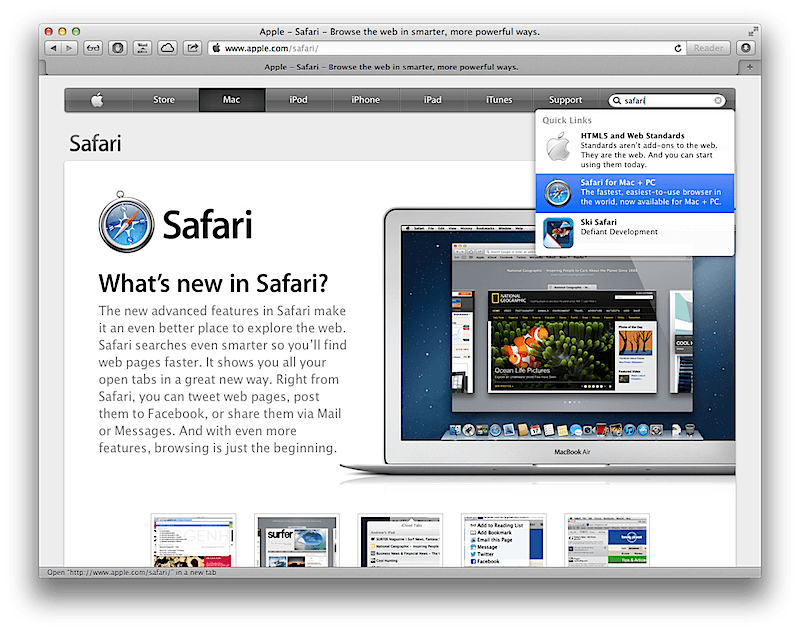
apple safari browser 2

The attack scenario is very dangerous and could be exploited by ill-intentioned to run phishing campaigns or to redirect victims on a website used to serve malware.

The Deusen team also published a proof-of-concept exploit code that makes the Safari web browser to display the Daily Mail’s website (dailymail.co.uk) although the browser is displaying the contents from another website, the deusen.co.uk.

The script used by the PoC page that forces Apple Safari users to visit the daily mail address appears as

<script> function f() { location="dailymail.co.uk/home/index.htm…"+Math.random(); } setInterval("f()",10); </script>

Let’s hope Apple will fix the flaw before criminal crews will exploit it in the wild.

Pierluigi Paganini

(Security Affairs –  Apple Safari, Phishing)


