
Security Affairs
Cyberattack Hits French Blood Banks as Hackers Target Refrigeration Systems Across Europe|CVE-2026-58868: Critical Android Bug Could Let Attackers Run Remote Code|U.S. CISA adds WordPress flaw to its Known Exploited Vulnerabilities catalog|Binance Hack: How Fake Job Interviews and AI Abuse Led to a $6.34 Billion Attack|Synology Warns of Ransomware Attacks Targeting NAS Devices Running Outdated DSM Versions|Inside XCPE, the botnet that turned 1.3M set-top boxes into proxy servers|NIS2 Makes Board Members Personally Liable for Access Control Decisions|Apple’s spyware notifications reach the Bundestag: what the BSI says to do now|VOLTA, the infostealer that asks an AI which victims are worth the effort|New wave of fridge cyberattacks hits European supermarkets, this time in Belgium, Luxembourg, Sweden and Estonia|Hackers Send Fake Nuclear Threat Alerts to Ukrainian and Russian Citizens|Chainalysis Investigates Security Incident Involving AI-Driven Attack Techniques|Cyberattack Hits French Blood Banks as Hackers Target Refrigeration Systems Across Europe|CVE-2026-58868: Critical Android Bug Could Let Attackers Run Remote Code|U.S. CISA adds WordPress flaw to its Known Exploited Vulnerabilities catalog|Binance Hack: How Fake Job Interviews and AI Abuse Led to a $6.34 Billion Attack|Synology Warns of Ransomware Attacks Targeting NAS Devices Running Outdated DSM Versions|Inside XCPE, the botnet that turned 1.3M set-top boxes into proxy servers|NIS2 Makes Board Members Personally Liable for Access Control Decisions|Apple’s spyware notifications reach the Bundestag: what the BSI says to do now|VOLTA, the infostealer that asks an AI which victims are worth the effort|New wave of fridge cyberattacks hits European supermarkets, this time in Belgium, Luxembourg, Sweden and Estonia|Hackers Send Fake Nuclear Threat Alerts to Ukrainian and Russian Citizens|Chainalysis Investigates Security Incident Involving AI-Driven Attack Techniques|
Advertisement

Ad Placeholder

Full Width × 90

Breaking News

The Ursnif Trojan has hit over 100 Italian banks

Avast researchers reported that the infamous Ursnif Trojan was employed in attacks against at least 100 banks in Italy. Avast experts recently obtained information on possible victims of Ursnif malware that confirms the interest of malware operators in targeting Italian banks. Operators behind this attacks have stolen financial data and credential from targeted financial institutions. “Among the […]

ursnif

Avast researchers reported that the infamous Ursnif Trojan was employed in attacks against at least 100 banks in Italy.

Avast experts recently obtained information on possible victims of Ursnif malware that confirms the interest of malware operators in targeting Italian banks.

Operators behind this attacks have stolen financial data and credential from targeted financial institutions.

“Among the countries Ursnif has significantly impacted is Italy, a fact that we found reflected in the information our researchers obtained.” reads the analysis published by Avast. “Specifically we found usernames, passwords, credit card, banking and payment information that appears to have been stolen from Ursnif victims by the malware operators. We saw evidence of over 100 Italian banks targeted in the information we obtained. We also saw over 1,700 stolen credentials for a single payment processor.”

According to data obtained by Avast, at least 100 Italian banks have been targeted with the Ursnif Trojan and in one case, crooks stolen over 1,700 sets of credentials from an unnamed payment processor.

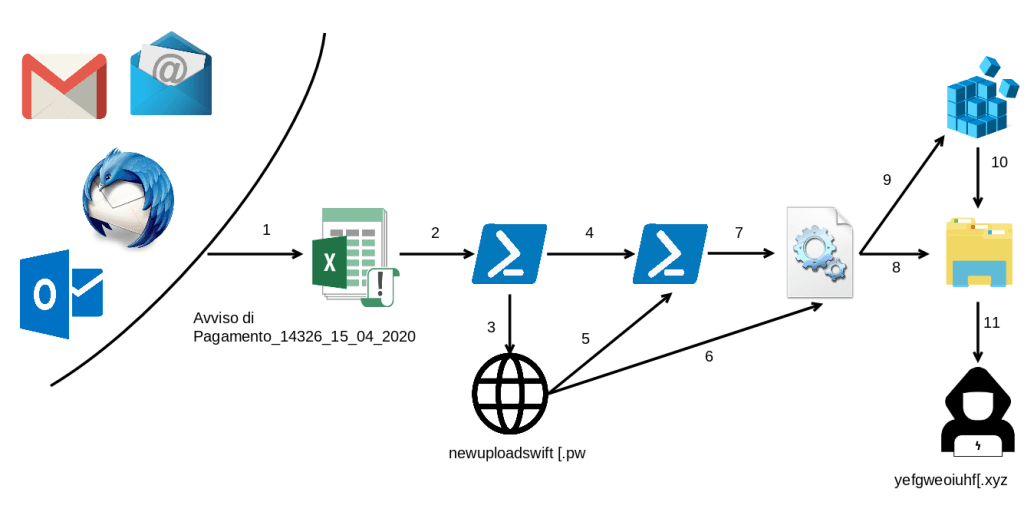
Ursnif is one of the most and widespread common threats today delivered through malspam campaigns. It appeared on the threat landscape about 13 years ago and gained its popularity since 2014 when its source code was leaked online giving the opportunity to several threat actors to develop their own version.

Avast researchers shared their findings with the impacted payment processors and banks and Italian authorities and financial CERTs, including CERTFin.

“With this information these companies and institutions are taking steps to protect their customers and help them recover from the impact of Ursnif.” concludes AVAST.

If you want to receive the weekly Security Affairs Newsletter for free subscribe here.

Follow me on Twitter: @securityaffairs and Facebook

[adrotate banner=”9″][adrotate banner=”12″]

Pierluigi Paganini

(SecurityAffairs – hacking, Ursnif)

[adrotate banner=”5″]

[adrotate banner=”13″]


