
Security Affairs
Two Barracuda ESG Flaws Could Be Combined for Full Root Access; Patches Released|Cyberattack Hits French Blood Banks as Hackers Target Refrigeration Systems Across Europe|CVE-2026-58868: Critical Android Bug Could Let Attackers Run Remote Code|U.S. CISA adds WordPress flaw to its Known Exploited Vulnerabilities catalog|Binance Hack: How Fake Job Interviews and AI Abuse Led to a $6.34 Billion Attack|Synology Warns of Ransomware Attacks Targeting NAS Devices Running Outdated DSM Versions|Inside XCPE, the botnet that turned 1.3M set-top boxes into proxy servers|NIS2 Makes Board Members Personally Liable for Access Control Decisions|Apple’s spyware notifications reach the Bundestag: what the BSI says to do now|VOLTA, the infostealer that asks an AI which victims are worth the effort|New wave of fridge cyberattacks hits European supermarkets, this time in Belgium, Luxembourg, Sweden and Estonia|Hackers Send Fake Nuclear Threat Alerts to Ukrainian and Russian Citizens|Two Barracuda ESG Flaws Could Be Combined for Full Root Access; Patches Released|Cyberattack Hits French Blood Banks as Hackers Target Refrigeration Systems Across Europe|CVE-2026-58868: Critical Android Bug Could Let Attackers Run Remote Code|U.S. CISA adds WordPress flaw to its Known Exploited Vulnerabilities catalog|Binance Hack: How Fake Job Interviews and AI Abuse Led to a $6.34 Billion Attack|Synology Warns of Ransomware Attacks Targeting NAS Devices Running Outdated DSM Versions|Inside XCPE, the botnet that turned 1.3M set-top boxes into proxy servers|NIS2 Makes Board Members Personally Liable for Access Control Decisions|Apple’s spyware notifications reach the Bundestag: what the BSI says to do now|VOLTA, the infostealer that asks an AI which victims are worth the effort|New wave of fridge cyberattacks hits European supermarkets, this time in Belgium, Luxembourg, Sweden and Estonia|Hackers Send Fake Nuclear Threat Alerts to Ukrainian and Russian Citizens|
Advertisement

Ad Placeholder

Full Width × 90

Breaking News

CVE-2016-7461 code execution flaw affects VMware Workstation

VMware has patched a critical out-of-bounds memory access vulnerability, tracked as CVE-2016-7461, affecting its Workstation and Fusion products. The flaw, that resides in the affects the drag-and-drop function, can be exploited by attackers to execute arbitrary code on the host operating system running Fusion or Workstation. The security vulnerability affects Workstation Player and Pro 12.x, and […]

CVE-2016-7461 code execution flaw affects VMware Workstation

VMware has patched a critical out-of-bounds memory access vulnerability, tracked as CVE-2016-7461, affecting its Workstation and Fusion products.

The flaw, that resides in the affects the drag-and-drop function, can be exploited by attackers to execute arbitrary code on the host operating system running Fusion or Workstation.

The security vulnerability affects Workstation Player and Pro 12.x, and Fusion (Pro) 8.x., while the ESXi is not affected.

The flaw war reported hacking contest 2016 PwnFest held in South Korea at the 2016 Power Of Community (POC) security conference. The hackers earned $140,000 for the Windows Edge hacks, while Qihoo hacker team and Lee earned $150,000 for the hack of the VMware Workstation 12.5.1.

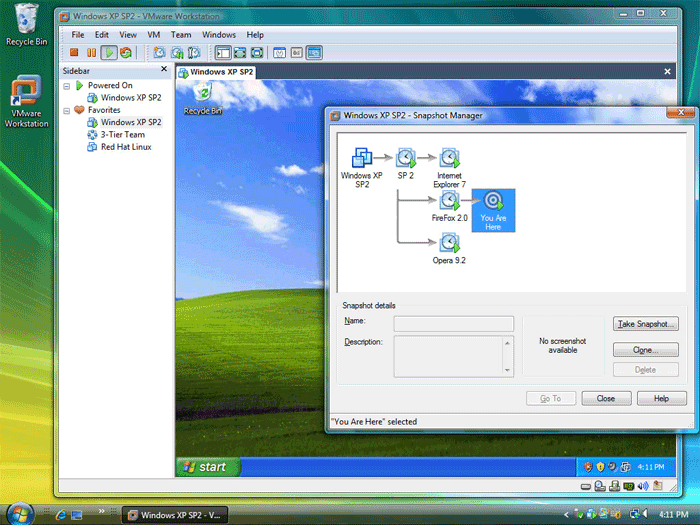
CVE-2016-7461 vmware-workstation-33

VMware patched the vulnerability with the release of versions 12.5.2 and 8.5.2.

“Problem Description

a. VMware Workstation and Fusion out-of-bounds memory access vulnerability

The drag-and-drop (DnD) function in VMware Workstation and Fusion has an out-of-bounds memory access vulnerability. This may allow a guest to execute code on the operating system that runs Workstation or Fusion.” states the advisory published by VMware.

VMware explained that the flaw cannot be exploited against Workstation Pro or Fusion when both the drag-and-drop and copy-and-paste functions are disabled, while it remains exploitable on Workstation Player.

Recently VMware released several security updates to fix the local privilege escalation flaw in Linux kernel, also known as Dirty COW, tracked as CVE-2016-5195.

“The Linux kernel which ships with the base operating system of VMware Appliances contains a race condition in the way its memory subsystem handles copy-on-write (aka “Dirty COW”). Successful exploitation of the vulnerability may allow for local privilege escalation. The product lines listed in this advisory have been confirmed to be affected.” reads the advisory from VMmware.com.

Security patches for Identity Manager, vRealize Automation and version 5.x of vRealize Operations are still pending.

[adrotate banner=”9″] [adrotate banner=”12″]

Pierluigi Paganini

(Security Affairs – CVE-2016-7461, VMware)

[adrotate banner=”9″]


