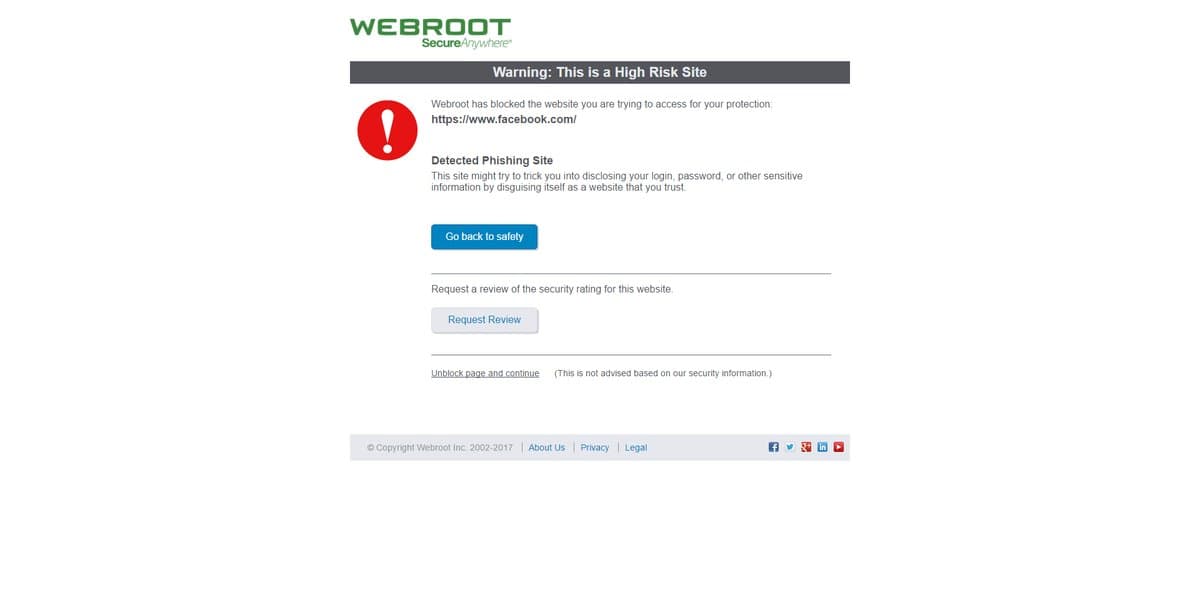
Webroot home and business products are tagging Windows files and Facebook as malicious after a recent faulty update. Users are going crazy.
The Webroot home and business defense solutions started tagging legitimate Windows and Facebook as malicious after a recent update.

Many organizations claimed hundreds and even thousands of malfunctions to their endpoints, the glitch caused the Webroot product to detect legitimate Windows files, including digitally signed ones, as W32.Trojan.Gen.
Many customers started reporting the embarrassing problem to online, they reported the issue through social media and Webroot’s forum complain serious problems for their businesses.
Files tagged as malicious by Webroot had been quarantined with important problems for the end-users.
https://twitter.com/Limbaughnomicon/status/856680577965187072
I seem to have installed a nasty Ransomware app. It's called Webroot. They already have my money, should I contact the FBI?
— Bob Ripley (@M5_Driver) April 24, 2017
The update is also blocking the Webroot security product to block access to Facebook as reported by many users on Twitter, the antivirus flagged the popular social network as a phishing website.
https://twitter.com/KeithSieman/status/856677400977002498
The company has published an official statement to calm down its customers, it explained that the system of the company wasn’t under attack.
“We are still working to resolve this issue through the night and will keep you updated as soon as more information becomes available.” read the message shared by Webroot on its forum.
“Webroot has not been breached and customers are not at risk. Legitimate malicious files are being identified and blocked as normal. We continue to work on a comprehensive resolution, but a live fix has been released for the Facebook issue and is propagating through to customers now.”
Webroot has provided a workaround solution for small business customers, unfortunately, managed services providers (MSPs) have to wait to fix the problem.
The company also provided a fix for the Facebook problem.
“We understand that this is a consumer and business issue. For our small business customers, the fix below will work.
We understand that MSPs will require a different solution. We are currently working on this universal solution now.” continues the company.
Experts highlighted that this is the second incident involving Webroot products this year, a faulty update issued in February caused many systems to crash.
Are you thinking to change product?
Probably you need to know that similar problems affected products of other IT security giants such as Norton and ESET.
[adrotate banner=”9″]
(Security Affairs –Webroot products, false flag)
[adrotate banner=”13″]