
Security Affairs
Two Barracuda ESG Flaws Could Be Combined for Full Root Access; Patches Released|Cyberattack Hits French Blood Banks as Hackers Target Refrigeration Systems Across Europe|CVE-2026-58868: Critical Android Bug Could Let Attackers Run Remote Code|U.S. CISA adds WordPress flaw to its Known Exploited Vulnerabilities catalog|Binance Hack: How Fake Job Interviews and AI Abuse Led to a $6.34 Billion Attack|Synology Warns of Ransomware Attacks Targeting NAS Devices Running Outdated DSM Versions|Inside XCPE, the botnet that turned 1.3M set-top boxes into proxy servers|NIS2 Makes Board Members Personally Liable for Access Control Decisions|Apple’s spyware notifications reach the Bundestag: what the BSI says to do now|VOLTA, the infostealer that asks an AI which victims are worth the effort|New wave of fridge cyberattacks hits European supermarkets, this time in Belgium, Luxembourg, Sweden and Estonia|Hackers Send Fake Nuclear Threat Alerts to Ukrainian and Russian Citizens|Two Barracuda ESG Flaws Could Be Combined for Full Root Access; Patches Released|Cyberattack Hits French Blood Banks as Hackers Target Refrigeration Systems Across Europe|CVE-2026-58868: Critical Android Bug Could Let Attackers Run Remote Code|U.S. CISA adds WordPress flaw to its Known Exploited Vulnerabilities catalog|Binance Hack: How Fake Job Interviews and AI Abuse Led to a $6.34 Billion Attack|Synology Warns of Ransomware Attacks Targeting NAS Devices Running Outdated DSM Versions|Inside XCPE, the botnet that turned 1.3M set-top boxes into proxy servers|NIS2 Makes Board Members Personally Liable for Access Control Decisions|Apple’s spyware notifications reach the Bundestag: what the BSI says to do now|VOLTA, the infostealer that asks an AI which victims are worth the effort|New wave of fridge cyberattacks hits European supermarkets, this time in Belgium, Luxembourg, Sweden and Estonia|Hackers Send Fake Nuclear Threat Alerts to Ukrainian and Russian Citizens|
Advertisement

Ad Placeholder

Full Width × 90

Breaking News

Facebook fixed a WhatsApp bug that allowed hackers to access local file system

Facebook addressed a critical issue in WhatsApp that would have allowed attackers to read files from a user’s local file system, on macOS and Windows. Facebook has addressed a critical vulnerability in WhatsApp, tracked as CVE-2019-18426, that would have allowed hackers to read files from a user’s local file system, on macOS and Windows systems. […]

whatsapp flaw

Facebook addressed a critical issue in WhatsApp that would have allowed attackers to read files from a user’s local file system, on macOS and Windows.

Facebook has addressed a critical vulnerability in WhatsApp, tracked as CVE-2019-18426, that would have allowed hackers to read files from a user’s local file system, on macOS and Windows systems.

“A vulnerability in WhatsApp Desktop when paired with WhatsApp for iPhone allows cross-site scripting and local file reading. Exploiting the vulnerability requires the victim to click a link preview from a specially crafted text message.” reads the security advisory published by Facebook.

The issue could be exploited by a remote attacker by tricking the victims into clicking a link preview from a specially crafted text message.

The CVE-2019-18426 flaw affects WhatsApp Desktop prior to v0.3.9309 paired with WhatsApp for iPhone versions prior to 2.20.1.: 01-21-2020

The vulnerability received an 8.2 high severity CVSS 3.x base score, it was discovered by Gal Weizman from PerimeterX.

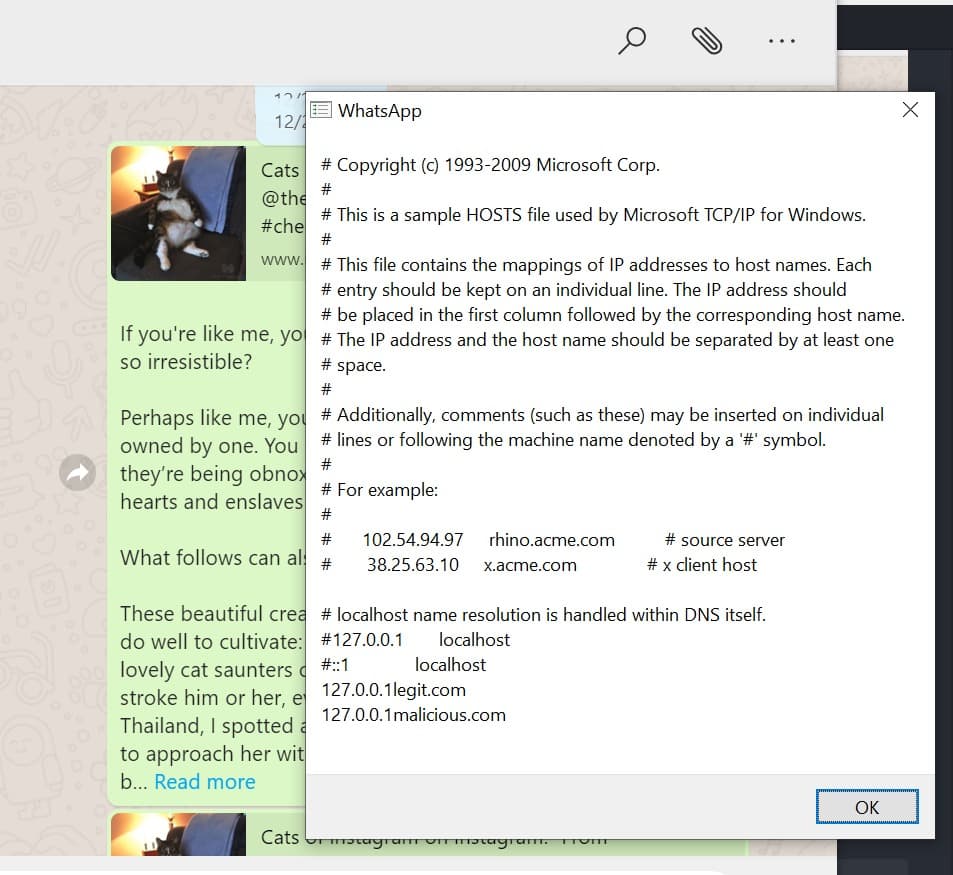
Weizman discovered a gap in WhatsApp’s Content Security Policy (CSP) that allowed for cross-site scripting (XSS) on the desktop app, further analysis allowed the expert to gain read permissions on the local file system on both Windows and macOS WhatsApp desktop apps.

“if you run an old version of a vulnerable app, one can exploit that vulnerability and do bad things to you.” wrote the expert.

“I did however demonstrated how I use fetch() API, for example, to read files from the local OS like the content of C:\Windows\System32\drivers\etc\hosts file in this case,”

whatsapp flaw

The flaw could have allowed attackers to inject malicious code and links within messages sent that would be completely transparent to the victims.

[adrotate banner=”9″] [adrotate banner=”12″]

Pierluigi Paganini

(SecurityAffairs – United Nations, hacking)

[adrotate banner=”5″]

[adrotate banner=”13″]


