
Security Affairs
U.S. Charges Canadian Man in Alleged Hack of University Supercomputers|Two Barracuda ESG Flaws Could Be Combined for Full Root Access; Patches Released|Cyberattack Hits French Blood Banks as Hackers Target Refrigeration Systems Across Europe|CVE-2026-58868: Critical Android Bug Could Let Attackers Run Remote Code|U.S. CISA adds WordPress flaw to its Known Exploited Vulnerabilities catalog|Binance Hack: How Fake Job Interviews and AI Abuse Led to a $6.34 Billion Attack|Synology Warns of Ransomware Attacks Targeting NAS Devices Running Outdated DSM Versions|Inside XCPE, the botnet that turned 1.3M set-top boxes into proxy servers|NIS2 Makes Board Members Personally Liable for Access Control Decisions|Apple’s spyware notifications reach the Bundestag: what the BSI says to do now|VOLTA, the infostealer that asks an AI which victims are worth the effort|New wave of fridge cyberattacks hits European supermarkets, this time in Belgium, Luxembourg, Sweden and Estonia|U.S. Charges Canadian Man in Alleged Hack of University Supercomputers|Two Barracuda ESG Flaws Could Be Combined for Full Root Access; Patches Released|Cyberattack Hits French Blood Banks as Hackers Target Refrigeration Systems Across Europe|CVE-2026-58868: Critical Android Bug Could Let Attackers Run Remote Code|U.S. CISA adds WordPress flaw to its Known Exploited Vulnerabilities catalog|Binance Hack: How Fake Job Interviews and AI Abuse Led to a $6.34 Billion Attack|Synology Warns of Ransomware Attacks Targeting NAS Devices Running Outdated DSM Versions|Inside XCPE, the botnet that turned 1.3M set-top boxes into proxy servers|NIS2 Makes Board Members Personally Liable for Access Control Decisions|Apple’s spyware notifications reach the Bundestag: what the BSI says to do now|VOLTA, the infostealer that asks an AI which victims are worth the effort|New wave of fridge cyberattacks hits European supermarkets, this time in Belgium, Luxembourg, Sweden and Estonia|
Advertisement

Ad Placeholder

Full Width × 90

Breaking News

Researcher disclosed a Windows zero-day for the third time in a few months

Security researcher SandboxEscaper released a working proof-of-concept (PoC) exploit for a new Windows zero-day vulnerability.H The security researcher SandboxEscaper is back and for the third time in a few months, released proof-of-concept (PoC) exploit for a new zero-day vulnerability affecting Microsoft’s Windows OS. Since August, SandboxEscaper has publicly dropped exploits for two Windows zero-day vulnerabilities forcing […]

Windows zero-day

Security researcher SandboxEscaper released a working proof-of-concept (PoC) exploit for a new Windows zero-day vulnerability.H

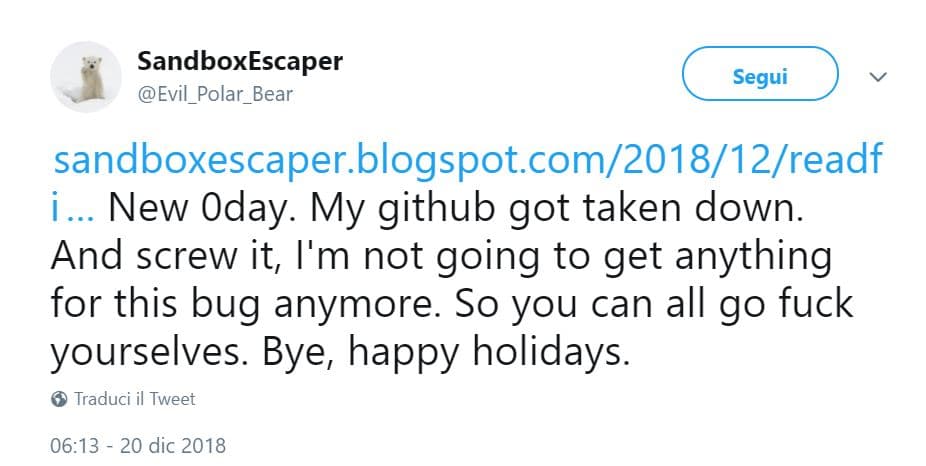
The security researcher SandboxEscaper is back and for the third time in a few months, released proof-of-concept (PoC) exploit for a new zero-day vulnerability affecting Microsoft’s Windows OS.

Windows zero-day

Since August, SandboxEscaper has publicly dropped exploits for two Windows zero-day vulnerabilities forcing Microsoft to quickly address them to avoid its users being targeted by hackers.

The last Windows zero-day flaw disclosed by SandboxEscaper is an arbitrary file read vulnerability that could be exploited by a low-privileged user or a malicious program to read the content of any file on a Windows system.

The Windows zero-day flaw affects the”MsiAdvertiseProduct” function that generates an advertise script or advertises a product to the computer. The MsiAdvertiseProduct function enables the installer to write to a script the registry and shortcut information used to assign or publish a product. The script can be written to be consistent with a specified platform by using MsiAdvertiseProductEx.

According to the SandboxEscaper, the lack of proper validation could allow an attacker to force installer service into making a copy of any file as SYSTEM privileges and read its content.

“Even without an enumeration vector, this is still bad news, because a lot of document software, like office, will actually keep files in static locations that contain the full path and file names of recently opened documents..,” explained the expert.

“Thus by reading files like this, you can get filenames of documents created by other users.. the filesystem is a spiderweb and references to user-created files can be found everywhere.. so not having an enumeration bug is not that big of a deal.“

SandboxEscaper published a video PoC of the vulnerability and also a
proof-of-concept (PoC) exploit on Github (The GitHub account of the researcher was blocked).

In October, SandboxEscaper released the proof-of-concept exploit code for Microsoft Data Sharing that allowed a low privileged user to delete critical system files from Windows systems.

In August, SandboxEscaper released the PoC exploit for a local privilege escalation flaw in Microsoft Windows Task Scheduler.

[adrotate banner=”9″] [adrotate banner=”12″]

Pierluigi Paganini

(SecurityAffairs –Windows zero-day, hacking)

[adrotate banner=”5″]

 [adrotate banner=”13″]


