Security Affairs
Cyberattack Hits French Blood Banks as Hackers Target Refrigeration Systems Across Europe|CVE-2026-58868: Critical Android Bug Could Let Attackers Run Remote Code|U.S. CISA adds WordPress flaw to its Known Exploited Vulnerabilities catalog|Binance Hack: How Fake Job Interviews and AI Abuse Led to a $6.34 Billion Attack|Synology Warns of Ransomware Attacks Targeting NAS Devices Running Outdated DSM Versions|Inside XCPE, the botnet that turned 1.3M set-top boxes into proxy servers|NIS2 Makes Board Members Personally Liable for Access Control Decisions|Apple’s spyware notifications reach the Bundestag: what the BSI says to do now|VOLTA, the infostealer that asks an AI which victims are worth the effort|New wave of fridge cyberattacks hits European supermarkets, this time in Belgium, Luxembourg, Sweden and Estonia|Hackers Send Fake Nuclear Threat Alerts to Ukrainian and Russian Citizens|Chainalysis Investigates Security Incident Involving AI-Driven Attack Techniques|Cyberattack Hits French Blood Banks as Hackers Target Refrigeration Systems Across Europe|CVE-2026-58868: Critical Android Bug Could Let Attackers Run Remote Code|U.S. CISA adds WordPress flaw to its Known Exploited Vulnerabilities catalog|Binance Hack: How Fake Job Interviews and AI Abuse Led to a $6.34 Billion Attack|Synology Warns of Ransomware Attacks Targeting NAS Devices Running Outdated DSM Versions|Inside XCPE, the botnet that turned 1.3M set-top boxes into proxy servers|NIS2 Makes Board Members Personally Liable for Access Control Decisions|Apple’s spyware notifications reach the Bundestag: what the BSI says to do now|VOLTA, the infostealer that asks an AI which victims are worth the effort|New wave of fridge cyberattacks hits European supermarkets, this time in Belgium, Luxembourg, Sweden and Estonia|Hackers Send Fake Nuclear Threat Alerts to Ukrainian and Russian Citizens|Chainalysis Investigates Security Incident Involving AI-Driven Attack Techniques|
Advertisement

Ad Placeholder

Full Width × 90

Breaking News

Third-Party researchers released micropatch for recently disclosed Windows Zero-Day

Security researchers from the opatch community released a micropatch for the recently disclosed Windows zero-day vulnerability. A few days ago, the security researcher who handles the Twitter account @SandboxEscaper has disclosed the details of zero-day privilege escalation vulnerability affecting Microsoft’s Windows operating systems that could be exploited by a local attacker or malicious program to obtain system privileges […]

Microsoft ShieldBreak

Security researchers from the opatch community released a micropatch for the recently disclosed Windows zero-day vulnerability.

A few days ago, the security researcher who handles the Twitter account @SandboxEscaper has disclosed the details of zero-day privilege escalation vulnerability affecting Microsoft’s Windows operating systems that could be exploited by a local attacker or malicious program to obtain system privileges on the vulnerable system.

The vulnerability resides in the Windows’ task scheduler program and ties to errors in the handling of Advanced Local Procedure Call (ALPC) systems.

Microsoft is expected to address the vulnerability in September security Patch Tuesday, that is scheduled for September 11, meantime a patch was released by 0patch, a community of experts that aims at addressing software flaws.

The community is known to develop tiny patches, usually less than 30 bytes in size, it released a fix within 24 hours after the public disclosure of the issue.

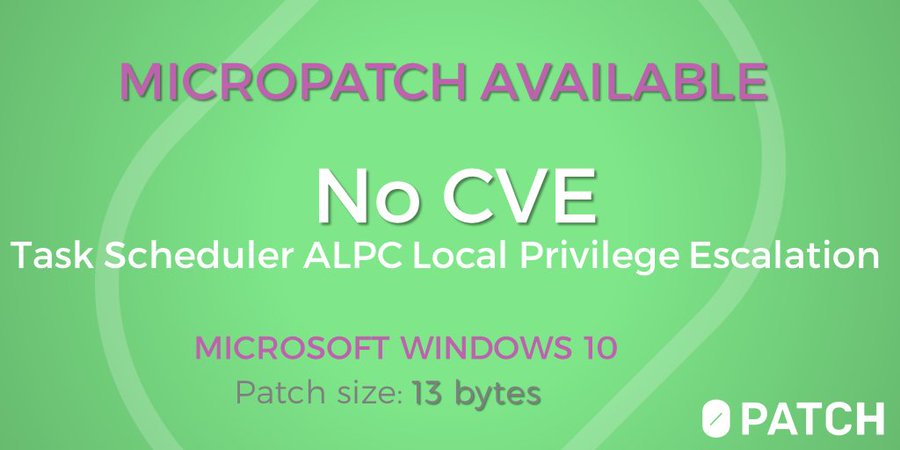
The fix for the Windows zero-day recently disclosed is only 13 bytes in size.

Experts explained that they have validated and verified the micropatch for @SandboxEscaper’s LPE in Task Scheduler.

It currently works only to fully updated 64bit Windows 10 1803.

View image on Twitter

“As the researcher’s POC demonstrates, one can use this vulnerability to replace a system executable file and wait for a privileged process to execute it. In particular, it was shown that a printing-related DLL could be replaced and then executed by triggering the Print Spooler Service to load it,” reads the analysis published by 0patch.

“SandboxEscaper’s documentation properly identifies the problem being in Task Scheduler’s SchRpcSetSecurity method, which is externally accessible via Advanced Local Procedure Call (ALPC)facility. “

Windows zero-day

This is just a temporary fix, Windows users are advised to apply the official Microsoft updates as soon as one becomes available.

0patch warns of unexpected errors that could be caused by the unofficial fix they released.

“Can we keep using this micropatch instead of applying Microsoft’s update? 

We strongly recommend against that. Microsoft’s update will not only fix this issue in a more informed way, but will also bring fixes for other vulnerabilities that we don’t have micropatches for. Yes, we hate losing hours of our lives to updating our systems too, but wouldn’t dream of outright replacing official updates with our micropatches 😉 ” concludes oparch.

[adrotate banner=”9″] [adrotate banner=”12″]

Pierluigi Paganini

(Security Affairs – Windows Zero-Day, micropatch)

[adrotate banner=”5″]

[adrotate banner=”13″]