
Security Affairs
Cyberattack Hits French Blood Banks as Hackers Target Refrigeration Systems Across Europe|CVE-2026-58868: Critical Android Bug Could Let Attackers Run Remote Code|U.S. CISA adds WordPress flaw to its Known Exploited Vulnerabilities catalog|Binance Hack: How Fake Job Interviews and AI Abuse Led to a $6.34 Billion Attack|Synology Warns of Ransomware Attacks Targeting NAS Devices Running Outdated DSM Versions|Inside XCPE, the botnet that turned 1.3M set-top boxes into proxy servers|NIS2 Makes Board Members Personally Liable for Access Control Decisions|Apple’s spyware notifications reach the Bundestag: what the BSI says to do now|VOLTA, the infostealer that asks an AI which victims are worth the effort|New wave of fridge cyberattacks hits European supermarkets, this time in Belgium, Luxembourg, Sweden and Estonia|Hackers Send Fake Nuclear Threat Alerts to Ukrainian and Russian Citizens|Chainalysis Investigates Security Incident Involving AI-Driven Attack Techniques|Cyberattack Hits French Blood Banks as Hackers Target Refrigeration Systems Across Europe|CVE-2026-58868: Critical Android Bug Could Let Attackers Run Remote Code|U.S. CISA adds WordPress flaw to its Known Exploited Vulnerabilities catalog|Binance Hack: How Fake Job Interviews and AI Abuse Led to a $6.34 Billion Attack|Synology Warns of Ransomware Attacks Targeting NAS Devices Running Outdated DSM Versions|Inside XCPE, the botnet that turned 1.3M set-top boxes into proxy servers|NIS2 Makes Board Members Personally Liable for Access Control Decisions|Apple’s spyware notifications reach the Bundestag: what the BSI says to do now|VOLTA, the infostealer that asks an AI which victims are worth the effort|New wave of fridge cyberattacks hits European supermarkets, this time in Belgium, Luxembourg, Sweden and Estonia|Hackers Send Fake Nuclear Threat Alerts to Ukrainian and Russian Citizens|Chainalysis Investigates Security Incident Involving AI-Driven Attack Techniques|
Advertisement

Ad Placeholder

Full Width × 90

Breaking News

WordPress botnet composed of +20k installs targets other sites

Experts from security firm Wordfence discovered a Botnet of 20,000 WordPress Sites Infecting other WordPress installs. Experts from security firm Wordfence uncovered a botnet composed of over 20,000 WordPress sites that is being used to compromise other websites running on the popular CMS and recruit them.   “The threat actors (hackers) use a group of four command […]

wordpress botnet

Experts from security firm Wordfence discovered a Botnet of 20,000 WordPress Sites Infecting other WordPress installs.

Experts from security firm Wordfence uncovered a botnet composed of over 20,000 WordPress sites that is being used to compromise other websites running on the popular CMS and recruit them.  

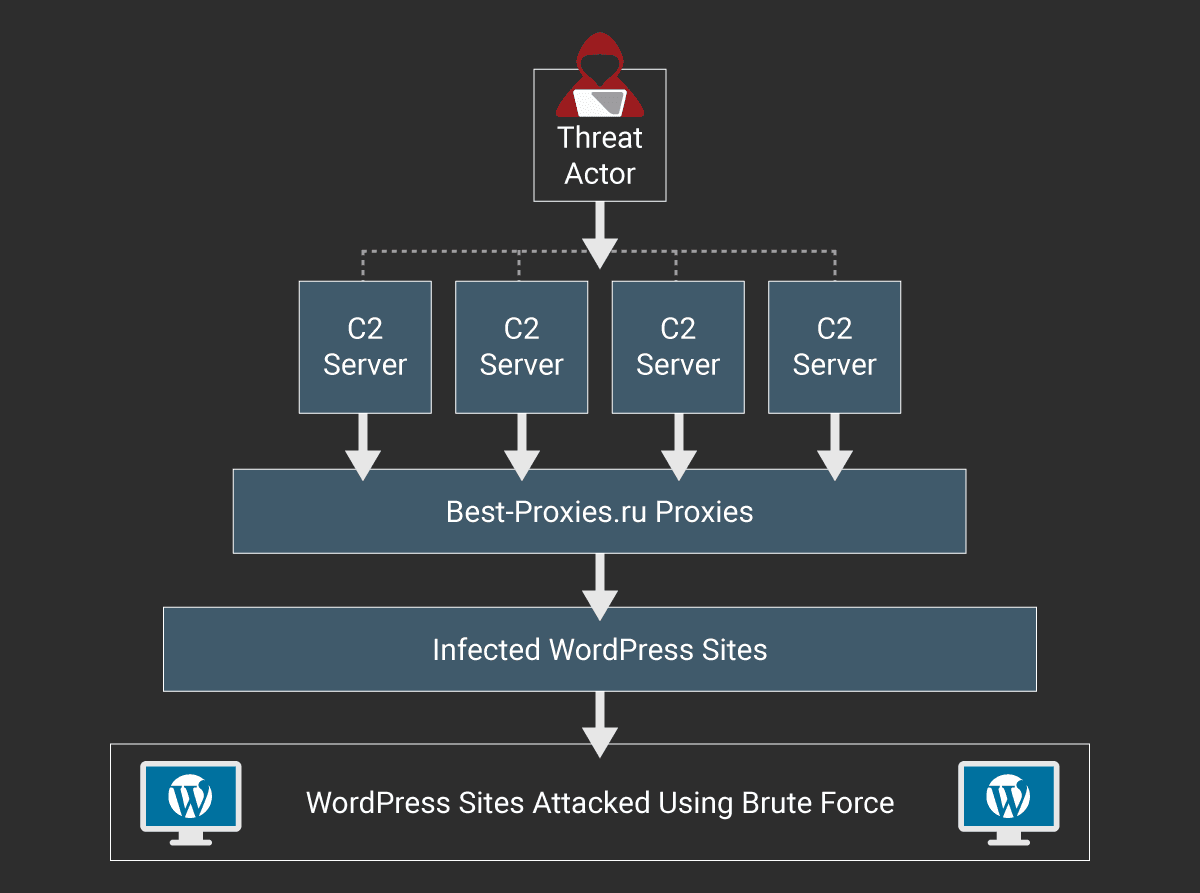
“The threat actors (hackers) use a group of four command and control (C2) servers to send requests to over 14,000 proxy servers provided by a Russian proxy provider called best-proxies[.]ru.” reads the analysis published by WordFence.

“They use these proxies to anonymize the C2 traffic. The requests pass through the proxy servers and are sent to over 20,000 infected WordPress sites. Those sites are running an attack script which attacks targeted WordPress sites.”

The botnet is used by attackers to carry out brute force attacks against other WordPress sites, according to Wordfence Defiant Threat Intelligence team, the botnet has already generated over 5 million authentication requests. The botnet attempts XML-RPC authentication to other WordPress sites in order to access privileged accounts.

The XML-RPC interface allows users to remotely post content to a WordPress site using the WordPress or other APIs, it is located in the root directory of a WordPress install at the xmlrpc.php file.

Unfortunately, the XML-RPC interface doesn’t implement a rate limiting on the number of API requests that it is possible to submit, a gift for brute-force attackers. 

A close look at the malicious infrastructure allowed the experts to discover that hackers used four command and control servers that issue commands to the bots through proxy servers at the Russian Best-Proxies.ru service.  Experts identified over 14,000 proxy servers used by the botmaster to anonymize the traffic.

Once a WordPress site is compromised it will start carrying out brute force attacks against the XML-RPC interface of other websites. 

“We also noted that the User-Agent strings associated with these requests matched those used by applications commonly seen interacting with the XML-RPC interface, like wp-iphone and wp-android,” continues the analysis.

“Since these applications typically store credentials locally, it was unusual to see a significant amount of failed logins from them, which drew our attention. We identified over 20,000 WordPress slave sites that were attacking other WordPress sites.”

Brute force scripts used by the attackers accept POST input from the C2 servers, the request includes domains to target and word lists to use when performing the brute force attacks.

It is also possible to use new wordlists by providing URL to the script.

Wordfence reported its discovery to the authorities and is helping them to dismantle the WordPress botnet.

[adrotate banner=”9″] [adrotate banner=”12″]

Pierluigi Paganini

(Security Affairs –WordPress Botnet, hacking)

[adrotate banner=”5″]

[adrotate banner=”13″]


