
Security Affairs
Cyberattack Hits French Blood Banks as Hackers Target Refrigeration Systems Across Europe|CVE-2026-58868: Critical Android Bug Could Let Attackers Run Remote Code|U.S. CISA adds WordPress flaw to its Known Exploited Vulnerabilities catalog|Binance Hack: How Fake Job Interviews and AI Abuse Led to a $6.34 Billion Attack|Synology Warns of Ransomware Attacks Targeting NAS Devices Running Outdated DSM Versions|Inside XCPE, the botnet that turned 1.3M set-top boxes into proxy servers|NIS2 Makes Board Members Personally Liable for Access Control Decisions|Apple’s spyware notifications reach the Bundestag: what the BSI says to do now|VOLTA, the infostealer that asks an AI which victims are worth the effort|New wave of fridge cyberattacks hits European supermarkets, this time in Belgium, Luxembourg, Sweden and Estonia|Hackers Send Fake Nuclear Threat Alerts to Ukrainian and Russian Citizens|Chainalysis Investigates Security Incident Involving AI-Driven Attack Techniques|Cyberattack Hits French Blood Banks as Hackers Target Refrigeration Systems Across Europe|CVE-2026-58868: Critical Android Bug Could Let Attackers Run Remote Code|U.S. CISA adds WordPress flaw to its Known Exploited Vulnerabilities catalog|Binance Hack: How Fake Job Interviews and AI Abuse Led to a $6.34 Billion Attack|Synology Warns of Ransomware Attacks Targeting NAS Devices Running Outdated DSM Versions|Inside XCPE, the botnet that turned 1.3M set-top boxes into proxy servers|NIS2 Makes Board Members Personally Liable for Access Control Decisions|Apple’s spyware notifications reach the Bundestag: what the BSI says to do now|VOLTA, the infostealer that asks an AI which victims are worth the effort|New wave of fridge cyberattacks hits European supermarkets, this time in Belgium, Luxembourg, Sweden and Estonia|Hackers Send Fake Nuclear Threat Alerts to Ukrainian and Russian Citizens|Chainalysis Investigates Security Incident Involving AI-Driven Attack Techniques|
Advertisement

Ad Placeholder

Full Width × 90

Breaking News

Vulnerability in WordPress Live Chat Plugin allows to steal and hijack sessions

Security researchers at Alert Logic have discovered a vulnerability in the WordPress Live Chat plugin that could be exploited to steal and hijack sessions. Experts at Alert Logic have discovered a vulnerability in the popular WordPress Live Chat plugin that could be exploited by an unauthorized remote attacker to steal chat logs or manipulate chat sessions. […]

WordPress Live Chat plugin

Security researchers at Alert Logic have discovered a vulnerability in the WordPress Live Chat plugin that could be exploited to steal and hijack sessions.

Experts at Alert Logic have discovered a vulnerability in the popular WordPress Live Chat plugin that could be exploited by an unauthorized remote attacker to steal chat logs or manipulate chat sessions.

The critical vulnerability, tracked as CVE-2019-12498, is a critical authentication bypass issue (CWE-287 / OWASP Top 10: A2: 2017-Broken Authentication) that affects version 8.0.32 and earlier of the plugin. 

The vulnerability is caused by the improper validation check for authentication, the attacker can trigger it to access restricted REST API endpoints.

“we uncovered a critical authentication bypass (CWE-287 / OWASP Top 10: A2: 2017-Broken Authentication) in version 8.0.32 and earlier.” reads the security advisory published by the experts. “This bypass allows an attacker to gain access to the REST API functionality without valid credentials—enabling exfiltration of chat logs and the ability to manipulate chat sessions.”

WP Live Chat Support provides customer support and chat with visitors through their WordPress websites, over 50,000 businesses currently use this plugin.

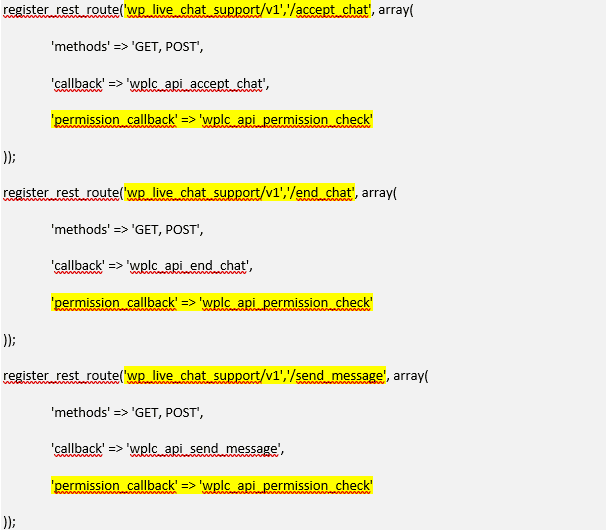
“The restricted REST API endpoints of the affected versions of WP Live Chat are vulnerable to abuse by unauthenticated remote attackers due to a flaw in the ‘wplc_api_permission_check()’ function.” continues the advisory.

WordPress Live Chat plugin

The REST API endpoints of unpatched WP Live Chat Support installs are potentially exposed to attacks carried out by unauthenticated remote attackers due to vulnerability in the ‘wplc_api_permission_check()’ function.”  

“The above series of ‘register_rest_route()’ calls define those REST API endpoints which should have access restrictions due to the nature of the functionality they expose,” continues the Alert Logic research team.

“Each restricted endpoint shares the same ‘permission_callback’ function, namely the ‘wplc_api_permission_check()’ function which will be explored shortly.”

A remote attacker can exploit exposed endpoints for several malicious purposes, including:

  • stealing the entire chat history for all chat sessions,
  • modifying or deleting the chat history,
  • injecting messages into an active chat session, posing as a customer support agent,
  • forcefully ending active chat sessions, as part of a denial of service (DoS) attack.

Below the timeline of the vulnerability:

Initial contact with vendor28 May 2019
Vulnerability disclosed to vendor29 May 2019
Vendor accepts vulnerability. Begins working on patch30 May 2019
Submit to NVD. CVE assigned31 May 2019
New version released. Confirmed no longer vulnerable31 May 2019
Responsible Disclosure embargo lifted10 June 2019

Fortunately, experts are not are of attacks in the wild exploiting the vulnerability.

[adrotate banner=”9″] [adrotate banner=”12″]

Pierluigi Paganini

(SecurityAffairs – WordPress Live Chat plugin, hacking)

[adrotate banner=”5″]

[adrotate banner=”13″]


