
Security Affairs
Two Barracuda ESG Flaws Could Be Combined for Full Root Access; Patches Released|Cyberattack Hits French Blood Banks as Hackers Target Refrigeration Systems Across Europe|CVE-2026-58868: Critical Android Bug Could Let Attackers Run Remote Code|U.S. CISA adds WordPress flaw to its Known Exploited Vulnerabilities catalog|Binance Hack: How Fake Job Interviews and AI Abuse Led to a $6.34 Billion Attack|Synology Warns of Ransomware Attacks Targeting NAS Devices Running Outdated DSM Versions|Inside XCPE, the botnet that turned 1.3M set-top boxes into proxy servers|NIS2 Makes Board Members Personally Liable for Access Control Decisions|Apple’s spyware notifications reach the Bundestag: what the BSI says to do now|VOLTA, the infostealer that asks an AI which victims are worth the effort|New wave of fridge cyberattacks hits European supermarkets, this time in Belgium, Luxembourg, Sweden and Estonia|Hackers Send Fake Nuclear Threat Alerts to Ukrainian and Russian Citizens|Two Barracuda ESG Flaws Could Be Combined for Full Root Access; Patches Released|Cyberattack Hits French Blood Banks as Hackers Target Refrigeration Systems Across Europe|CVE-2026-58868: Critical Android Bug Could Let Attackers Run Remote Code|U.S. CISA adds WordPress flaw to its Known Exploited Vulnerabilities catalog|Binance Hack: How Fake Job Interviews and AI Abuse Led to a $6.34 Billion Attack|Synology Warns of Ransomware Attacks Targeting NAS Devices Running Outdated DSM Versions|Inside XCPE, the botnet that turned 1.3M set-top boxes into proxy servers|NIS2 Makes Board Members Personally Liable for Access Control Decisions|Apple’s spyware notifications reach the Bundestag: what the BSI says to do now|VOLTA, the infostealer that asks an AI which victims are worth the effort|New wave of fridge cyberattacks hits European supermarkets, this time in Belgium, Luxembourg, Sweden and Estonia|Hackers Send Fake Nuclear Threat Alerts to Ukrainian and Russian Citizens|
Advertisement

Ad Placeholder

Full Width × 90

Breaking News

Authorities shut down XDEDIC marketplace in an international operation

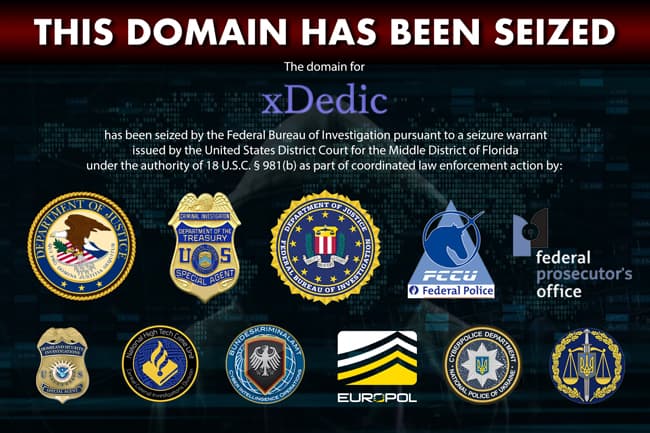
A  joint operation conducted by law enforcement agencies in the United States and Europe allowed seizing the xDedic marketplace. Law enforcement agencies in the US and Europe announced the seizure of the popular xDedic marketplace, an underground market offering for sale access to compromised systems and personally identifiable information. “On 24 January, the U.S. Prosecutor’s […]

xdedic seized

A  joint operation conducted by law enforcement agencies in the United States and Europe allowed seizing the xDedic marketplace.

Law enforcement agencies in the US and Europe announced the seizure of the popular xDedic marketplace, an underground market offering for sale access to compromised systems and personally identifiable information.

“On 24 January, the U.S. Prosecutor’s Office for the Middle District of Florida, the FBI and the Internal Revenue Service (IRS) of Tampa (Florida), the Federal Computer Crime Unit (FCCU), the Federal Prosecutor’s Office and the Investigating Judge of Belgium, as well as the Ukrainian National Cyber Police and Prosecutor General’s office of Ukraine, with the support of the Bundeskriminalamt of Germany and Europol seized the xDedic Marketplace.” reads the press release published by the Europol.

xdedic seized

The black marketplace has been active since 2014, it was first analyzed by experts at Kaspersky Lab in 2016.

At the time, the domain (xdedic[.]biz) went offline following a report from Kaspersky Labs that detailed in its Corporate News section, the scope, and method of operations of the illicit marketplace. The website quickly reappeared in the Tor network.

In 2016 the service was offering up to 70,000 hacked servers as little as $6 USD, and with 416 registered sellers in 173 countries, the platform was operating a highly successful global business model.

The researchers confirmed that the xDedic marketplace is run by a Russian-speaking group.

xdedic

Law authorities in the United States, Belgium and Ukraine, in collaboration with the Europol, seized xDedic on January 24.

Buyers were able to search accesses to compromised systems by multiple criteria, including price, geographic location, and operating system.

The xDedic administrators maintained servers worldwide, they allowed payment in Bitcoin to protect users’ anonymity. Compromised systems belong to any industries, including local, state, and federal government infrastructure, hospitals, emergency services, major metropolitan transit authorities, accounting and law firms, pension funds, and universities.

According to the investigators, the website facilitated more than $68 million in fraud.

[adrotate banner=”9″][adrotate banner=”12″]

Pierluigi Paganini

(Security Affairs –xDedic market, cybercrime)

[adrotate banner=”5″]

[adrotate banner=”13″]


