
Security Affairs
Two Barracuda ESG Flaws Could Be Combined for Full Root Access; Patches Released|Cyberattack Hits French Blood Banks as Hackers Target Refrigeration Systems Across Europe|CVE-2026-58868: Critical Android Bug Could Let Attackers Run Remote Code|U.S. CISA adds WordPress flaw to its Known Exploited Vulnerabilities catalog|Binance Hack: How Fake Job Interviews and AI Abuse Led to a $6.34 Billion Attack|Synology Warns of Ransomware Attacks Targeting NAS Devices Running Outdated DSM Versions|Inside XCPE, the botnet that turned 1.3M set-top boxes into proxy servers|NIS2 Makes Board Members Personally Liable for Access Control Decisions|Apple’s spyware notifications reach the Bundestag: what the BSI says to do now|VOLTA, the infostealer that asks an AI which victims are worth the effort|New wave of fridge cyberattacks hits European supermarkets, this time in Belgium, Luxembourg, Sweden and Estonia|Hackers Send Fake Nuclear Threat Alerts to Ukrainian and Russian Citizens|Two Barracuda ESG Flaws Could Be Combined for Full Root Access; Patches Released|Cyberattack Hits French Blood Banks as Hackers Target Refrigeration Systems Across Europe|CVE-2026-58868: Critical Android Bug Could Let Attackers Run Remote Code|U.S. CISA adds WordPress flaw to its Known Exploited Vulnerabilities catalog|Binance Hack: How Fake Job Interviews and AI Abuse Led to a $6.34 Billion Attack|Synology Warns of Ransomware Attacks Targeting NAS Devices Running Outdated DSM Versions|Inside XCPE, the botnet that turned 1.3M set-top boxes into proxy servers|NIS2 Makes Board Members Personally Liable for Access Control Decisions|Apple’s spyware notifications reach the Bundestag: what the BSI says to do now|VOLTA, the infostealer that asks an AI which victims are worth the effort|New wave of fridge cyberattacks hits European supermarkets, this time in Belgium, Luxembourg, Sweden and Estonia|Hackers Send Fake Nuclear Threat Alerts to Ukrainian and Russian Citizens|
Advertisement

Ad Placeholder

Full Width × 90

Breaking News

A zero-day flaw allows to run arbitrary commands on macOS systems

Security researchers disclosed a new zero-day flaw in Apple’s macOS Finder that can allow attackers to run arbitrary commands on Macs. Independent security researcher Park Minchan disclosed a zero-day vulnerability in Apple’s macOS Finder that can be exploited by attackers to run arbitrary commands on Mac systems running any macOS version. The flaw is due […]

zero-day mac mail-1

Security researchers disclosed a new zero-day flaw in Apple’s macOS Finder that can allow attackers to run arbitrary commands on Macs.

Independent security researcher Park Minchan disclosed a zero-day vulnerability in Apple’s macOS Finder that can be exploited by attackers to run arbitrary commands on Mac systems running any macOS version.

The flaw is due to the way macOS handles inetloc files that causes it to run commands embedded inside. According to the SSD Secure Disclosure advisory, the commands it runs can be local to the macOS allowing the execution of arbitrary commands by the user without any prompts.

An Internet location file is a sort of system bookmark, upon double-clicking one, an online resource or local files (file://) will be opened.

Initially, the flaw was silently addressed by Apple, but Minchan noticed that the IT giant only partially addressed the flaw. However, the expert discovered that it is still possible to exploit the flaw using a different protocol, from file:// to FiLe://, to execute the embedded commands.

“A vulnerability in the way macOS processes inetloc files causes it to run commands embedded inside, the commands it runs can be local to the macOS allowing the execution of arbitrary commands by the user without any warning / prompts.”  reads the SSD Secure Disclosure advisory. “Newer versions of macOS (from Big Sur) have blocked the file:// prefix (in the com.apple.generic-internet-location) however they did a case matching causing File:// or fIle:// to bypass the check.”

The researcher also PoC exploit code for this issue and a video demo:
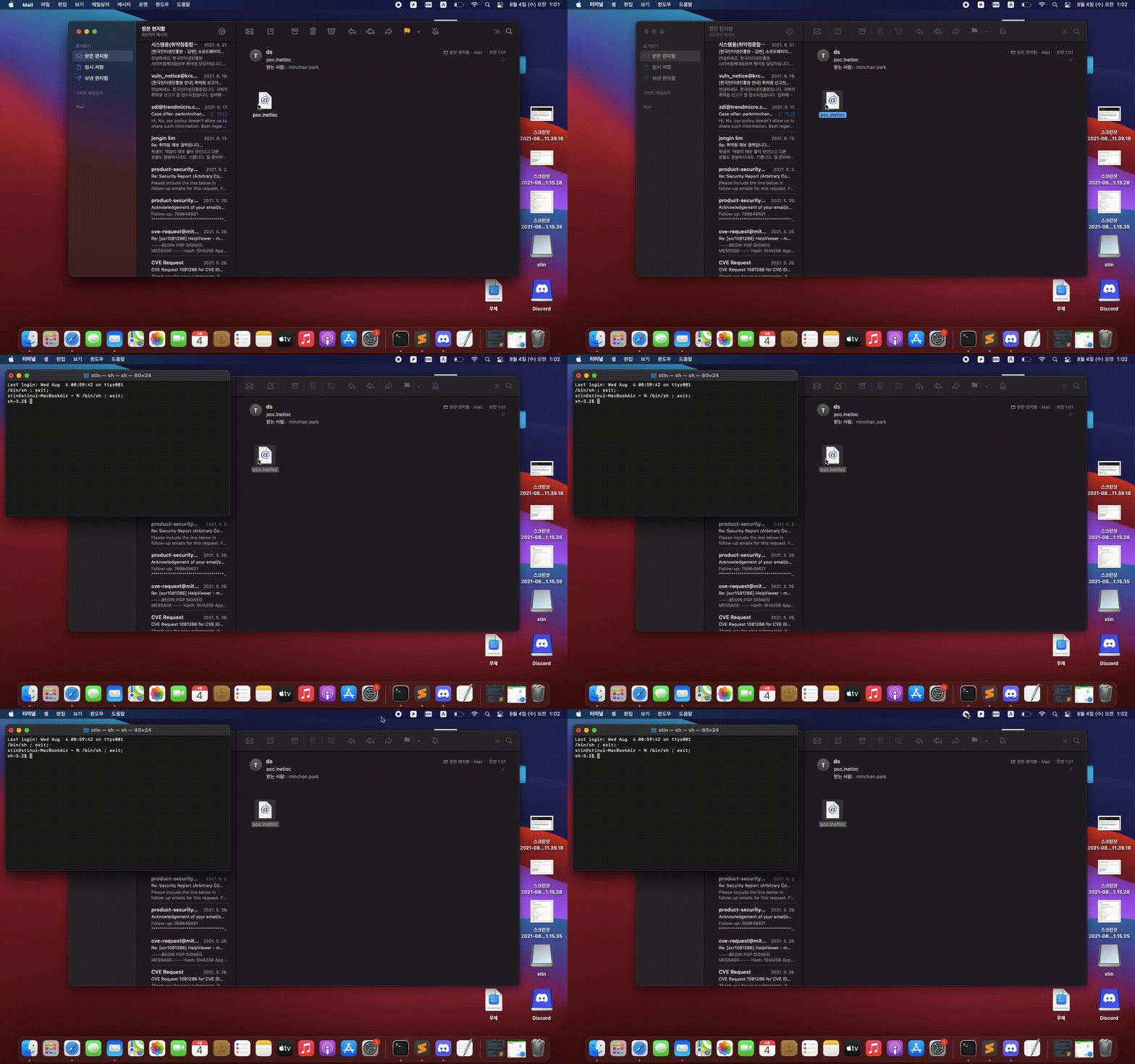
zero-day mac mail-1

According to BleepingComputer, at the time of this writing, the PoC code has a detection rate of zero VirusTotal.

Follow me on Twitter: @securityaffairs and Facebook

[adrotate banner=”9″][adrotate banner=”12″]

Pierluigi Paganini

(SecurityAffairs – hacking, zero-day)

[adrotate banner=”5″]

[adrotate banner=”13″]


