
Security Affairs
U.S. Charges Canadian Man in Alleged Hack of University Supercomputers|Two Barracuda ESG Flaws Could Be Combined for Full Root Access; Patches Released|Cyberattack Hits French Blood Banks as Hackers Target Refrigeration Systems Across Europe|CVE-2026-58868: Critical Android Bug Could Let Attackers Run Remote Code|U.S. CISA adds WordPress flaw to its Known Exploited Vulnerabilities catalog|Binance Hack: How Fake Job Interviews and AI Abuse Led to a $6.34 Billion Attack|Synology Warns of Ransomware Attacks Targeting NAS Devices Running Outdated DSM Versions|Inside XCPE, the botnet that turned 1.3M set-top boxes into proxy servers|NIS2 Makes Board Members Personally Liable for Access Control Decisions|Apple’s spyware notifications reach the Bundestag: what the BSI says to do now|VOLTA, the infostealer that asks an AI which victims are worth the effort|New wave of fridge cyberattacks hits European supermarkets, this time in Belgium, Luxembourg, Sweden and Estonia|U.S. Charges Canadian Man in Alleged Hack of University Supercomputers|Two Barracuda ESG Flaws Could Be Combined for Full Root Access; Patches Released|Cyberattack Hits French Blood Banks as Hackers Target Refrigeration Systems Across Europe|CVE-2026-58868: Critical Android Bug Could Let Attackers Run Remote Code|U.S. CISA adds WordPress flaw to its Known Exploited Vulnerabilities catalog|Binance Hack: How Fake Job Interviews and AI Abuse Led to a $6.34 Billion Attack|Synology Warns of Ransomware Attacks Targeting NAS Devices Running Outdated DSM Versions|Inside XCPE, the botnet that turned 1.3M set-top boxes into proxy servers|NIS2 Makes Board Members Personally Liable for Access Control Decisions|Apple’s spyware notifications reach the Bundestag: what the BSI says to do now|VOLTA, the infostealer that asks an AI which victims are worth the effort|New wave of fridge cyberattacks hits European supermarkets, this time in Belgium, Luxembourg, Sweden and Estonia|
Advertisement

Ad Placeholder

Full Width × 90

Breaking News

Zerodium payouts for Messaging, Email App Exploits are $500,000

Zerodium payouts include up to $500,000 for RCE and privilege escalation vulnerabilities affecting popular instant messaging and email applications. The zero-day and exploit broker Zerodium, founded by former VUPEN co-founder Chaouki Bekrar, offers $500,000 for a zero-day exploit in secure messaging Messaging (i.e. such as WhatsApp, Signal, Facebook Messenger, iMessage, Telegram, WeChat, Viber) and Email […]

zerodium payouts

Zerodium payouts include up to $500,000 for RCE and privilege escalation vulnerabilities affecting popular instant messaging and email applications.

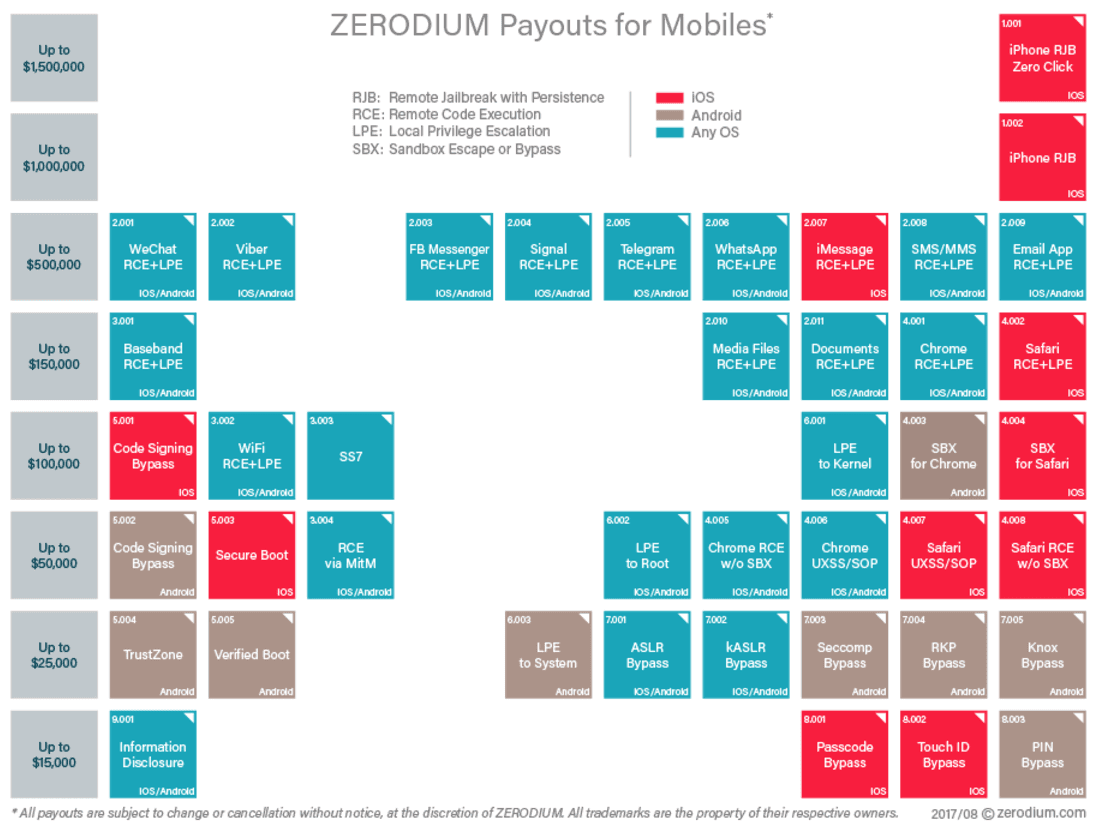
The zero-day and exploit broker Zerodium, founded by former VUPEN co-founder Chaouki Bekrar, offers $500,000 for a zero-day exploit in secure messaging Messaging (i.e. such as WhatsApp, Signal, Facebook Messenger, iMessage, Telegram, WeChat, Viber) and Email App.

Secure messaging apps continues to represent a serious obstacle to the investigations conducted by law enforcement agencies and secret services, for this reason, zero-day exploits are precious commodities.

The firm has officially announced that it will reward experts for remote code execution and privilege escalation vulnerabilities affecting popular instant messaging and email applications.

The company published separate payout lists for mobile device exploits and desktop and server exploits.

zerodium payouts

Zerodium offers half a million dollars for SMS/MMS flaws and exploits targeting default email apps on both iOS and Android.

The company will pay up to $1.5 million for a remote iPhone jailbreak that will not need any user interaction, while the same exploit with user interaction will be paid up to $1 million.

Looking at the payout lists we can notice new entries in the mobile category, such as baseband, and media file and document vulnerabilities.

Zerodium will pay up to $100,000 for sandbox escapes, code-signing bypasses, kernel LPE, Wi-Fi RCE and LPE, and SS7 attacks.

Zerodium also announced that it would offer $300,000 for Windows 10 remote code execution zero days, especially exploits for Windows services such as SMB or RDP.

Web server zero days, specifically Apache on Linux and Microsoft IIS remote code execution attacks, goes for $150,000, while a Microsoft Outlook RCE is worth $100,000. Mozilla Thunderbird RCE and VMware ESXi guest-to-host escapes are both worth $80,000.

Zerodium payouts for Chrome, PHP, and OpenSSL attacks nearly doubled, meanwhile prices for antivirus privilege escalation flaws dropped from $40,000 to $10,000.

Tor RCEs on Linux and Windows jumped from $30,000 up to $100,000 and $80,000 respectively.

Zerodium payouts for Adobe Flash are up to $100,000 for exploits targeting the application.

[adrotate banner=”9″] [adrotate banner=”12″]

Pierluigi Paganini

(Security Affairs – Zerodium payouts, hacking)

[adrotate banner=”13″]


