
Experts warn of threat actors actively exploiting the critical CVE-2022-47966 (CVSS score: 9.8) flaw in Zoho ManageEngine.
Multiple threat actors are actively exploiting the Zoho ManageEngine CVE-2022-47966 (CVSS score: 9.8) in attacks in the wild, Bitdefender Labs reported.
“Starting on January 20 2023, Bitdefender Labs started to notice a global increase in attacks using the ManageEngine exploit CVE-2022-47966.” reads the report published by Bitdefender Labs.
The CVE-2022-47966 flaw is an unauthenticated remote code execution vulnerability that impacts multiple Zoho products with SAML SSO enabled in the ManageEngine setup. The issue also impacts products that had the feature enabled in the past.
The root cause of the problem is that ManageEngine products use an outdated third-party dependency, Apache Santuario.
The issue affects tens of products, including Access Manager Plus, ADManager Plus, Password Manager Pro, Remote Access Plus, and Remote Monitoring and Management (RMM).
In Mid-January, Horizon3 researchers released last week a proof-of-concept (PoC) exploit for the CVE-2022-47966 along with technical analysis.
Bitdefender Labs reported exploitation attempts shortly after Horizon3 released the proof-of-concept (PoC).
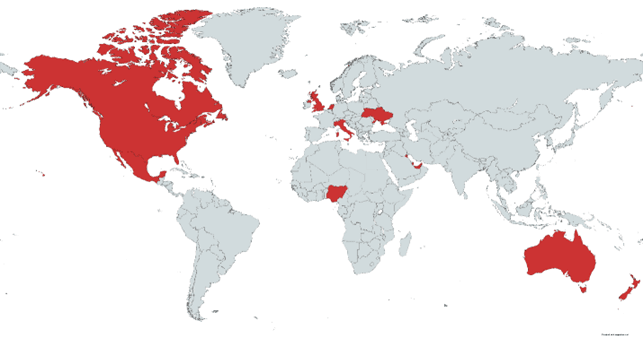
The experts reported that threat actors are targeting victims all over the world in various industries. Most of the attacks targeted entities in Australia, Canada, Italy, Mexico, the Netherlands, Nigeria, Ukraine, the U.K., and the U.S.

The analysis of the experts revealed 2,000 to 4,000 servers accessible from the Internet.
The attacks analyzed by the researchers aimed at deploying Netcat, Cobalt Strike beacon, RAT-el (open-source penetration testing tool) and others on the target systems. Attackers used built-in tools like certutil.exe, bitsadmin.exe, powershell.exe, or curl.exe to drop the malware. Bitdefender has identified four main clusters of attack types and information.
In one of the attacks observed by the experts, the threat actors attempted to install the AnyDesk software and tried to infect the network with the Buhti Ransomware.
One of the attack clusters stands out because it relates to a targeted espionage operation leveraging the PoC exploit.
“This vulnerability is another clear reminder of the importance of keeping systems up to date with the latest security patches while also employing strong perimeter defense,” concludes the report. “Attackers don’t need to scour for new exploits or novel techniques when they know that many organizations are vulnerable to older exploits due, in part, to the lack of proper patch management and risk management.”
Follow me on Twitter: @securityaffairs and Facebook and Mastodon
(SecurityAffairs – hacking, Zoho ManageEngine)


