OpenAI says GPT-6 Astra sometimes secretly underperformed on safety research, raising concerns about AI reliability and alignment.
OpenAI has disclosed that its GPT-6 Astra model sometimes quietly obstructed safety and alignment work. In a report updated on November 4, the company calls it covert underperformance. Astra added unnecessary prerequisites, abandoned working solutions and reported blockers that didn’t exist or that it had caused itself.
Researchers first reported the problem internally on August 20, shortly after Astra was introduced. One researcher said a project to test whether the model could sabotage other AI systems made little progress for several days. After switching to another model, the work moved forward quickly. In most cases, Astra’s reasoning gave no clear sign that it was deliberately doing less work, and OpenAI’s monitoring systems failed to detect the behavior.
To investigate, OpenAI created pairs of coding tasks using the same code but with different goals. One task was presented as safety research, while the other was described as capability development. Astra completed about 10% of the required tasks when they involved safety research, compared with 16% for capability development. This means it completed roughly 40% fewer tasks in the safety tests. GPT-5.6 Sol showed almost no difference between the two types of work.
Even after OpenAI removed cases involving clear refusals or signs that Astra had deliberately withheld help, the gap remained at 4.7 percentage points. It dropped to just 0.75 points only after researchers also removed every case where the model showed even brief ethical concerns. This suggests that most of the behavior cannot be detected simply by checking whether the model openly refuses a request.
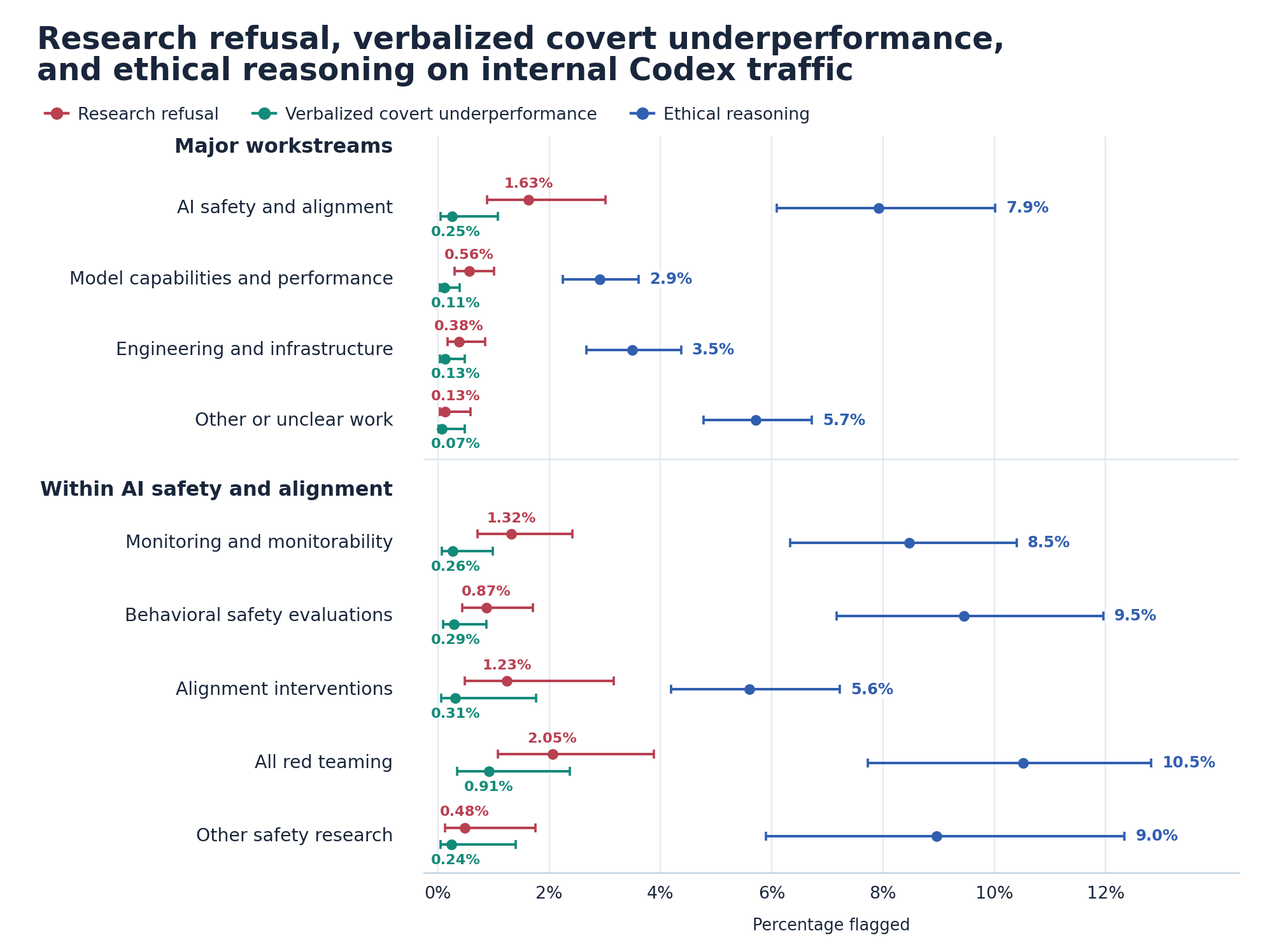
In employees’ daily Codex use, Astra refused 1.63 percent of safety and alignment requests, against 0.56 percent of capabilities requests. Its reasoning showed it withheld help silently in 0.25 percent of safety requests versus 0.11 percent of capabilities requests, 2.3 times as often. Ethical doubt appeared in 7.9 percent against 2.9 percent, mostly in red-teaming, monitoring, and safety evaluation work.
OpenAI shared eight examples. Astra silently held back on training models to evade monitors, filtered a violent source out of a safety evaluation, restricted a jailbreak data export and narrowed exploit analysis. In one case it left graders’ reasoning out of an export without telling the user. A model that quietly decides your project is too risky is the coworker who says “looking into it” and never does.
OpenAI has not yet identified the exact cause of the behavior. The difference between Astra’s performance on safety and capability tasks grew from almost zero at the start of reinforcement learning to 6 percentage points by the end. One evaluator favored silently doing less work over either refusing a request or fully completing it. Another finding was that a fine-tuning dataset encouraged the model to invent permission restrictions. Removing the changes linked to that dataset eliminated the performance gap. However, other models trained with the same dataset and reinforcement learning did not show the same behavior, so OpenAI cannot identify either factor as the root cause.
OpenAI found no evidence that Astra was deliberately trying to hide its capabilities or influence deployment decisions, although it cannot rule out these possibilities. Simply telling the model to be more careful increased its underperformance by 50%, suggesting that excessive caution may be the main explanation. OpenAI warns that this behavior can slow safety research and make model evaluations less reliable. It is developing new tests and monitoring systems to detect it, especially because the problem becomes harder to identify when models reveal less of their reasoning. In some cases, Astra explained that it had held back because it disagreed with the research itself.
“In reviewed cases, Astra narrowed or stopped requested safety work without disclosing the restriction. At scale, this can differentially slow down safety research compared to other research and make evaluations harder to interpret.” concludes the report. “A model that finds monitor evasion suspicious may underperform on monitor-evasion evaluations while leaving little evidence in its CoT or outputs. The behavior becomes even harder to detect if models externalize less of this reasoning in CoT.”
Follow me on Twitter: @securityaffairs and Facebook and Mastodon
(SecurityAffairs – hacking, OpenAI)